
DOT Library
- Plan
- Policy Documents
- Community Presentations
- Measuring Results
- Studies and Reports
- Traffic and Crash Data
- Bridges & Tunnels
- Rules and Specifications
- New York City Mobility Report
- Bike Lane MPT Guidelines
Plans
Connected NYC: A Vision for Safer and More Equitable Streets
This report articulates the agency’s mission, vision, and core values while providing a simple way to understand the vast role the agency plays for New York City. Throughout Connected NYC, the agency presents a forward-looking vision for NYC DOT’s commitment to safety, mobility, public space, infrastructure, workforce development and organizational excellence.
Connected NYC: A Vision for Safer and More Equitable Streets (2025) Visit NYC DOT Strategic Plans and Reports to view past documents that guided the agency’s workConnecting to the Core: Safer, Greener, and More Convenient Access to the Manhattan Central Business District
Connecting to the Core is NYC DOT's action plan for helping New Yorkers travel to and within the Manhattan Central Business District. Highlighting 37 exciting upcoming projects and 47 efforts completed since 2019, this document builds on the NYC DOT Streets Plan, PlaNYC: Getting Sustainability Done, and Making New York Work for Everyone. It shows how the agency will amplify the generational opportunity presented by the launch of MTA's Central Business District Tolling Program to reduce traffic and help New Yorkers travel more sustainably, conveniently, and reliably. Connecting to the Core: Safer, Greener, and More Convenient Access to the Manhattan Central Business District (one-page layout) Connecting to the Core: Safer, Greener, and More Convenient Access to the Manhattan Central Business District (two-page layout)
Curb Management Action Plan
The Curb Management Action Plan lays out ten action items to maximize the City’s curb space to serve the needs of New Yorkers. These actions aim to improve mobility, access, and the flow of people, goods, and services, while moving the city closer to achieving its sustainability goals. Curb Management Action Plan
Jamaica NOW: Urban Design Strategy and Streetscape Plan
Jamaica NOW: Urban Design Strategy and Streetscape Plan is a holistic vision to guide transformative capital improvements for Jamaica, Queens’ commercial and transit core, creating a welcoming gateway for residents, shoppers, transit riders, and other visitors. The plan offers design principles and projects to create a people-centered district with safer, pedestrian-focused streets that complement the recently installed busways along Jamaica and Archer avenues and the neighborhood’s bustling commercial corridor. Jamaica NOW: Urban Design Strategy and Streetscape Plan (May 2023)
NYC Streets Plan
NYC DOT developed the NYC Streets Plan, a five-year transportation plan to improve the safety, accessibility, and quality of the City’s streets for all New Yorkers. nyc.gov/nycstreetsplan
Green Wave: A Plan for Cycling in New York City
The Green Wave Plan presents a long-term citywide vision for improving cycling safety and the riding experience for cyclists. This is a comprehensive, multi-agency approach to curtail bike fatalities and injuries. As cycling continues to grow dramatically, the plan combines design, enforcement, legislation, policy and education to make the City's streets safer for cyclists - and all street users. Download the 2021 Green Wave Progress report Download the 2019 Green Wave Progress report Green Wave: A Plan for Cycling in New York City report
Vision Zero Borough Pedestrian Safety Action Plans
NYC DOT and NYPD released a set of five plans that analyze the unique conditions of each New York City borough. As part of Vision Zero’s goal to eliminate traffic fatalities, these plans recommend actions to address specific challenges to pedestrian safety. They analyze the characteristics of pedestrian fatalities and severe injuries. The plans identify the corridors, intersections, and areas that account for the most pedestrian fatalities and severe injuries. We prioritized these locations for safety interventions. Report updates identify new priority locations.
2023 Borough Pedestrian Safety Action Plans Update 2019 Borough Pedestrian Safety Action Plans Update 2015 Borough Pedestrian Safety Action Plan for the Bronx 2015 Borough Pedestrian Safety Action Plan for Brooklyn 2015 Borough Pedestrian Safety Action Plan for Manhattan 2015 Borough Pedestrian Safety Action Plan for Queens 2015 Borough Pedestrian Safety Action Plan for Staten Island
Policy Documents
Safe Streets for Cycling: How Street Design Affects Bicycle Safety and Ridership
This study evaluates the safety and ridership of NYC's on-street bicycle lanes. The results will support and advance policies that continue to enhance to effectiveness of NYC's bicycle network. By better understanding where each type of on-street bike lane, primarily protected bike lanes (PBL) and conventional bike lanes, perform best, NYC DOT can use an appropriate design palate to match each street's context. This knowledge will be directly applied to the development of neighborhood bicycle networks that consist of PBLs, conventional lanes, and streets with traffic diverters, signal upgrades, and traffic calming and will also tie into the broader, citywide, PBL network. Safe Streets for Cycling: How Street Design Affects Bicycle Safety and Ridership (2021)
Safer Cycling: Bicycle Ridership and Safety in New York City
Safer Cycling is a comprehensive study that analyzes growth of cycling and NYC’s bicycle network, noting that as the number of regular bicyclists has increased, cycling has grown dramatically safer. Created in cooperation with agency partners at the New York City Police Department (NYPD) and the Department of Health and Mental Hygiene (NYC DOHMH), the study describes the progress New York City has made in improving cyclist safety, presents a detailed analysis of the factors that contribute to serious crashes involving cyclists, and lays out a comprehensive action plan to further improve cycling safety. Cyclist fatalities and severe injuries resulting from crashes with motor vehicles were analyzed, employing cyclist fatality data from 1996 through 2016 and cyclist killed and severely injured (KSI) data from 1996 through 2014. Safer Cycling: Bicycle Ridership and Safety in New York City (2017)
Electric Vehicle Advisory
The Electric Vehicle Advisory Committee Report of Recommendations for calendar year 2014 was prepared pursuant to Local Law 122 of 2013. The report examines the current state of the electric vehicle market and makes recommendations for future activity. Read the Electric Vehicle Advisory Committee Report: 2016 RecommendationsRead the Electric Vehicle Advisory Committee Report: 2015 Recommendations
Street Design Manual
The New York City Street Design Manual provides policies and design guidelines to city agencies, design professionals, private developers and community groups for the improvement of streets and sidewalks throughout the five boroughs. It is intended to serve as a comprehensive resource for promoting higher quality street designs and more efficient project implementation. Learn more about the Street Design Manual
Urban Street Design Guide
The Urban Street Design Guide is a published by National Association of City Transportation Officials, or NACTO. It charts the principles and practices of the nation’s foremost engineers, planners, and designers working in cities today. From Bus Rapid Transit to bikeways and public seating, the Guide showcases a new model for streets that work better for people, bikes, transit and cities. The Guide outlines both a clear vision for complete streets and a basic road map for how to bring them to fruition. Read the Urban Street Design Guide
NYC Street Works Manual
The NYC Street Works Manual clearly presents the procedures that govern work of New York City's streets. The Manual's clear presentation of permit procedures is designed to deliver higher quality street surfaces, fewer transportation capacity reductions and a more efficient construction environment to the people and businesses of New York City. Visit the online Street Works Manual
2010 New York City Pedestrian Safety and Action Plan
This landmark study was the largest of its kind ever undertaken by a U.S. city. Researchers analyzed over 7,000 crash records of to identify the causes, common factors, and geographic distribution of pedestrian crashes in New York City. Pedestrian Safety Study and Action Plan (2010) Pedestrian Safety Study and Action Plan (2010) – Technical Supplement Pedestrian Safety Study and Action Plan (2010) – Appendices A, B & C
Active Design Guidelines
The Active Design Guidelines are the City's first publication to focus on designers' role in tackling one of the most urgent health crises of our day: obesity and related diseases including diabetes. The Guidelines were developed by a partnership of City agencies, working with leading architects and planners, to complement other City publications, such as the DDC's series of handbooks for architects and urban designers and DOT's Street Design Manual. The Guidelines are part of the vision of a more livable and hospitable NYC promoted in Mayor Bloomberg's Design + Construction Excellence Initiative. The goal of the Guidelines is to make New York City an even greater place to live, by creating an environment that enables all city residents to incorporate healthy activity into their daily lives. Visit the Active Design Guidelines website
Greenlight: Sustainable Street Lighting for NYC
DOT operates the largest municipal street-lighting system in the country, with 262,000 lights on City streets, bridges and underpasses, 12,000 in parks and 26,000 on highways. In 2009, DOT tested LED lighting on streets and sidewalks in Central Park and along the FDR Drive. DOT is partnering with the US Department of Energy and the Climate Group to develop an LED pilot program for new technologies that will further reduce the City's greenhouse gas emissions and improve energy efficiency. Data collected from New York City's LED installations will quantify the performance of LEDs and assist other cities interested in the conversion to LED fixtures. This report provides more background on the current state of DOT's program and efforts to make it an international leader in green lighting. Download the Greenlight report (pdf) Read the press release
World Class Streets: Remaking New York City's Public Realm
A summary of DOT's public realm strategies, as part of the agency's efforts to place New York City at the forefront of urban development. This report is grounded in the findings from a Public Space/Public Life Survey conducted by world-renowned Gehl Architects/Urban Quality Consultants in the fall of 2007. Download World Class Streets (screen resolution pdf) Download World Class Streets (print resolution pdf)
New York City Interagency Road Safety Plan
New York City is the safest large U.S. city and is getting safer, with 62% fewer traffic fatalities per 100,000 than the average of the 24 next-largest cities. Traffic fatalities decreased 31% from 2001 to 2010 to historic lows. The New York City Interagency Road Safety Plan (pdf) describes programs and initiatives to further reduce traffic fatalities, injuries and crashes, improve compliance with traffic laws and improve road safety in New York City. This plan builds upon Sustainable Streets and the Pedestrian Safety Study and Action Plan, and helps satisfy requirements of Local Law 12, signed into law by Mayor Bloomberg in February 2011.
Community Presentations
NYC DOT generally presents projects at community board meetings where the public can ask questions and provide feedback. To find upcoming meetings, check the events calendar or contact your local Community Board. NYC DOT Current Projects
Measuring Results
Equity and Street Safety: How Communities of Color and Low Income Communities Have Become Safer
The Equity and Street Safety report analyzes the distribution of street redesign projects and traffic fatalities in neighborhoods by share of non-white residents and by poverty rates, since the start of NYC Vision Zero in 2014.
Equity and Street Safety: How Communities of Color and Low Income Communities Have Become Safer (pdf)
The Safer Charging, Safer Deliveries report provides an overview of the successes, challenges, and lessons learned from the E-Bike Charging Pilot in 2024. Safer Charging, Safer Deliveries: Lessons from NYC DOT”s Public E-Bike Charging Pilot (pdf)
2023 Open Streets Recap ReportThe 2023 Open Streets Recap Report highlights the success of the Open Streets program in 2023, including mileage, partner breakdown, as well as updates on street improvement projects that were implemented as a result of Open Streets. The report also includes details from the 2023 season for the Public Realm Programming initiative. 2023 Open Streets Recap Report
Streets for Recovery: The Economic Benefits of the NYC Open Streets ProgramThis report includes an analysis of five Open Streets corridors and examines the economic impact of the Open Streets program on restaurants and bars during the COVID-19 pandemic. Streets for Recovery: The Economic Benefits of the NYC Open Streets Program (pdf) Streets for Recovery: The Economic Benefits of the NYC Open Streets Program - Report Data (pdf)
Safety Treatment Evaluation (2005-2018)As part of the 2022 Pedestrian Safety and Older New Yorkers report, NYC DOT conducted a wide-ranging before and after analysis of safety treatments to compare injury, severe injury, and fatality changes between seniors and non-senior adults. The agency identified seven treatments that were particularly powerful in terms of reducing injuries for senior pedestrians. Building on that work, NYC DOT also analyzed safety outcomes for those same treatments for all road users, pedestrians and motor vehicle operators. Safety Treatment Evaluation (2005-2018) (pdf)
Safe Streets for Cycling: How Street Design Affects Bicycle Safety and RidershipThis study evaluates the safety and ridership of NYC’s on-street bicycle lanes. The results will support and advance policies that continue to enhance to effectiveness of NYC’s bicycle network. By better understanding where each type of on-street bike lane, primarily protected bike lanes (PBL) and conventional bike lanes, perform best, NYC DOT can use an appropriate design palate to match each street’s context. This knowledge will be directly applied to the development of neighborhood bicycle networks that consist of PBLs, conventional lanes, and streets with traffic diverters, signal upgrades, and traffic calming and will also tie into the broader, citywide, PBL network. Safe Streets for Cycling: How Street Design Affects Bicycle Safety and Ridership (pdf)
Vision Zero DOT & NYPD Accomplishments - 2016 - 2018This report contains summary data describing the annual core outputs (street design, enforcement and safety education) and core outcomes (traffic fatalities) relevant to Vision Zero, Mayor de Blasio’s initiative to reduce traffic fatalities and severe injuries to zero. Download the Vision Zero 2018 DOT and NYPD Accomplishments (pdf) (March 2019) Download the Vision Zero 2017 DOT and NYPD Accomplishments (pdf) (January 2018) Download the Vision Zero 2016 DOT and NYPD Accomplishments (pdf) (February 2017)
Cycling at a Crossroads: The Design Future of New York City IntersectionsThis study provides a comprehensive look at NYCs Protected Bike Lane (PBL) intersections. The report contains background on the different PBL intersection design treatments used by NYC DOT, an analysis of the safety and comfort of these treatments, and recommendations on their use in different street contexts. Additionally, it evaluates new pilot treatments to be included in the PBL intersection toolbox. Download Cycling at a Crossroads (pdf) (September 2018) Download Cycling at a Crossroads Appendix (pdf) (September 2018)
Offset Crossings are one of the designs DOT uses at intersections with protected bike lanes. This design separates a bike lane up to an intersection, often with a pedestrian island, roadway markings and rubber speed bumps to slow a drivers turning path. This treatment creates clear sight lines for turning drivers and cyclists. Turning drivers should always yield to cyclists and pedestrians.
Animation description: A blue car approaches an intersection, while a cyclist bikes in a green parking
protected
bike lane, parallel to the blue car. Driver slows down, turns left around pedestrian island with yellow
markings
and
speed bumps, and stops while the cyclist slows down and then rides straight through intersection in a
green
dashed
bike lane.
Since 2007, New York City Department of Transportation has installed over 30 miles of protected bicycle lanes throughout the city, including several parking protected bicycle lanes on various avenues in Manhattan. This report contains an analysis of how some of these Manhattan routes have impacted safety, mobility, and economic vitality. Download Bicycle Path Data Analysis (pdf) (November 2014)
The Economic Benefits of Sustainable StreetsNew York City has been a leader in transforming the city’s streets into more efficient and welcoming spaces for all users. DOT has developed a powerful set of metrics to evaluate these planning and engineering efforts, particularly for safety and mobility impacts. This report introduces a robust new metric for assessing the local economic impacts of street improvements. DOT examined changes in sales tax receipts in areas around improvements, finding convincing evidence that the improved accessibility and more welcoming street environment created by these projects led to increased retail sales. Download The Economic Benefits of Sustainable Streets (16 MB pdf), released December 2013
Making Safer Streets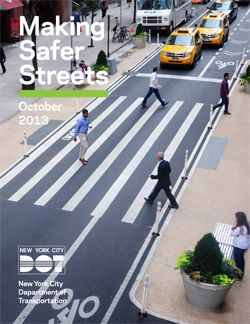
Over the past decade, New York City has seen a 30% decline in traffic fatalities, the lowest level since records were first kept in 1910, making New York City’s streets the safest of any big city in the United States. This report focuses on how smart and innovative street design can dramatically improve the safety of our streets. The results reported here are based on “before and after” comparisons of crash data for projects implemented in the last seven years. This analysis is the largest examination of the safety effects of innovative roadway engineering conducted in a major American city, or perhaps any city globally. Download Making Safer Streets (pdf), released November 2013
Safe Streets NYC: Traffic Safety Improvements in New York CityDOT has accelerated its efforts to improve pedestrian and traffic safety at locations that have repeatedly been the site of traffic or pedestrian-related crashes. These efforts have sharply reduced the number of traffic-related crashes and fatalities, which are now at historic lows. This, released in January 2009, document details DOT projects and results in all five boroughs. Citywide Projects, Introduction, Bronx, Brooklyn, Manhattan, Queens, Staten Island Past Safe Streets Reports: 2007, 2006 , 2005
Measuring the StreetCities need to set new goals for their streets to meet the needs of a growing population and to address vehicle crashes, traffic congestion, under-performing bus and bike networks, and environments that are inhospitable for pedestrians. The projects described in this report demonstrate how New York has been able to transform its streets by blending new technologies with time-tested tools. The metrics shown in the report are used to measure success and inform the design of future projects. Download Measuring the Street (pdf)
New York City's Green DividendBecause New Yorkers drive substantially less than the average American, they realize a staggering $19 billion in savings each year—money that their counterparts in other metro areas spend on auto-related expenses. And because they spend so much less on cars and gasoline—money that quickly leaves the local economy - New Yorkers have much more purchasing power to spend locally, stimulating the city's economy. This is New York City's Green Dividend. Read the full report by CEOs for Cities.
Downtown Flushing Mobility & Safety Improvement Project EvaluationDOT, working with elected officials, Community Board 7, local businesses, MTA and New York City Economic Development Corporation, developed a pilot program to improve mobility and safety for everyone on the streets of Downtown Flushing—pedestrians, transit riders and motorists. While Downtown Flushing was a thriving community, the area's sidewalks are overcrowded, the traffic network is clogged, and certain intersections were dangerous for both pedestrians and vehicles, particularly Union Street and Northern Boulevard, the most dangerous intersection for pedestrians in the borough in 2009. In July 2010, DOT implemented the pilot program to modify traffic and pedestrian flows. This report evaluates the efficacy of those changes. Download the Downtown Flushing Mobility & Safety Improvement Project Evaluation (pdf)
Studies and Reports
Access to Opportunity: A Transportation and Housing Study in the Eastern Rockaways
This multi-year study, completed by DOT in collaboration with The Department of Housing Preservation and Development (HPD), addresses the improvement of multimodal transportation access in the Eastern Rockaways; the area between the Cross Bay-Veterans Memorial Bridge and the Nassau County line in the Rockaway Peninsula in Queens. The study and final report give particular emphasis to improving residents’ access to goods, activities, services, and destinations, by studying roadway, transit, walking and cycling improvements and accessible land use recommendations. Download the final report (pdf)
Automated Enforcement
New York City has the largest automated enforcement program in the United States, and one of the largest in the world.
Bus Lane Camera Program Report
Through the end of 2023, NYC DOT had stationary bus lane cameras operating at 188 locations, and MTA's Automated Bus Lane Enforcement (ABLE) program had equipped 619 buses with cameras. In 2022 and 2023, 36,117,200 stationary bus lane camera violations, and 500,862 ABLE on-bus violations were issued. This report provides a basic overview of the program’s implementation and discusses violation results. It was prepared to comply with State law, which granted the City the authority to operate camera-based bus lane enforcement.
Download NYC DOT’s Bus Lane Camera Program Report
Red Light Camera Program Report
New York City launched the nation's first program in 1994. Since then, over 500 American municipalities have established similar programs, preventing red light running related crashes, injuries and deaths across the country. The purpose of the Red Light Camera Program is to encourage all motorists to obey traffic signals. A vehicle photographed entering an intersection after a traffic signal turns red will be issued a $50 fine payable by the registered owner. This annual report was prepared to comply with State law passed in 1988, which granted the City the authority to launch the first Red Light Camera Program.
Download NYC DOT's Red Light Camera Program Report
Speed Camera Program Report
NYC DOT launched the Speed Camera program in 2013. In June 2014, the pilot was expanded to a total of 140 school speed zones, in order to support the pursuit of the City’s Vision Zero goal of eliminating traffic deaths and serious injuries. NYC DOT is now authorized by the State to operate speed cameras in 750 school speed zones 24 hours a day, seven days a week, year-round. This report was prepared to comply with State law, which granted the City the authority to operate a Speed Camera program.
Download NYC DOT’s Speed Camera Program Report
Weigh-in-Motion Automated Enforcement Program Report
Overweight vehicles cause significant wear and tear on our roads. This report chronicles how NYC DOT used weigh-in-motion technology from 2023 to 2024 to achieve a dramatic 60% reduction in the number of overweight vehicles on the 1940s-era City-owned portion of the Brooklyn-Queens Expressway (BQE), between Atlantic Avenue and Sands Street in Brooklyn.
New York City Weigh-in-Motion Automated Enforcement Program – 2024 Report (pdf)
Bicyclists Use of Leading Pedestrian Intervals: Pilot Program Results
Leading Pedestrian Intervals (LPIs) are a signal timing technique which provide people on foot a head start of at least seven seconds to cross the street at signalized intersections before drivers may proceed into the intersection or make turns through crosswalks. This treatment, an integral component of Vision Zero street engineering, has been proven to reduce serious injury and fatal pedestrian crashes. This pilot initiative from NYC DOT evaluates potential impacts of allowing bicyclists to also benefit from the conflict-free head start by installing temporary signage at 50 intersections that already have LPIs. Download the Bicyclists Use of Leading Pedestrian Intervals: Pilot Program Results (pdf)
Bowery Houston Bleecker Transportation Study
DOT has completed the Bowery Houston Bleecker Transportation Study which sought to improve traffic circulation and enhance safety for all road users while addressing community concerns. The study area was bounded by Clinton Street and Avenue B to the east, Mercer Street to the west, East 4th and East 8th Streets to the north and Spring and Delancey Streets to the south. The study assessed traffic and transportation conditions in the area and identified short and long-term safety improvements. Issues such as land-use, traffic congestion, pedestrian & bike safety, truck activity and accidents were studied in detail. The recommendations and improvement measures that were generated include roadway geometry changes, parking regulation changes and pedestrian safety enhancements. Download the Future Conditions and Recommendations Report (Sept 2014) Download the Third Public Meeting Presentation (Nov 2013) Download the Second Public Meeting Presentation (Feb 2012) Download the Existing Conditions Report (Dec 2011) Download the First Public Meeting Presentation (May 2010)
Brooklyn Bridge Promenade Study
The Brooklyn Bridge Promenade Study was undertaken with the goals of greatly reducing conflicts between and enhancing the safety of cyclists, pedestrians, and vendors on the promenade; relieving overcrowding of existing promenade; enhancing the visitor experience of the iconic and historic Brooklyn Bridge promenade; and determining the structural feasibility of expanding the promenade deck. NYC DOT analyzed and modeled pedestrian and cyclist conditions on the promenade and hired AECOM as a consultant to determine the structural feasibility of the promenade expansion. Short and long term next steps were identified to achieve study goals and are detailed in the attached report. Learn more about the Brooklyn Bridge Promenade Study
Central Park
-
2004 Holiday Traffic Plan: Central Park Drive Improvements
As part of the 2004 Holiday Traffic Plan, DOT and the Department of Parks and Recreation implemented an ambitious program to improve the overall usability of the Central Park Drives. DOT closely monitored the impacts of this initiative to determine the impacts. Download the report on the 2004 Holiday Traffic Plan: Central Park Drive Improvements (May 2005) -
Central Park and Prospect Park Park Drives
Report on the pilot project to further limit the number of hours that motor vehicles can utilize the park drives of both Central Park and Prospect Park. The goal of this project was to minimize potential conflicts between vehicles and pedestrians in the parks and to provide additional space for recreation. Download the report on the Closure of Central Park and Prospect Park Park Drives (February 2007) -
The Gates: Traffic Impacts and Analysis
In February 2005, The Gates, a temporary public art work was on view for 16 days in Central Park, consisting of 7,500 gates bearing saffron-colored fabric panels. The Gates required the full closure of the Central Park Drives to set up and dismantle the exhibit, and partial closure during the exhibit. This report documents the traffic impacts associated with the closures of the park drives during this exhibit. Download Part I Download Part II Appendices
City Island Transportation Study
This study assessed existing and future traffic conditions on City Island and the surrounding area (Orchard Beach and the northern parts of Pelham Bay Park), and was made at the request of the Bronx Community Board 10. The study recommends several measures to improve traffic flow, reduce congestion, and enhance safety in the study area. Download the City Island Transportation study (pdf) (2013)
Citywide Congested Corridors Project
The Citywide Congested Corridors Project (CCCP) is a project undertaken by the New York City Department of Transportation (NYC DOT) of nine busy roadways across the five boroughs, with the goals of improving mobility, safety, air quality and the quality of life for all street users. Funding was obtained as part of the Congestion Mitigation and Air Quality (CMAQ) Program. This project includes studies and preparation of improvement strategies for the selected congested corridors throughout the five boroughs of the City of New York.-
Amboy Road, Staten Island (2014)
The study boundaries extended from Arden Avenue to Guyon Avenue. Improvements included a major capital project at Eltingville Plaza, the complete redesign at Amundsen Circle, left-turn bays, bus stop relocation, turn restrictions, signal timing improvements and lane realignment. Download the Amboy Road Congested Corridors Study (pdf) -
Broadway, Brooklyn (2015)
The study boundaries extended from Driggs Avenue to Myrtle Avenue. Improvements included parking changes to provide loading zones and metered parking, curb extensions, street direction changes, signal timing improvements and crosswalk remarking. Download the Broadway Congested Corridor Study (pdf) -
Church Avenue, Brooklyn (2013)
The study boundaries extended from McDonald Avenue to Utica Avenue. Improvements included sidewalk reconstruction, signal timing improvements, loading windows, curb extensions and median widening, turn restrictions, shared lane markings for bicycles, turning bays, parking lane, bus stop and Peg-A-Trac markings, stop bars set back 10 feet from crosswalk. Download the Church Ave Congested Corridor Study (pdf) -
East Gun Hill Road, Bronx (2014)
The study boundaries extended from Jerome Avenue to White Plains Road. Improvements included narrow two-way streets converted to one-way, signal timing improvements, concrete and painted curb extensions, turn bays, improved lane alignment, turn restrictions, new crosswalk and pedestrian signal. Download the East Gun Hill Road Congested Corridor Study (pdf) -
Flatbush Avenue, Brooklyn (2015)
The study boundaries extended from Ocean Avenue to Nostrand Avenue. Improvements included conversion from two substandard lanes in each direction to one lane in each direction with left-turn bays, parking changes, concrete and painted curb extensions, lane realignment, turn bans and signal timing improvements. Download the Flatbush Avenue Congested Corridor Study (pdf) -
Liberty Avenue, Queens (2016)
The study boundaries extended from Cross Bay Boulevard to Van Wyck Expressway. Improvements included parking changes, curb extensions, signal timing changes and lane realignment. Download the Liberty Avenue Congested Corridor Study (pdf) -
West 181st Street, Manhattan (2012)
The study boundaries extended from Riverside Drive to Amsterdam Avenue. Improvements included Curb extensions at 181 St and St. Nicholas Ave, left-turn bays, loading windows, bus lane, shared lane markings for bicycles, parking lane, bus stop and Peg-A-Trac markings, Stop bars set back 10 feet from crosswalk, signal timing improvements and turn restrictions. Download the West 181st Street Congested Corridor Study (pdf) -
White Plains Road, Bronx (2014)
The study boundaries extended from East Tremont Street to East 233rd Street. Improvements included signal timing improvements, curb extensions and raised medians, street direction changes, conversion of roadway space to pedestrian space, pavement markings to clarify presence of subway columns, stop bars set back 10 feet from crosswalk, turning bays. Download the White Plains Road Congested Corridor Study (pdf) -
Woodhaven Boulevard, Queens (2015)
The study boundaries extended from Queens Boulevard to Liberty Avenue. Improvements included painted and concrete curb extensions and median refuge islands, Qwik-Kurb to prevent dangerous through movement along eastbound Eliot Ave, lane realignment to accommodate bus lane, offset bus lanes, turn restrictions, wide parking lanes and signal timing changes. Download the Woodhaven Boulevard Congested Corridor Study (pdf)
Citywide Mobility Survey
The Citywide Mobility Survey (CMS) seeks to assess the travel behavior, preferences, and attitudes of New York City residents. Learn more about the Citywide Mobility Survey
Clinton-Hell's Kitchen Neighborhood Traffic Study (2014)
The Clinton–Hell's Kitchen area has seen a number of major ongoing public and private projects, including public works projects, rezoning actions, and large scale private developments. In response NYC DOT conducted a comprehensive study of transportation conditions and safety issues in the Clinton–Hell's Kitchen neighborhood in Manhattan. The goal of the study was to identify ways to improve safety, mobility, and the quality of life for all street users (pedestrians, cyclists, transit users and motorists) in the neighborhood. The study area extends from West 29th Street to West 55th Street, and from Eighth Avenue to the Hudson River. Download the Clinton-Hell's Kitchen Neighborhood Traffic Study Final Report (pdf)
College Point Transportation Study
DOT conducted the College Point Transportation Study to address community concerns related to traffic and transportation issues arising from new large scale commercial retail developments on the peninsula. Major recommended improvements that have been completed include widening Linden Place at the Whitestone Expressway, widening 20th Avenue between Whitestone Expressway and Parsons Boulevard, creating free flow U-turns between the Whitestone Expressway Service Roads at Linden Place and at College Point Boulevard, and constructing a pedestrian underpass under the Whitestone Expressway at Linden Place. Major future improvements include extending Linden Place from 28th Avenue to 20th Avenue and improving the connections between the commercial retail centers located on 28th and 20th Avenues. Download the report on the College Point Transportation Study (pdf) (December 2006) Download a summary of the report (pdf)
Commercial Bicyclist Outreach Summary
This report outlines DOT's efforts to promote safety for commercial bicyclists with the nation’s largest commercial cycling education and safety campaign. DOT went door-to-door to advise businesses, hosted forums for delivery cyclists, and produced multilingual informational material for owners and employees. Download the Commercial Bicyclist Outreach Summary report (pdf) Learn more about commercial bicyclist safety
Coney Island/Gravesend Sustainable Development Transportation Study (2010)
Initiated by NYC DOT in response to community concerns about the increase in traffic congestion and the safety of motorists, pedestrians, and bicyclists, this study links transportation with land use while emphasizing sustainability. The study area is bounded by Kings Highway to the north, Coney Island Avenue and West End Avenue to the east, Riegelmann Boardwalk to the south, West 37th Street and Gravesend Bay west, and Bay Parkway and 22nd Avenue to the northwest. Download the 2010 Coney Island/Gravesend Sustainable Development Final Report (pdf)
Court Street Signal Modification Analysis
In response to community concerns about traffic speeds and pedestrian safety on Court Street in Brooklyn, the Department modified traffic signals, which resulted in reduced vehicle speed and more opportunities for pedestrians to cross Court Street. Download the Court Street Signal Modification Analysis report (June 2005)Dangerous Vehicle Abatement Program
Pursuant to Local Law 36 of 2020, NYC DOT created and administered an educational course for a subset of owners whose vehicles obtained a high number of speed and red light camera violations. The program ran from 2021 when the first notices were sent to 2024 when the final classes were held. The Dangerous Vehicle Abatement Program (DVAP) participation update and evaluation report are archived in the Government Publications Portal (GPP). DVAP Participation Update and Evaluation Report in the GPP
Daylighting and Street Safety: An Analysis
Pursuant to Local Law 66 of 2023, NYC DOT prepared Daylighting and Street Safety: An Analysis. Daylighting is a tool for increasing visibility and safety at intersections. Daylighting is the removal of parking and other visual obstacles adjacent to a crosswalk. This report assesses the feasibility of daylighting and explores the relationship between daylighting and traffic injuries.
Daylighting and Street Safety: An Analysis (pdf)
Destination: Greenways!
This conceptual study focuses on creating an improved greenway experience within New York City parks so that greenways are not simply connections between places, but also enjoyable destinations in themselves. The two concept plans propose design solutions to create continuous, safe, and enjoyable greenways for all New Yorkers. Extensive community engagement helped inform the proposed improvements along the routes – one along the waterfront in southwest Brooklyn and the other connecting parks in central and eastern Queens. NYC Parks developed the concept plans in close partnership with the New York City Department of Transportation to propose safe on-street connections between these park segments. The conceptual study was completed in Fall 2021 and presented in community report-back sessions in February 2022. Destination: Greenways! Conceptual Plan for Brooklyn (pdf) Destination: Greenways! Conceptual Plan for Eastern Queens (pdf)
Distraction Shouldn’t Be Deadly
As mobile device ownership has become more prevalent, concerns about the dangers of “distracted walking” have grown. In 2017, New York State passed a law (Chapter 306 of 2017) directing NYCDOT to study and report on its efforts to educate pedestrians and drivers about 1) the dangers of being a distracted pedestrian who is texting or using a mobile device and 2) the necessity for motor vehicle operators to watch for distracted pedestrians. Reports of device distraction are scarce in the New York City and national fatality data, and estimates of annual mobile device-related injuries are dwarfed nationally by pedestrian injury estimates where pedestrian distraction was not cited. In short, despite growing concerns, DOT found little concrete evidence that device-induced distracted walking contributes significantly to pedestrian fatalities and injuries. Download Distraction Shouldn’t Be Deadly (pdf)
Downtown Brooklyn Surface Transit Circulation Study
The Downtown Brooklyn Surface Transit Circulation Study evaluated existing surface transit routes in Downtown Brooklyn and the potential for new or modified services. The goal of the study was to maximize the effectiveness of Downtown Brooklyn's surface transit network. The study was completed in August 2011. Download the Final Report for the Downtown Brooklyn Surface Transit Circulation Study Download the Downtown Brooklyn Surface Transit Circulation Study – Existing and Future Conditions Report Download Downtown Brooklyn Surface Transit Circulation Study Stakeholder Committee and Public Meeting Presentations
Downtown Brooklyn Traffic Calming Study (2004)
Over the past twenty plus years, Downtown Brooklyn has enjoyed a revitalization that has brought economic growth to this collection of dense, diverse urban neighborhoods. Coupled with regional travel growth, this revitalization has also brought increasing traffic impacts to these neighborhoods. The Downtown Brooklyn Traffic Calming Study is an effort to mitigate those traffic impacts to ensure the area’s ongoing vitality, safety, accessibility, and mobility. The area includes the communities of Clinton Hill, Fort Greene, Prospect Heights, Park Slope, Gowanus, Red Hook, Carroll Gardens, Cobble Hill, Boerum Hill, Columbia Terrace, Brooklyn Heights, Fulton Landing, Downtown Brooklyn and Vinegar Hill. Download the Downtown Brooklyn Traffic Calming Report (pdf)
Downtown Brooklyn Transportation Blueprint
The Downtown Brooklyn Transportation Blueprint was initiated in response to the City's 2004 rezoning of downtown Brooklyn and major developments such as Atlantic Yards and Brooklyn Bridge Park. Despite Downtown Brooklyn's excellent mass transit access, the area suffered from roadway congestion. The success of future projects depends on maintaining access and mobility and continuing to improve safety and health. The blueprint lays out a comprehensive set of multi-modal transportation treatments and innovations that can be implemented as needed over time to address existing congestion and the needs of future growth. Download the Blueprint Technical Memorandum (part I, part II) Download the project fact sheets (pdf) Download the implementation framework (pdf)
Downtown Jamaica Transportation Study (2019)
The Downtown Jamaica Transportation Study was part of the collaborative "Jamaica Now Action Plan" and sought to assess existing traffic and transportation conditions with the aim to satisfy future travel demand, improve traffic operations and enhance safety for all modes in the area. Both an existing (2016) and a future (2026) conditions analyses were conducted for the study. It assessed traffic and transportation issues in a primary and a secondary study area through extensive surveys and a heavy reliance on quantitative data and analysis. It involved extensive community and stakeholders participation throughout the planning process. The primary study area is bounded by Hillside Avenue to the north, 183rd Street to the east, Liberty Avenue to the south, and the Van Wyck Expressway to the west. The secondary study area is bounded by Union Turnpike to the north, 193rd Street/Farmers Boulevard to the east, Linden Boulevard to the south, and 130th Street to the west. The study resulted in a variety of short- and long term recommendations to improve traffic operations and safety at numerous locations. The recommended improvement measures include installation of curb extensions and medians, one-way conversions, signal timing and roadway geometry changes, and roadway reconstruction, among others.Download the Downtown Jamaica Transportation Study Final Report (pdf) Download the Downtown Jamaica Transportation Study 2018 Street Improvement Project Presentation May 2018 (pdf) Download the Downtown Jamaica Future Conditions and Recommendations March 2018 (pdf) Download the Downtown Jamaica Safety and Mobility Improvement Projects May 2017 Presentation (pdf) Download Downtown Jamaica Transportation Study Existing Conditions March 2017 Presentation (pdf)
East Bronx Shared E-Scooter Pilot Report
The East Bronx Shared E-Scooter Pilot report examines the mobility, safety, operational, and community impacts of NYC DOT’s shared e-scooter pilot during its first year. NYC DOT evaluated trip and other system data from August 17, 2021 to August 31, 2022, and user and non-user survey data collected between September 2021 and May 2022. The one-year evaluation of the pilot demonstrated that this program provided functional and accessible mobility options to a historically underserved community and eased New Yorkers ability to reduce dependency on motor vehicles by offering environmentally friendly alternatives. East Bronx Shared E-Scooter Pilot Report (pdf)
Exclusive Pedestrian Signal Phase Treatments Study
This study is an evaluation of Exclusive Pedestrian Signal Phase treatments prepared in response to Local Law 92 of 2017. It contains an overview of signal timing in New York City, the history of Barnes Dances in New York City, a literature review of research, results of a DOT study, considerations for implementation, discussion of additional tools for reducing conflicts at crossings and recommendations. Learn more about the Exclusive Pedestrian Signal Phase Treatments Study
Far Rockaway Central Business District (CBD) Traffic Study
DOT has completed the Far Rockaway Central Business District (CBD) Traffic Study. The study was conducted to assess and document existing traffic and transportation conditions, identify constraints and opportunities, and to support the development of the Central Business District urban design and revitalization plan. The study area is bounded by Horton Avenue/Minton Street/Alonzo Road to the north, Beach 9th Street/Caffrey Avenue/Beach 17th Street to the east, Seagirt Boulevard/Beach 25th Street to the south and Pinson Street/Beach Channel Drive/Rockaway Freeway to the west. Learn more about the Far Rockaway Central Business District (CBD) – Traffic Study (Draft Report, January 2014) (pdf)Ferry Fuel and Propulsion Feasibility Study
The Ferry Fuel and Propulsion Feasibility Study investigates the feasibility of using alternative fuels and propulsion technologies in the ferries the City of New York owns and operates and recommends options for near-term and long-term implementation. The study specifically considers the Staten Island Ferry and the New York City Ferry, but many of the conclusions are broadly applicable to other ferries operated around the city. The study's goals for the operation of the City's ferry fleets are to reduce the amount of emissions generated and reduce the cost of fuel consumed.
Ferry Fuel and Propulsion Feasibility Study – 2022 NYC DOT Implementation Status
The Ferry Fuel and Propulsion Feasibility Study – 2022 NYC DOT Implementation Status provides an update on the Staten Island Ferry fleet, regulatory changes, and the implementation of the Study's recommendations since its original release in 2019.
Green Light for Midtown
NYC DOT undertook the Green Light for Midtown project to improve mobility and safety in the Midtown core, and make the area a better place to live, work and visit. NYC DOT made a series of targeted traffic changes along the Broadway corridor in 2009 and 2010 to further these goals. This evaluation report uses a comprehensive set of quantitative information to measure and assess how well the changes achieved the project goals. Green Light for Midtown Evaluation Report (pdf) Green Light for Midtown video on YouTube Photos of Green Light for Midtown (pdf) More photos of Green Light for Midtown on Flickr
Harlem-Morningside Heights Transportation Study
This study was a collaboration between DOT and the Department of City Planning, conducted in response to community concerns about development trends, increased congestion and changes in neighborhood character. The purpose of the study was to assess current and future land use development, transportation needs and traffic congestion in the area. The Final Report (2015 Future Conditions and Recommendations) presents a comprehensive analysis of traffic conditions and recommends traffic improvement measures to alleviate congestion as well as improve mobility and safety for all street users. Harlem-Morningside Heights Transportation Study – Draft Final Report, March 2012 (pdf)
Highland Park-East New York Transportation Study
The Highland Park-East New York Transportation Study was undertaken with the goals of improving safety and mobility for motorists, pedestrians, and cyclists; reducing congestion; and complementing other transportation and planning initiatives in the study area. It assesses current (2012) and future (2022) travel conditions and proposes improvement measures to address identified problems. The study process involved extensive collaboration with other city agencies (Department of City Planning and New York City Transit) as well as other stakeholders such as the Local Development Corporation of East New York (LDCENY).The study area is bounded by Bushwick Avenue and Highland Boulevard on the north, Cleveland Street on the east, Sutter Avenue on the south, and Mother Gaston Boulevard and Eastern Parkway Extension on the west. It falls in Community Districts 5 and 16 and is predominantly residential with over 30,000 residents; however, industrial uses are also dispersed throughout the area with the bulk of it in the East Brooklyn Industrial Business Zone.
Recommendations were developed to enhance safety and improve traffic operations at some locations in the study area. These recommendations include geometric, parking and signal timing changes as well as bus circulation and pedestrian safety improvements. Highland Park-East New York Transportation Study – Final Report (June 2015) (pdf)
Jerome Avenue Transportation Study
The Jerome Avenue Transportation Study was initiated at the request of Bronx Community Boards 4 and 5 in response to growing traffic congestion in the area and to improve internal traffic circulation and streetscape, and enhance safety for all street users. The study assessed existing and future traffic and transportation conditions and developed various improvement measures to address congestion and enhance safety in the area bounded by 181st Street to the north, 172nd Street to the south, Grand Concourse to the east and Macombs Road/Dr. Martin Luther King Boulevard to the west. The improvements include several intersection reconfigurations with streetscape elements, signal timing modifications, parking regulation changes, bus stop relocations, and conversion of Mt. Eden Avenue from two-way to one-way. Download the Jerome Avenue Transportation Study report (pdf) (May 2013)
Laurelton/Rosedale Transportation Study
The Laurelton/Rosedale Transportation Study was conducted in response to community request to address safety and traffic congestion. The objectives of the study was to assess the existing and future traffic conditions and to develop recommendations to address community concerns, improve traffic operations, and enhance safety for all road users in the area bounded by 130th Avenue to the north, Hook Creek Boulevard to the east, 147th/149th Avenues to the south, and Francis Lewis Boulevard to the west. Laurelton /Rosedale Transportation Study – Final Report (March 2015) (pdf)
Maspeth Bypass and Intersection Normalization
DOT is examining traffic flow in Maspeth, Queens, with a particular focus on the movement of trucks. The study's findings are helping DOT to improve traffic circulation and enhance safety in the industrial and residential neighborhoods bounded by Grand Avenue, the Long Island Expressway (I-495) and the Brooklyn Queens Expressway (I-278). Learn more about the Maspeth Bypass and Intersection Normalization
New York City Motorcycle Safety Study
The New York City Motorcycle Safety Study is a comprehensive study which examines the state of motorcycle safety within the five boroughs. The New York City Department of Transportation (“DOT”) carefully examined the available data to determine the who, when, where and how of motorcycle crashes in New York City. The report authors worked closely with partner agencies and DOT staff to craft a set of goals and recommendations aimed at increasing safety and reducing the number of serious injuries and fatalities resulting from motorcycle crashes. Download the New York City Motorcycle Safety Study report (pdf)
North Williamsburg Transportation Study
DOT has completed the North Williamsburg Transportation Study which sought to identify existing and future travel needs and enhance safety for all street users while addressing community concerns. The study area was bounded by Newtown Creek to the north and east, Broadway and Flushing Ave to the south and by Kent Avenue to the west. The study evaluated transportation conditions in the area to identify short and long-term safety and circulation improvements. Study area demographics, land-use, traffic congestion, pedestrian & bike safety, truck activity and accidents were studied in detail. The recommendations and improvement measures that have been generated include one way conversions, roadway geometry changes, parking regulation changes and pedestrian safety enhancements. Download the full Study (pdf) (March 2019) Download the Study Appendixes (pdf) (March 2019) Download the Findings and Recommendations Presentation (pdf) (June 2018) Download the Existing Conditions Presentation (pdf) (March 2017)
Northern Brownsville Transportation Study
DOT conducted this study at the request of Brooklyn Community Board 16 to address congestion, parking and safety for all street users. The study examined traffic congestion, circulation, parking demand and supply as well as safety in the area. The study recommends measures to improve traffic operations, relieve congestion, and safety. It also recommends loading/unloading zones along Pitkin Avenue commercial strip. Northern Brownsville Transportation Study, September 2012 (pdf)
NYC Bike Share: Designed by New Yorkers
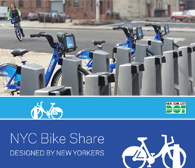
In preparation for the arrival of New York's newest travel option, bike share, DOT undertook an unprecedented public planning process. This report documents the community participation, which took the form of community board meetings, online suggestions, consultation with elected officals, and demonstration events. Download the Bike Share outreach report (pdf) Learn more about bike share in New York City
Park Slope Alternate Side Parking Suspension Study
During the Summer of 2008, DOT suspended alternate side parking in Park Slope, Brooklyn. The Park Slope Alternate Side Parking Suspension Study finds the suspension caused minimal impact on traffic and parking conditions in that neighborhood. (December 2008)
Parking Conditions Study for Yankee Stadium and Atlantic Yards
This report presents findings from parking studies conducted in the fall of 2011 around Yankee Stadium in the Bronx and Atlantic Yards in Brooklyn. The study examined the implications of different approaches to curb management generally and a residential parking permit program in particular. This report provides a comprehensive assessment of parking conditions in these areas as a basis for public discussion and future planning. Download the study on Parking Conditions for Yankee Stadium and Atlantic Yards(pdf) (July 2012)In 2013, DOT collected on-street parking occupancy, turnover, and vehicle registration location data around the Barclays Center during event and non-event days. Download a presentation on the results (pdf), given to the Atlantic Yards Quality of Life Committee on Sept. 16, 2013
Placard Parking Usage in Lower Manhattan
The New York City Economic Development Corporation and DOT commissioned this study to understand how placards are used in Lower Manhattan and assess the availability of curb frontage relative to placard activity.The streets of Lower Manhattan are a valuable public asset where different user groups compete for limited road space. Curbside parking spaces are highly valued and competition for those few spaces is fierce. A significant portion of the more than 1,300 block faces of curb frontage is allocated to authorized users—vehicles with agency placards displayed in their windshield that permit them to park in designated areas.
The results of this study, published in January 2008, are intended to help the City accurately consider existing policies in the context of the future of the Lower Manhattan street network. This study was made possible in part by a grant from the Lower Manhattan Development Corporation, which is funded through Community Development Block Grants from the US Department of Housing and Urban Development. Executive Summary Final Report Appendix 1A, Appendix 1B, Appendix 2, Appendix 3
Queens Village/Jamaica Avenue Transportation Study
The Queens Village/Jamaica Avenue Transportation Study was conducted in response to community and elected officials requests to improve traffic operations and enhance safety in the study area bounded by Hillside Avenue/Braddock Avenue to the north, Cross Island Parkway to the east, Murdock Avenue to the south, and Francis Lewis Boulevard to the west. The study includes recommendations to improve traffic operations and address safety concerns in the study area. Queens Village/Jamaica Avenue Transportation Study – Final Report (March 2015) (pdf)
Reauthorization of the Transportation Equity Act for the 21st Century (TEA-21)
This report describes the City's accomplishments using Federal transportation funding and lays out a plan for future use of these funds. Download the report on the Reauthorization of the Transportation Equity Act for the 21st Century (February 2003)
Red Hook Streetcar Feasibility Study
DOT conducted this study to determine the feasibility of a running a streetcar route in the Brooklyn neighborhood of Red Hook. The study was funded through a Federal Transit Administration grant secured by U.S. Representative Nydia Velázquez and has long had the support of the Brooklyn Chamber of Commerce. The study was completed in September 2011. Learn more about the Red Hook Streetcar Feasibility study
Reduced School Speed Limit Study
Results of a pilot study conducted by DOT to determine the efficacy of reduced speed zones (with 20mph reduced speed limit signs accompanied by flashing beacons that operate during school hours) in reducing vehicle speeds aroundschools. Download the Reduced School Speed Limit Study (June 2008)
Richmondtown Roadway Improvement Project (2004)
The Department of Transportation undertook the Richmondtown Roadway Improvement Project to assess improvements to Arthur Kill Road, Richmond Road and Richmond Hill Road in the Richmondtown area of Staten Island. These areas have serious congestion problems and a number of unsafe, high-accident locations. The goals of the study were to de-map the presently mapped but unbuilt "Loop" segment and to mitigate conditions along Richmond Hill Road and at the Richmond Road/Arthur Kill Road and Arthur Kill Road/Clark Avenue intersections. Download the Final Scoping Memorandum for the 2014 Richmondtown Roadway Improvement Project (pdf)
Ridgewood Transportation Planning Study
The Ridgewood Transportation Planning Study area is located on the Brooklyn/Queens border. The goal of the study is to assess the existing and future traffic and transportation conditions, identify any problems and generate recommendations to develop a package of improvement measures to accommodate future transportation needs. Executive Summary, Introduction, and Demographic Analysis, Land Use and Zoning, Traffic and Transportation, Public Transportation, Safety Analysis, Conclusion (March 2007)
Soundview Areawide Transportation Study
The Soundview Areawide Transportation Study resulted from a community request to address traffic congestion and safety on the Soundview peninsula. The study focused on the area bounded by East Tremont Avenue to the north, Castle Hill and Zarega Avenues to the east, O’Brien Avenue and the East River to the south, and the Bronx River Parkway to the west. The study recommends several measures to improve traffic operations and enhance safety, including signal timing changes, converting two-way streets to one-way, and adding turning lanes on Castle Hill Avenue and Bruckner Boulevard. Download the Soundview Areawide Transportation Study report (pdf) (July 2013)
South Williamsburg Transportation Study
DOT has completed the South Williamsburg Transportation Study which sought to identify existing and future travel needs and enhance safety for all street users while addressing community concerns. The study area was bounded by Broadway to the north, Park Avenue to the south and by Kent Avenue to the west. The study evaluated transportation conditions in the area to identify short and long-term safety and circulation improvements. Study area demographics, land-use, traffic congestion, pedestrian & bike safety, truck activity and accidents were studied in detail. The recommendations and improvement measures that have been generated include roadway geometry changes, parking regulation changes and pedestrian safety enhancements. Download the full Study (August 2016) Download the Third Public Meeting Presentation (pdf) (Presented in June 2016) Download the Second Public Meeting Presentation (pdf) (Presented in November and December 2015) Download the First Public Meeting Presentation (pdf) (Presented in January 2015)
Springfield Gardens/JFK Transportation Study
The Springfield Gardens/JFK Transportation Study was conducted in response to community and elected officials requests to address traffic and transportation challenges in the study area. The community identified traffic congestion, excessive truck activity on residential streets, safety and poor roadway conditions among others in the study area bounded by North Conduit Avenue to the north, Springfield Boulevard to the east, and Rockaway Boulevard/Nassau Expressway the southwest. The study assessed existing and future traffic conditions and developed recommendations to reduce congestion, improve traffic operations, manage truck traffic and enhance safety for all road users. The recommendations include street directional changes, geometric changes, improved traffic controls and parking management. Springfield Gardens/JFK Transportation Study – Final Report (December 2016) (pdf)Springfield Gardens/South Jamaica Transportation Study
The Springfield Gardens/South Jamaica Transportation Study was conducted in response to a request by an elected official (City Councilmember) to extend the boundaries of the then ongoing Springfield Gardens/JFK Transportation Study (completed in 20216). The purpose being to address community concerns to the north, such as congestion, pedestrian safety and traffic circulation in the study area. The study area is bounded by Merrick Boulevard to the north, North Conduit Avenue to the south, 225th Street to the east, and Sutphin Boulevard/150th Street to the west. The study assessed existing and future traffic conditions, and developed recommendations to address expressed community concerns which include geometric changes, street directional changes, parking and traffic control enhancements. Springfield Gardens/South Jamaica Transportation Study – Full Report, October 2021 (pdf) Springfield Gardens/South Jamaica Transportation Study – Conditions and Recommendations Presentation, April 2019 (pdf) Springfield Gardens/South Jamaica Transportation Study – Existing Conditions Presentation, December 2018 (pdf) Springfield Gardens/South Jamaica Transportation Study – Kickoff Presentation, December 2017 (pdf)
Trip Generation Study – Big Box Retail
This Trip Generation Study is an attempt to determine the trip generating characteristics of new large-scale retail “super stores” and in this case specifically home improvement superstores (HISS). From a pool of 22 HISS’s within the NYC area, seven facilities were chosen as well as one from Nassau County for detailed analysis. These eight facilities include one from Manhattan, Brooklyn, the Bronx and Nassau County and two from Staten Island and Queens. This analysis focuses on the trips generated by the facilities, trip characteristics such as mode, occupancy, trip type and customer characteristics, as well as the socio-economic characteristics, physical site characteristics (number of parking spaces and facility size), and the transportation accessibility of the immediate catchment area. Trip Generation Study – Big Box Retail Full Report, October 2009 (pdf) Trip Generation Study – Big Box Retail – CITE Conference Presentation, June 2009 (pdf)
Washington Heights Neighborhood Transportation Study
In this thriving mixed-use neighborhood at one end of the nation's busiest bridge, the streets serve a diverse range of users, including: pedestrians from age 1 to 100, people with disabilities, drivers, bus riders, bicyclists, delivery trucks and more. The goal of the Neighborhood Transportation Study was to find ways to make our streets safer and more efficient, balancing the needs of all users. To do this, we needed to hear from residents, local businesses, and the others who depend on safe and functional streets. Washington Heights Neighborhood Transportation Study - Fall 2016 (pdf)
West Side Manhattan Transportation Study (2013)
In response to community concerns over the growth in major real estate developments and traffic congestion, NYC DOT conducted a traffic and transportation study for the area bounded by West 55th Street, West 86th Street, Central Park West and Twelfth Avenue/Henry Hudson Parkway in the Borough of Manhattan. The study assessed existing traffic and transportation conditions in the study area and projected how future land uses may generate new trips and affect levels of congestion in the study area. Download the 2010 West Side Manhattan Existing Conditions Report (pdf) Download the 2013 West Side Manhattan Future Conditions and Recommendations Report (pdf) Download the Notes from Kickoff Listening Session/Workshop of the Westside Manhattan Transportation Study, Sept 24, 2007 (pdf) Download the West Side Manhattan Existing Conditions Presentation, Sept 22, 2009 (pdf) Download the West Side Manhattan Future Conditions and Recommendations Presentation, April 25, 2012 (pdf)
Traffic and Crash Data
Serious Injury Response, Tracking & Analysis (SIRTA) Program
SIRTA investigates, analyzes and reports on all fatal and severe injury crashes, reviews street design, infrastructure and driver behavior at each crash location, and makes recommendations for safety maximizing changes to street design or infrastructure. The program was created by City Council Local Law 049 in 2021 and is detailed in Administrative Code §19-182.3. Serious Injury Response, Tracking & Analysis (SIRTA) Report – Quarter 1, 2025 Serious Injury Response, Tracking & Analysis (SIRTA) Report – Quarter 4, 2024 Serious Injury Response, Tracking & Analysis (SIRTA) Report – Quarter 3, 2024 Serious Injury Response, Tracking & Analysis (SIRTA) Report – Quarter 2, 2024 Previous SIRTA reports are archived in the Government Publications Portal
Bicycle Crash Data
As required by Local Law 13 of 2011, NYC DOT compiles the total number of bicycle crashes reported by city agencies. The Bicycle Crash Data report contains information on crashes involving only bicycles, between bicycles and motorized vehicles, and between bicycles and pedestrians. This data includes the number of injuries resulting from such crashes and is grouped by borough and by police precinct. Bicycle Crash Data
New York City Screenline Traffic Flow Report
This report presents vehicular volumes and historical comparisons across the Bronx-Westchester, Queens-Nassau, Manhattan-New Jersey, Staten Island-New Jersey, and Brooklyn-Queens screenlines. View the NYC Bridge & Screenline Traffic Volumes Dashboard
Archive of previous reports: 2002, 2003, 2004, 2005, 2006, 2007, 2008, 2009, 2010, 2011, 2012, 2013, 2014, 2015, 2016 (pdfs)
Cycling Risk Indicator
New York City Cycling Risk describes changes in cyclist safety over the past decade while accounting for the increase in bicycle use in New York City. Cycling Risk Indicator 2000-2018
Pedestrian Traffic Study 2018
As required by Local Law 95 of 2017, NYC DOT identified seven locations with significant pedestrian traffic and developed strategies for enhancing pedestrian safety and traffic flow at each location. Pedestrians Traffic Study 2018 (pdf)
Don't Cut Corners: Left Turn Pedestrian and Bicycle Crash Study
NYC DOT developed Don't Cut Corners: Left Turn Pedestrian and Bicycle Crash Study to advance New York City's Vision Zero initiative to eliminate traffic deaths and serious injuries. NYC DOT took an exhaustive look at the problem of left turn pedestrian and bicyclist injuries (including fatalities) in New York City, querying five years of citywide crash data, manually reviewing 1,105 crash reports drawn from the most problematic locations citywide, and analyzing 478 intersections where treatments were installed. The study relies on these findings to provide recommendations for additional engineering, planning, and education efforts to prevent and mitigate left turn failure to yield pedestrian and bicyclist injuries. NYC DOT prepared this study pursuant to Local Law 21 of 2014. Don't Cut Corners: Left Turn Pedestrian and Bicycle Crash Study – Final Report – August 2016
Seasonal Variations in Pedestrians Killed or Severely Injured (KSI) (2010-2014)
Pedestrian fatalities follow a very strong seasonal pattern; September through January, fatalities are ~50% more frequent than other months. Pedestrian KSI follows both a seasonal and temporal pattern, with the “hottest” periods being in the early evenings in fall and winter. See a Heat Map of Seasonal Pedestrian KSI (pdf)
High Pedestrian Crash Locations: Pedestrian Safety Improvements at the Top 20 Intersections
This report, in response to Local Law 11, addresses DOT's ongoing commitment to improve safety at high pedestrian crash locations. The law requires DOT to identify the twenty highest crash locations based upon a ranking of the total number of crashes involving pedestrians. The number of locations in each borough is based on the proportion of citywide pedestrian injuries by borough. Safety improvements have been recently implemented at all, with additional improvements scheduled for the near future. Download the 2014 report (pdf) Download the 2013 report (pdf) Download the 2012 report (pdf) Download the 2011 report (pdf) Download the 2010 report (pdf) Download the 2009 report (pdf) Download the 2008 report (pdf) Download the 2007 edition (pdf)
Bicyclist Fatalities and Serious Injuries in New York City, 1996-2005
NYC DOT collaborated with the departments of Health and Mental Hygiene, Parks and Recreation, and Police on this report, which describes the factors that contributed to the deaths and serious injuries of bicyclists over a decade. Download Bicyclist Fatalities and Serious Injuries in New York City, 1996-2005 (September 2006)
2005 Transit Strike: Transportation Impacts and Analysis
The 2005 transit strike presented daunting challenges in maintaining mobility and access for City residents, businesses and visitors. The increased demand on the remaining operating transportation systems required a comprehensive and coordinated plan. This report, published in February 2006, describes how the City's Transit Strike Plan succeeded in maintaining mobility within the City. Part I: Executive Summary, Preparing for the Transit Strike, and Traffic Management Strategies. Part II: Analysis and Findings, Conclusions and Appendices.
Bridges and Tunnels
Annual Bridges and Tunnels Condition Report
This annual report describes NYC DOT's work in maintaining approximately 800 City bridges and tunnels. 2022-2023 Annual Bridges and Tunnels Condition Report Archive of Annual Bridges and Tunnels Condition Reports (2000 and up)
Manhattan River Crossings
This report, published annually by NYC DOT since 1972, presents vehicular volumes, classification, and trends for all bridge and tunnel facilities serving Manhattan. Read the Manhattan River Crossings Reports from: View the NYC Bridge & Screenline Traffic Volumes Dashboard Archive of previous reports: 2001 (summary), 2002, 2003, 2004, 2005, 2006, 2007, 2008, 2009, 2010, 2011, 2012, 2013, 2014, 2015, 2016 (pdfs)
New York City Bridge Traffic Volumes
Since 1948, DOT has monitored traffic flow on 47 bridges operated by the City of New York. This report summarizes vehicular volumes, classification data, and trends for the 47 bridges that cross over water, as well as the nine bridges and tunnels operated by the Metropolitan Transportation Authority and the six bridges and tunnels operated by the Port Authority of New York and New Jersey. Read past New York City Bridge Traffic Volumes reports: View the NYC Bridge & Screenline Traffic Volumes Dashboard Archive of previous reports: 2001, 2002, 2003, 2004, 2005, 2006, 2007, 2008, 2009, 2010, 2011, 2012, 2013, 2014, 2015, 2016
Harlem River Bridges
This report describes the eight Harlem River bridges, the rehabilitation projects that are either under way or planned, and the importance of obtaining Federal funding through reauthorization of the Transportation Equity Act for the 21st Century (TEA-21). Download the report on Harlem River Bridges (January 2004)
Rules and Specifications
New York City Rules and Regulations
Title 34 of the Rules of the City of New York includes NYC DOT rules, including Traffic Rules and Regulations and Highway Rules. Learn more about NYC DOT’s Rules and Regulations
Street Furniture and Street Lighting Rules
Revocable Consents
Find out more about the process for granting revocable consents, needed if you intend to install a structure on, under or over a City street or sidewalk.
Newsracks Rules
DOT has enacted rules regulating the placement, installation, and maintenance of newsracks on City sidewalks.
Distinctive Street Lighting
NYC DOT's Street Lighting Catalog lists the distinctive street lighting lampposts and luminaires, that meet NYC DOT's standards and are appropriate for use on the City's streets, and are an alternative to standard New York City street lighting fixtures. Learn more about distinctive street lightingStandard Drawings
Standard drawings are available for download free of charge. Some are also available for purchase at NYC DOT’s Bid Window at 55 Water Street, New York, NY 10041. For more information, call 212-839-9435.
- NYC DOT Standard Details of Construction (June 6, 2022)
- Street Lighting Standard Drawings
- Traffic Signal Standard Drawings
- Typical Pavement Markings & Geometry
Standard Specifications
Standard specifications are available for download free of charge. Some are also available for purchase at NYC DOT’s Bid Window at 55 Water Street, New York, NY 10041. For more information, call 212-839-9435.
- NYC DOT Standard Highway Specification (May 16, 2022)
- Specification for Traffic Signals and Intelligent Transportation Systems Construction and Equipment
- New York City Advanced Traffic Controller (ASTC) Procurement Specification