
What you should know
- Mayor Adams Brought Smart, Focused Leadership to “Get Stuff Done” Every Day, Commemorates Historic Record With Time Capsule to Be Opened in 10 Years
- Adams Administration Set Records for Fewest Shootings, Most Jobs and Small Businesses in City History
- Passed Landmark “City of Yes for Housing Opportunity” Legislation, Delivered Five Neighborhood Plans, and More to Create, Preserve, or Plan Over 433,000 Homes
- Rewrote City’s Approach to Homelessness and Serious Mental Illness
- Saved New Yorkers Over $30 Billion, Eliminated Medical Debt for More Than 500,000 People, Lowered Cost of Child Care, Launched Free “After-School for All,”
- Overhauled Reading and Mathematics in Public Schools
- Transformed Public Spaces, Moved Trash into Bins, Drove Down Rat Sightings
NEW YORK – New York City Mayor Eric Adams and leaders across city government today celebrated four years of historic accomplishments under the Adams administration. After taking office in the middle of a once-in-a-generation pandemic, a global recession, and rising crime, Mayor Adams moved quickly to keep New Yorkers safe, reopen the city, and rebuild the economy. But Mayor Adams did more than just bring New York City back; the Adams administration launched landmark initiatives to create a safer, more affordable city in its place — passing historic housing legislation, overhauling the city’s approach to homelessness and mental health, making landmark strides against the cost-of-living crisis, transforming public schools, expanding public spaces, and much more — all helping to make New York the best place to live and raise a family. Thanks to four years of responsible, common-sense leadership, the Adams administration leaves behind a city where working-class New Yorkers can still get ahead.
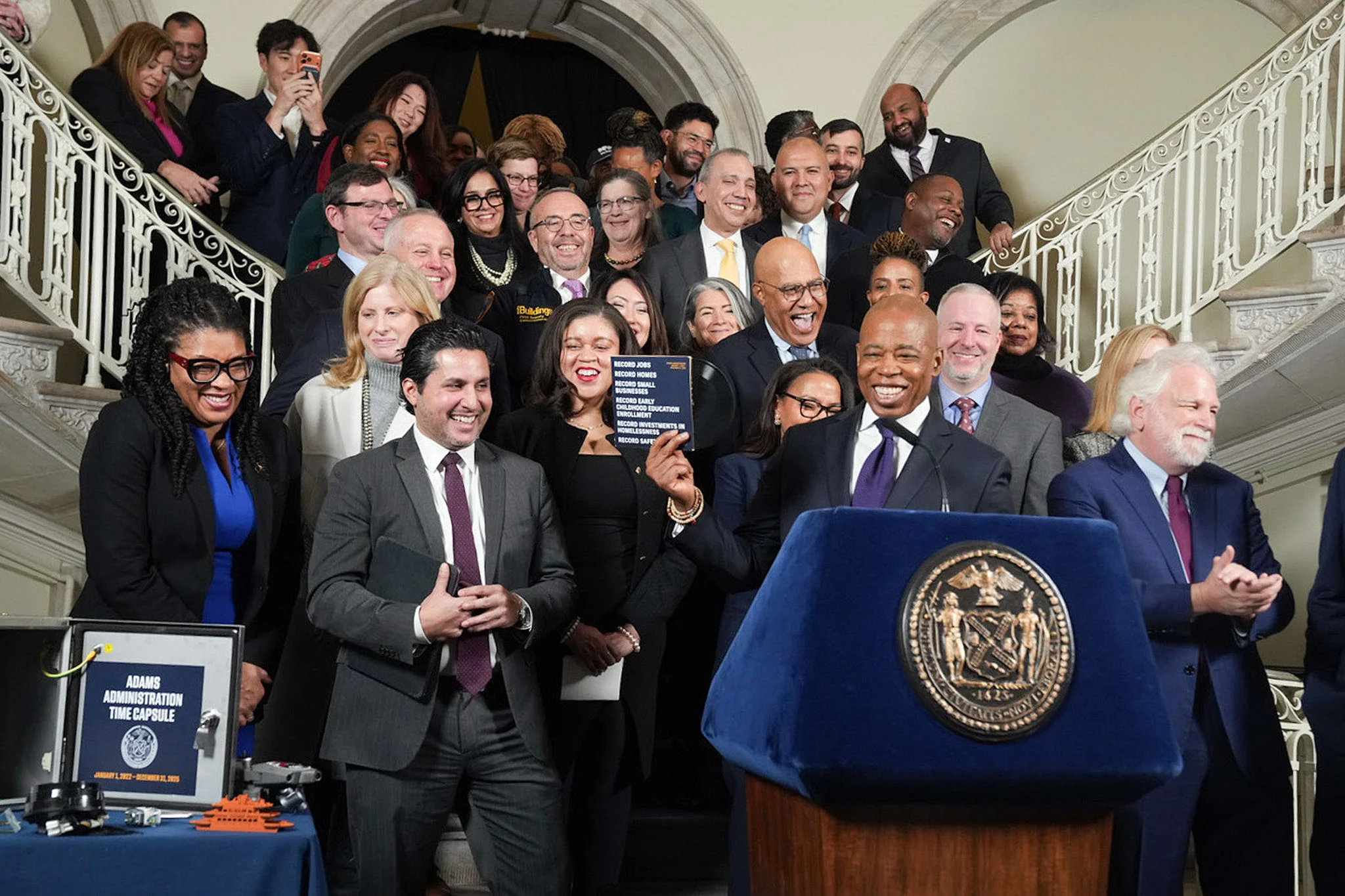
Additionally, Mayor Adams today commemorated his administration’s historic accomplishments with a time capsule buried near City Hall. The time capsule — which includes objects selected by each senior leadership team to represent their work over the last four years — will be opened in a decade.
“We took office with a simple promise: to ‘Get Stuff Done,’ and, four years later, our administration can say that we delivered on that promise every day for working-class New Yorkers,” said Mayor Adams. “We drove shootings to record lows and pushed jobs and small businesses to record highs. We rewrote the playbook on homelessness and mental health to finally get New Yorkers living on our streets the help they need, and, after decades of half-measures, passed historic housing legislation to turn New York into a ‘City of Yes.’ We overhauled the way our students learn to read and do math, cut the cost of child care, and forgave medical debt. We eliminated taxes for low-income families and launched free universal after-school programming. We got scaffolding off our buildings, trash bags off our streets, and opened up new public spaces for New Yorkers to enjoy. The haters may have doubted us, but the results are clear. On issue after issue, we brought common-sense leadership to create a safer, more affordable city, and our work has changed our city for the better; it will stand the test of time because we made New York City the best place to live and raise a family.”
Made America’s Safest Big City Even Safer
When Mayor Adams came into office, crime was rising and quality of life was deteriorating. The Adams administration moved quickly to protect New Yorkers — bringing a comprehensive, whole-of-government approach to public safety.
The Adams administration expanded New York City Police Department’s (NYPD) recruitment efforts, strengthened training procedures, and hired nearly 10,000 new NYPD officers. To combat a surge in gun violence and turn the tide from double-digit increases in gun violence to double-digit decreases in gun violence, the Adams administration unveiled the “Blueprint to End Gun Violence” and launched Neighborhood Safety Teams at the NYPD that have helped remove approximately 25,000 illegal guns from city streets; carried out 61 gang-related takedowns; and launched another $485 million blueprint to prevent gun violence through mentorship, mental health counseling, and job training. These strategies have paid off: shootings have plummeted by 55 percent and homicides have dropped by nearly 36 percent compared to the same period before the start of the Adams administration. Today, shooting incidents and shooting victims are at the lowest levels in the city’s recorded history for the first 11 months of the year.
When the administration began, auto theft was on an upward trajectory, so the administration worked with outside partners to distribute free tracking devices for New Yorkers to place in their cars, deployed dedicated vehicles in each police precinct to identify and track stolen cars, and worked with automobile dealers and the New York State Department of Motor Vehicles to crack down on car theft and grand larceny auto. After declining in 2024, car theft is now down another 5.8 percent year-to-date. Additionally, Mayor Adams’ “Charge Safe, Ride Safe: New York City’s Electric Micromobility Action Plan ” helped cut lithium-ion battery fire deaths by 67 percent since its introduction in 2023, after lithium-ion battery fire deaths skyrocketed the year before. After deploying 1,000 additional police officers into the city’s subway system in October 2022 and then again several times during the administration, transit crime declined for three years in a row.
To address New Yorkers’ non-emergency concerns — such as noise complaints, illegal parking, outdoor drug use, and more — Mayor Adams created a new Quality of Life Division at the NYPD, assigned 1,500 NYPD officers to the division, and expanded Quality of Life teams to all precincts across the city. After securing the power from the New York state Legislature to shut down illegal cannabis shops, Mayor Adams launched “Operation Padlock to Protect” to crack down on the sale of illegal cannabis; shut down over 1,600 illegal cannabis stores; and seized over $116 million in illegal products.
The Adams administration also seized more than 125,000 ghost cars and illegal mopeds, scooters, and all-terrain vehicles and implemented a 15 miles-per-hour speed limit for e-bikes across the five boroughs. Further, the administration installed a record number of protected bike lanes and completed major street redesigns across the city to protect pedestrians and cyclists. Bicycle fatalities, motorized two-wheeler fatalities, and overall traffic fatalities are all down by double digits year-to-date.
A Whole New Approach to Homelessness and Severe Mental Illness
Mayor Adams transformed the city’s approach to street homelessness and severe mental illness many New Yorkers are suffering from. Shortly after taking office, Mayor Adams launched an ambitious Subway Safety Plan to get New Yorkers living on city streets and subways the help, health care, and housing they deserve. Since the start of the plan, over 8,900 New Yorkers have been connected from subways to shelter and 1,200 have been connected to permanent affordable housing. Across the administration’s efforts, the New York City Department of Social Services connected over 53,200 New Yorkers to subsidized permanent housing from shelter — a 26 percent increase compared to the second term of the last administration.
The administration increased outreach staffing at the New York City Department of Homeless Services (DHS) and aggressively expanded specialized shelter beds — which are designed to serve the unique needs of New Yorkers experiencing unsheltered homelessness — bringing nearly 1,350 new low-barrier shelter beds online. Earlier this year, Mayor Adams announced a historic $650 million investment to bolster these efforts, including bringing DHS’ street programming budget to $400 million; this will be the largest annual investment in street sheltering in city history and more than double the city’s programming budget compared to when Mayor Adams entered office. The administration also prioritized co-response outreach teams, such as Subway Co-Response Outreach Teams (SCOUT) and Partnership Assistance for Transit Homelessness (PATH), that bring together law enforcement and mental health professionals to support the hardest-to-reach New Yorkers. Since launching the PATH program in August 2024, PATH teams have made over 20,000 engagements with unhoused New Yorkers and delivered critical services over 6,100 times. Mayor Adams also announced a major evolution of the Behavioral Health Emergency Assistance Response Division (B-HEARD) — the city’s mental health-led response to 911 mental health calls — that will shift the focus even further towards a health-first response by streamlining management to be fully operated and managed by NYC Health + Hospitals in the coming months.
Moreover, Mayor Adams fundamentally shifted the conversation on how to help people with severe mental illness. Since 2022, Mayor Adams forcefully advocated for more proactive use of involuntary commitments to help those experiencing a psychiatric crisis. In 2025, following Mayor Adams’ repeated calls, Albany passed a budget incorporating key provisions of the administration’s “Supportive Interventions Act” to help deliver life-saving psychiatric care, even for those who cannot recognize their own need for it. And, as part of his campaign to “End the Culture of Anything Goes,” Mayor Adams laid out a vision to expand upon this work with a change in state law to authorize civil commitment for those struggling with substance use disorder.
The Most Pro-Housing Administration in City History
When Mayor Adams came into office, he promised to turn the page on decades of dysfunction, make real progress against New York City’s long-standing housing crisis, and create 500,000 units of housing by 2032; four years later, he delivered, and the Adams administration is well on the way to that goal by creating, preserving, or planning over 433,000 homes through its efforts to date.
Thanks to decisive strategies to build more housing — including cutting red tape to speed up construction of new developments and investing a historic $26 billion towards affordable housing through the city’s 10-Year Capital Plan in Fiscal Year 2025 — the Adams administration has produced nearly 86,000 affordable homes, with the last three fiscal years representing the most new affordable homes ever created in a three fiscal-year stretch (Fiscal Year 2023 – Fiscal Year 2025).
The Adams administration also passed landmark changes to overhaul the city’s outdated zoning code and spark the creation of new housing. In December 2024, Mayor Adams passed “City of Yes for Housing Opportunity” — the most pro-housing legislation in city history — to create over 80,000 new homes and invest $5 billion in housing and infrastructure. Additionally, Mayor Adams passed five neighborhood plans to create nearly 50,000 homes over the next 15 years in the Bronx Metro North neighborhood, Central Brooklyn, Midtown South in Manhattan, and Long Island City and Jamaica in Queens. The Adams administration’s rezoning efforts in less than four years alone are expected to create more new housing than the previous two mayoral administrations’ rezoning efforts in 20 years combined.
To build new housing everywhere, Mayor Adams advanced over 10,000 new homes on city-owned land through his historic Executive Order 43; secured a landmark housing deal in Albany to give the city new housing tools; and convened the first-ever Charter Revision Commission to focus specifically on housing and land use measures.
Additionally, the Adams administration put public housing first, helping to unlock nearly $5.5 billion in capital repairs for over 24,000 residents through the Permanent Affordability Commitment Together program and helping establish the Preservation Trust to repair, rehabilitate, and modernize 25,000 apartments under control of the New York City Housing Authority (NYCHA).
Moreover, the Adams administration has worked to connect New Yorkers to homes and keep New Yorkers in their homes, connecting a record number 30,000 New Yorkers with affordable homes through the city’s Housing Lottery.
An Economy That Has Delivered for Working-Class New Yorkers
Shortly after coming into office, Mayor Adams released “Rebuild, Renew, Reinvent: A Blueprint for New York City’s Economic Recovery” to accelerate the city’s recovery and create a more equitable, inclusive economy. Four years later, the Adams administration has shattered the record for the most jobs in city history 12 times, with nearly 5 million jobs across the five boroughs today. Unemployment has fallen by nearly 40 percent since the start of the Adams administration, including a 31 percent drop in Black, indigenous, and people of color unemployment.
The Adams administration launched hiring halls across the five boroughs to bring both public- and private-sector job opportunities and career services directly to New Yorkers; established new programs to attract major companies to New York City; and won the 2026 FIFA World Cup Finals for New York and New Jersey to add $2 billion to the metro area’s economy.
Mayor Adams not only helped create new jobs; he took proactive steps to boost wages, expand benefits, and make sure new jobs across the five boroughs paid well. The Adams administration established a first-of-its-kind minimum hourly pay rate for app-based delivery workers and helped increase delivery worker wages by $1 billion; secured a $741 million cost-of-living adjustment for 80,000 human services workers; and reached union contracts with nearly 99 percent of city workers, finally giving the public-sector workforce the pay and benefits they deserve. Additionally, to make sure that the city is promoting inclusive growth, the Adams administration has awarded $24 billion to minority- and- women-owned businesses (M/WBE) and, for the first time in city history, achieved a combined citywide M/WBE utilization rate of 36 percent among city agencies.
To support the mom-and-pop stores that power New York City’s neighborhoods, the Adams administration facilitated more than $350 million in financing to small business owners and entrepreneurs, including $85 million through its innovative Small Business Opportunity Fund to give capital directly to the city’s small businesses. The Adams administration cut red tape to save small businesses nearly $16 million and passed “City of Yes for Economic Opportunity” to provide businesses with clear, modern zoning rules that support growth. Additionally, to support the city’s cultural institutions, the Adams administration invested a historic $300 million into the New York City Department of Cultural Affairs and delivered the largest expansion of the city’s Cultural Institutions Group in nearly five decades.
But Mayor Adams not only focused on creating jobs and businesses today; the Adams administration made smart investments to keep New York City at the front of the global economy for decades to come. The administration released the “Green Economy Action Plan,” a first-of-its-kind plan that lays out a roadmap to growing the city’s green economy, invests in jobs and sectors that help the city combat climate change, and positions New Yorkers to benefit from the nearly 400,000 projected ‘green-collar’ jobs in New York City by 2040. Additionally, under the Adams administration, New York City’s waterfront has been reimagined as a ‘Harbor of the Future,’ with a modern maritime port and vibrant mixed-use community hub at the Brooklyn Marine Terminal in Red Hook, the Hunts Point Produce Market in the Bronx, the newly-announced climate innovation hub “BATWorks” at the Brooklyn Army Terminal in Sunset Park, the country’s largest offshore wind port at the South Brooklyn Marine Terminal, the Science Park and Research Campus in Kips Bay in Manhattan, new sustainable housing and public space on the North Shore of Staten Island, and an anchor research and educational partnership with the New York Climate Exchange on Governors Island. Along with smart investments in artificial intelligence, digital gaming, and the film and television sector, these investments will create hundreds of thousands of jobs in the future.
Putting Billions of Dollars Back into New Yorkers’ Pockets
Mayor Adams launched sweeping programs to address New York City’s cost of living crisis and save New Yorkers money on child care, internet, rent, and more. The Adams administration put more than $30 billion back into New Yorkers’ pockets through city, state, and federal programs.
In June 2022, Mayor Adams launched “Accessible, Equitable, High-quality, Affordable: A Blueprint for Child Care & Early Childhood Education in New York City” to provide high-quality, affordable child care to New York City families. The Adams administration created a new “MyCity” portal to give families a one-stop shop for city services, cut the cost of subsidized child care from $55 per week in 2022 to less than $5 today, and saved families more than $3 billion through child care vouchers. The Adams administration launched a child care initiative for 0-2 year olds that puts New York City on the path to universal child care for low-income families, established a pilot program for city workers employed by the New York City Department of Citywide Administrative Services, and enrolled 150,000 children — an all-time high — across the early childhood education system. Additionally, Mayor Adams established a historic “After-School for All” program to offer free afterschool programming to 184,000 young people in kindergarten through eighth grade and create the first-ever comprehensive plan for universal afterschool in New York City.
To bridge the digital divide, Mayor Adams launched “Big Apple Connect” and brought free internet and basic cable service to 330,000 New Yorkers across 220 sites in NYCHA. Mayor Adams also launched a dynamic “Liberty Link” pilot to build on the program’s success and bring free internet to another 2,200 households across 35 affordable housing buildings in the Bronx and Upper Manhattan. And — to bring more young people online — Mayor Adams is issuing new internet-enabled devices for free to public school students during the 2025-2026 school year.
Mayor Adams took landmark steps to wipe out New Yorkers’ debt, partnering with Undue Medical Debt to forgive $2 billion in medical debt for 500,000 New Yorkers. Mayor Adams also launched eight new NYC Financial Empowerment Centers at select NYC Health + Hospitals locations across the health system to help New Yorkers better plan and avoid going into medical debt in the future.
Additionally, Mayor Adams launched the largest student loan forgiveness aid program in the country to help roughly 1.4 million New Yorkers enroll in federal student debt relief and repayment programs and, ultimately, keep up to $1 billion. The Adams administration has also secured more than $120 million in consumer and worker relief for New Yorkers since the start of the administration, including through the largest worker protection settlement in city history with Starbucks.
Finally, the Adams administration went to Albany to fight for lower taxes — expanding the Earned Income Tax Credit to save over 1.7 million New Yorkers more than $345 million every year and introducing and getting passed “Axe the Tax for the Working Class” to slash and eliminate city personal income taxes to give $63 million back to over 582,000 New Yorkers. Moreover, the administration has helped New Yorkers complete 367,000 tax returns for free and save more than $95 million in free tax prep services over the past four years.
A First-Rate Education for Every Student
Mayor Adams promised to give every New York City public-school student a first-rate education and took historic steps to overhaul outdated curricula, open up new gifted and talented seats for students, and prepare young people for the 21st century. Mayor Adams launched “NYC Reads” and “NYC Solves” to bring evidence-based reading and math instruction to half a million students and — thanks in part to these transformative initiatives — increased reading and math scores for public-school students up in the 2024-2025 school year. The Adams administration also opened up 33,000 new school seats — including the most new seats in two decade last year alone — and established the Division of Inclusive and Accessible Learning to serve students with disabilities and multilingual learners.
To support students outside of the classroom and give more young people good-paying summer jobs, the Adams administration expanded the city’s Summer Youth Employment Program to a record 100,000 slots per year. Under the Adams administration’s FutureReadyNYC program, the administration provided 15,000 students with work-based learning experiences at companies such as Google, Norwell Health, and more. Additionally, through Mayor Adams’ “Financial Literacy for Youth” initiative, the city set an ambitious goal of making sure that every public school student can learn to save and spend money by 2030; to help meet this goal, the Adams administration is placing financial educators in every single school district and launching an innovative in-school banking program to bring banking services directly to 15 public schools.
To support youth in foster care, Mayor Adams expanded the New York City Administration for Children’s Services (ACS) Fair Futures program to give approximately 6,000 young people one-on-one coaching and tutoring, launched the ACS College Choice program to give over 500 youth financial support for college, and created the Career Choice program to support approximately 400 youth seeking vocational, trade, and workforce development training.
Healthier City, Longer Lives
In 2023, Mayor Adams launched “HealthyNYC,” an ambitious whole-of-government campaign to increase New Yorkers’ average life expectancy to 83 years by 2030. In late 2025, Mayor Adams announced that the city had already met its goal, five years ahead of schedule. The achievement followed several strategic investments by the administration to address the greatest drivers of premature death.
After significant multi-year investments in overdose prevention and drug use recovery services, New York City saw the first significant decrease in opioid overdose deaths in a decade. The progress builds on the work the Adams administration has done to ramp up annual support to $50 million per year for opioid prevention and treatment using settlement funds secured by New York City and New York state from pharmaceutical companies. The administration provided free doula services to over 3,500 expecting parents through its Citywide Doula Initiative, increasing doula coverage to 25 percent of New York City residents without any maternal deaths through the program. The city also connected over 12,000 individuals to licensed abortion care providers through its Abortion Access Hub.
Mayor Adams expanded the NYC Health + Hospitals’ lifestyle medicine program — which helps patients make evidence-based lifestyle changes, including a plant-based diet, increased physical activity, improved sleep habits, stress reduction, avoidance of substance use, and stronger social connections — to the entire city and made plant-based meals the default choice for lunch and dinner at 11 hospitals. The city’s health system has served over 2 million plant-based meals since the program began in March 2022.
To support the health of young people, Mayor Adams launched “NYC Teenspace,” a free tele-mental health service for teens that saw over 10,000 teens sign up, and repeatedly brought litigation against e-vape distributors and wholesalers. The Adams administration also issued a landmark Health Commissioner’s Advisory identifying unfettered access to social media as a public health hazard and filed a lawsuit to hold the owners of five social media platforms accountable for their role in helping fuel the nationwide youth mental health crisis.
Meeting the Moment on Asylum Seekers
The Adams administration skillfully managed an unprecedented, international humanitarian crisis — opening up over 260 shelters and serving approximately 245,000 migrants from over 160 countries who arrived in the five boroughs seeking care and support since the spring of 2022. The city’s Asylum Application Help Center — a first-in-the-nation entity — helped complete more than 140,000 applications for work authorization, Temporary Protected Status, and asylum. Through a herculean effort involving dozens of city agencies, the city was able to shelter, feed, clothe, educate, vaccinate, and support new arrivals to the city. To date, over 86 percent of migrants and asylum seekers who have asked for help have taken the next steps in their journeys. Finally, Mayor Adams successfully achieved more than $7.1 billion in asylum seeker savings over three fiscal years thanks to smart decisions.
Additionally, the administration launched the largest network of coordinated municipal immigrant legal services and the largest community support network in the United States, investing in 29 Immigration Legal Support Centers that deliver free, high-quality immigration legal assistance. Through the Fiscal Year 2026 Adopted Budget, the Adams administration and the New York City Council nearly doubled the amount of funding invested into immigrant legal services, bringing the 2026 immigrant legal services budget to $120.7 million — a record level.
Creating World-Class Public Spaces
Public spaces are an essential part of New York City, giving families a place to play, learn, rest, and connect. That is why the Adams administration created 49 football fields of new public spaces and launched bold initiatives to transform Fifth Avenue into a world-class, pedestrian-centered boulevard; advance the East Side Coastal Resiliency Project to protect Manhattan from future storms and high tides; create a new public space under the Brooklyn Bridge with The Arches; redesign Kimlau Plaza in Chinatown as a safer, simpler intersection; and much more. Through its “Vital Parks for All” initiative, the Adams administration has put an additional 37,000 New Yorkers within a 10-minute walk of greenspace.
To create cleaner streets, the Adams administration launched the “Trash Revolution” and issued landmark rules requiring 70 percent of trash bags to be moved into container bins. Through these efforts, approximately 11 billion pounds of trash have been taken off the city’s streets over the last 12 months alone and a pathway to 100 percent trash containerization for businesses has been laid out for the coming decade. The administration’s Targeted Neighborhood Task Force has completed more than 46,000 cleanings while rat sightings reported to 311 have declined for 12 straight months in a row.
To create brighter streets, the administration launched a historic “Get Sheds Down” initiative, took down over 425 longstanding sidewalk sheds, passed landmark legislation to remove unsightly scaffolding from buildings, and unveiled newer, safer, lighter scaffolding designs.
Additionally, the Adams administration established “Dining Out NYC,” the largest outdoor dining program in the country, to deliver a safe, accessible outdoor dining experience; in 2025, the number of outdoor dining applicants was triple the size of the city’s pre-pandemic program.
Finally, to prepare New York City for the long-term threat of climate change, the administration invested $1.2 billion into anti-flooding efforts, constructed over 2,900 rain gardens and infiltration basins with city sidewalks, and passed “City of Yes for Carbon Neutrality” to deliver clean energy, lower emissions, and more convenient electric charging to New Yorkers.
Budgeting for Success
Despite unprecedented fiscal challenges — including the need to fund long term programs that had previously been supported with expiring federal stimulus dollars and an unprecedented humanitarian asylum seeker emergency that cost the city more than $8.6 billion — the Adams administration delivered four on-time, balanced, fiscally-responsible, annual budgets. In Fiscal Year 2026, the Adams administration successfully negotiated the first adopted budget in nearly 20 years to receive a unanimous vote by the entire City Council. Thanks to strong fiscal management, four independent, internationally- recognized credit rating agencies affirmed the city’s strong bond ratings and stable outlook 18 consecutive times.
Finally, the Adams administration launched and implemented Climate Budgeting, making New York City the first big city in the United States to permanently embed climate considerations into budgeting decisions and joining an elite group of global cities, including London, Oslo, and Mumbai.
###