
 Environmental Protection311Search all NYC.gov websites


Green Infrastructure on Streets and Sidewalks

Sidewalks, parking lanes, and the roadway (also known as the public right-of-way) make up approximately 30% of the impervious cover in New York City. DEP has built thousands of green infrastructure assets in the public right-of-way, such as rain gardens, infiltration basins, and green medians, throughout the city. Visit Types of Green Infrastructure for more information. To report a maintenance issue, please call 311 or submit a report online.
Rain Garden Stewardship Volunteer Signup

Our Rain Garden Stewardship Program enables community members to volunteer to help care for their neighborhood rain gardens. If you would like to sign up to volunteer, please fill in the Rain Garden Stewardship Interest Form.
To view rain gardens that are eligible for stewardship, use the Green Infrastructure Map. (Instructions: When you open the map, scroll to the bottom of the page and click on “layers list.” Then select the box next to “Rain Garden Stewardship” and de-select all remaining boxes to reveal rain gardens that are eligible for stewardship.)
Download the Rain Garden Stewardship Program Maintenance Manual to learn more about what rain garden stewards do and why it is important.
Workforce Development
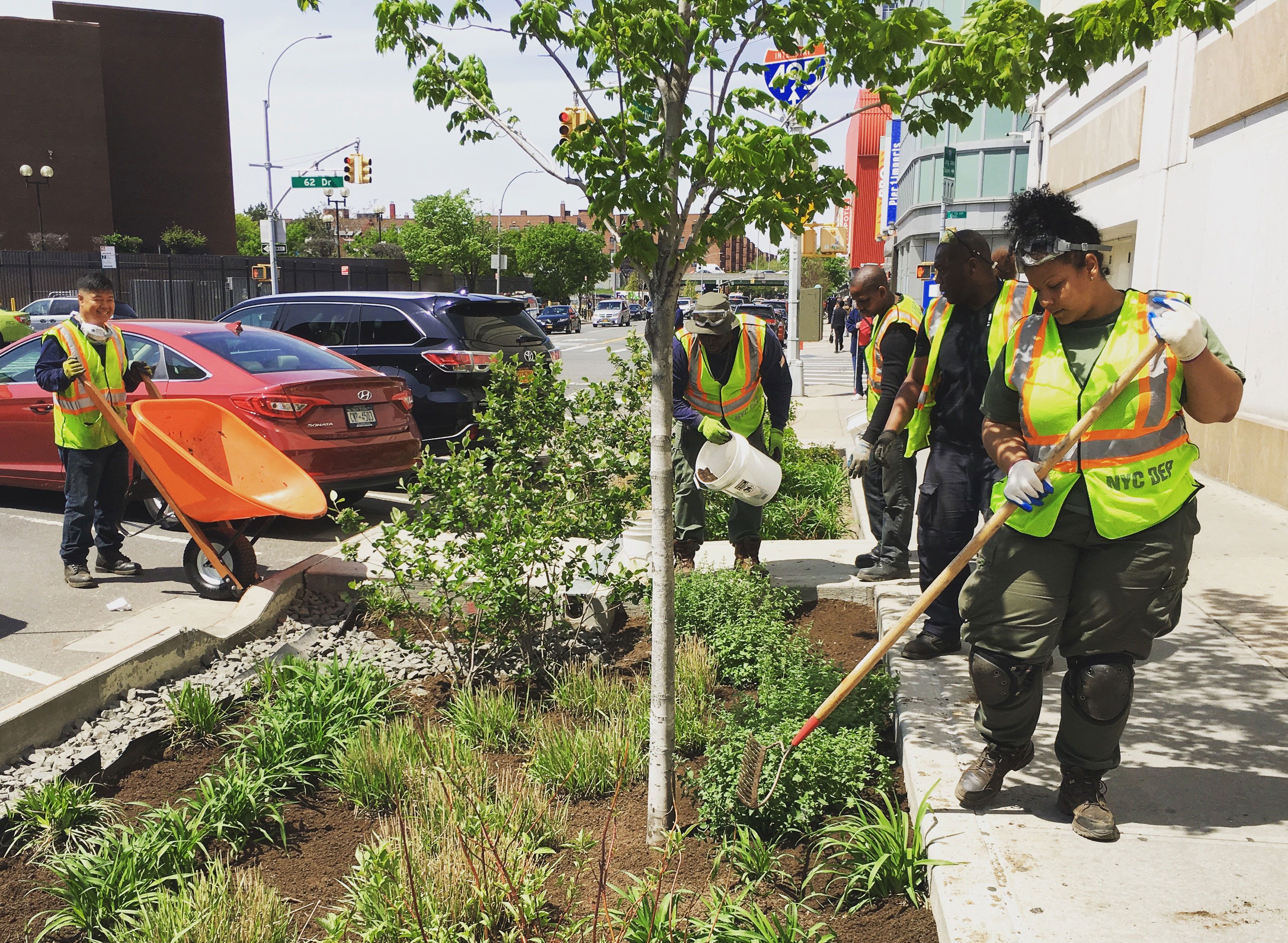
DEP has initiated a pilot green infrastructure educational training program managed by The Doe Fund, in collaboration with Gowanus Canal Conservancy and Public Works Partners. This DEP-funded program will provide participants with on-the-job maintenance training and soft skills training support, helping to develop a workforce pipeline that will feed NYC’s growing need for green infrastructure and water industry professionals.
Right-of-Way Green Infrastructure Standards, Specifications, and Protections
DEP has developed design guidelines, standards and specifications for green infrastructure built in city streets and sidewalks (public “right-of-way”). These guidelines are used by engineers, architects, landscape architects, and other city agencies to streamline the development of contract plans and drawings, and reduce the timeline and costs associated with design and approval processes.
Right-of-Way Green Infrastructure Design Standards
- Download the Standards for Green Infrastructure
- Download the Survey Procedure
- Download the Geotechnical Investigation Procedure and Appendices
- Download the Green Infrastructure Siting Criteria
Right-of-Way Green Infrastructure Standard Specifications
- Download the New York City DEP Standard Green Infrastructure Specifications from the New York City Department of Design and Construction
Right-of-Way Green Infrastructure Protections
Proper protection of green infrastructure is crucial as contractors shall be liable for any damage to assets due to construction activities. Please notify giutility@dep.nyc.gov at least 48 hours prior to commencing construction work near green infrastructure.
- Download the Protection Requirements for Right-of-Way Green Infrastructure
- Download the Right-of-Way Green Infrastructure Protections FAQ
- Download the Right-of-Way Green Infrastructure Protections During Construction Presentation
Rain Garden FAQs
What do rain gardens do?
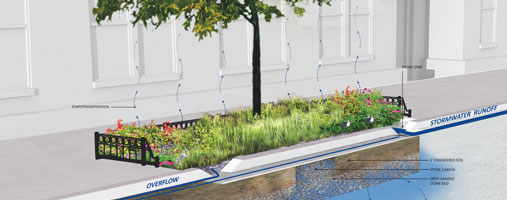
When it rains, rainwater or “stormwater runoff” flows down the street gutter along the curb and into the rain garden. The collected stormwater is absorbed by the sandy soil on the top (engineered soil) and stone layer at the bottom, and seeps into the ground underneath in a process called “infiltration”. Some of the water will be absorbed by the trees and plants through evapotranspiration, and any remaining water will evaporate after the rain event is over. During a heavy rainstorm, stormwater goes into the rain garden, but some water may go past the inlet and go straight into the catch basin. If the rain garden reaches capacity, the stormwater will overflow at the outlet and go into the catch basin the way it normally would.
How does DEP care for rain gardens?
We care for New York City’s expansive network of rain gardens citywide. We inspect them on a regular basis, as well as remove litter and sediment that stormwater may have carried in. We also pull weeds, prune trees and shrubs, and monitor plants to make sure they are thriving.
Do rain gardens attract mosquitoes?
Mosquitoes require a minimum of 72 hours in standing water for larvae development. Rain gardens are designed to drain in 48 hours or less. If your rain garden does not appear to be draining properly, please call 311.
Do rain gardens prevent people from walking on the sidewalk or block driveways and building entrances?
No, we work with the Department of Transportation to ensure that rain gardens comply with the City’s requirements for pedestrian access and safety.
Do rain gardens remove parking?
Most rain gardens are installed in the sidewalk and are designed to have no impact on parking. When larger rain gardens are proposed, we work with Department of Transportation work to minimize parking impacts.
Do tree roots crack the sidewalk or interfere with utility lines?
During design and construction, we work with utility companies to ensure that rain gardens will not directly interfere with existing underground and above-ground utility service lines. Older tree roots can break sidewalks because the tree pit is not large enough for the tree roots. But the City’s standard rain gardens are at least 10 feet long, which gives tree roots plenty of space to grow.
Contractors have been working on rain gardens in my neighborhood and there are tree guards but no plants. Why are these sites still unfinished?
Construction on rain gardens may begin at different times throughout the year. However, planting of the rain gardens must occur during the spring or fall season when conditions are optimal for planting. Construction on these rain gardens may have begun earlier in order to be ready for the next appropriate planting season.