
What you should know
- Adams Administration Leads on Embracing Technology to Deliver Services, Make New York City More Inclusive and Accessible to All
- All City-Owned Smart Phones Will Receive Language App to Empower City Employees to Better Communicate with New Yorkers
- Goal is to Make All New York City Agencies More Language Friendly
- Updated NYPD Patrol Guide Policy Will Allow Officers to Use Language Applications to Communicate with People with Limited English Proficiency While on Patrol
- New York City Public Schools to Develop New, Custom App to Bridge Language Gaps in School Communities
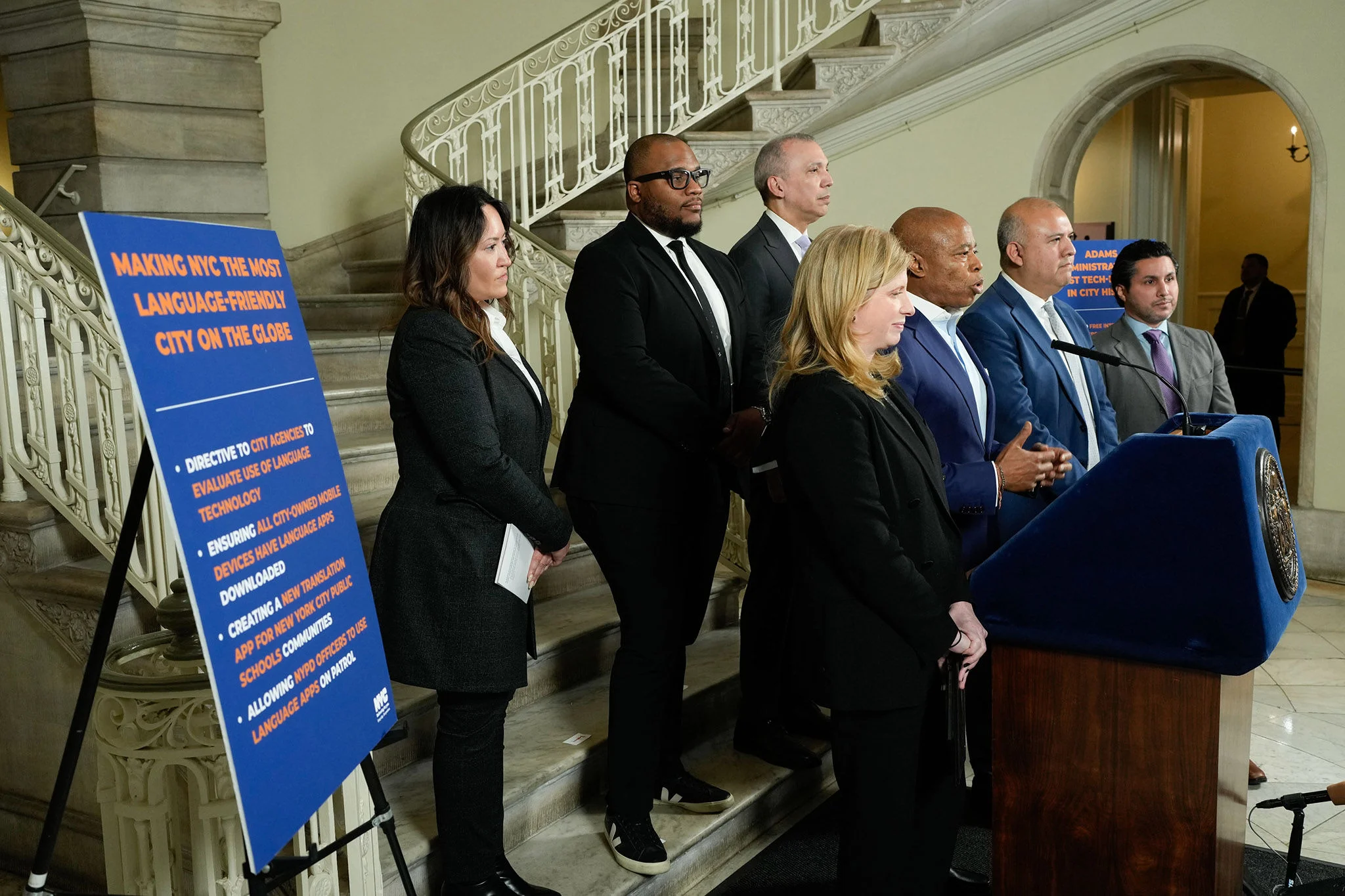
NEW YORK – New York City Mayor Eric Adams today issued a directive to city agencies to evaluate how they can further incorporate language technologies into their day-to-day interactions with the public to improve communications with all New Yorkers, including non-English speaking communities. To start, the city is planning to install language apps on all city-owned smart devices — more than 100,000 in total — to make city services more accessible to New Yorkers as part of the City of New York’s push to become the most language-friendly city on the globe. The New York City Office of Technology and Innovation (OTI) will provide support to city agencies to facilitate downloads and usage of tools like Google Translate and Apple’s built-in Translate app, while continuing to evaluate advances in technology to ensure effective, safe, and quality communications. Additionally, the New York City Police Department (NYPD) will immediately begin using language technology to communicate with New Yorkers they interact with on a day-to-day basis, while New York City Public Schools has begun development on Hello, a new app to help bridge language gaps that will be rolled out in the spring of 2026.
In order to reach New Yorkers in the languages they speak, NYC311 already provides interpretation services in over 175 languages. Residents can text 311 at 311-692 to receive help through translation services. In 2024, these language resources were used in more than 320,000 customer interactions across 104 languages. Additionally, MyCity, which connects New Yorkers to city services and benefits, is available in the city’s 10 most common languages.
“From the very start, our administration has continually expanded our use of technology to keep New Yorkers safer, stronger, and more informed, but to be a more inclusive and accessible city, we must also be the most language-friendly city on the globe,” said Mayor Adams. “Today, we are taking another step forward by expanding the use of language technology to improve communications with all New Yorkers, no matter what language they speak. This is a global city, where you can hear over 175 languages spoken on every street, every store, and every stoop. That is why we are issuing a directive to our city agencies that will make it possible to expand the use of language apps in their work. The city will kickstart this process by ensuring every city-owned smart device has language apps, like Google Translate, available at their fingertips. Additionally, the NYPD is updating its Patrol Guide Policy to allow officers to use translation apps while interacting with the public, and, in our school system, we will begin developing a new custom app to bridge language gaps in school communities. Today’s announcement further builds on the work we have done to improve service delivery and make New York City government more inclusive and accessible because when we embrace technology, we are able to deliver every part of our vision more effectively — making our city safer, more affordable, and the best place to raise a family.”
“Our administration has made it clear that we need to use every tool we have to meet New Yorkers wherever they are; for me, that mission has always been personal. Growing up in a community full of immigrants, like my own, I learned first-hand how important it is for government to speak to every person, with every tool, in every language. But, too often, language and cultural barriers have made it hard for our city’s residents to understand what’s happening in their neighborhood, to learn what resources are available, and to know where to turn for help in a crisis,” said Deputy Mayor for Communications Fabien Levy. “The Adams administration is changing that by being laser-focused on speaking to all New Yorkers. With this new directive, we will double down on that mission by giving our agencies new tools to meet New Yorkers where they are, deliver the information they need, and help our city government connect with every New Yorker, regardless of their background or the language they speak as we make it easier to live, work, and raise a family in the greatest city in the world.”
“The Adams administration has ushered New York City into the 21st century with bold technology strategies that make city services and benefits more accessible to all New Yorkers,” said New York City Chief Technology Officer (CTO) Matthew C. Fraser. “Today's announcement builds upon the mayor's forward-thinking efforts to deploy technology in fresh ways to remove barriers to government resources for those who need them most. By putting language technologies at the fingertips of more than 100,000 public sector workers, the city is significantly expanding its ability to deliver the services and support that non-English speaking New Yorkers deserve. That is a success in any language.”
“Language should never be a barrier to safety or access to city services,” said New York City Department of Citywide Administrative Services (DCAS) Commissioner Louis A. Molina. “By equipping city-owned smart devices with language technology, we can help ensure that the public servants who keep New York City running can communicate more clearly with the New Yorkers they serve. At DCAS, we value equity and inclusion for all, and we’re proud to support our agency partners in making the city more accessible to every community.”
“Clear communication is essential to public safety,” said NYPD Commissioner Jessica Tisch. “Our officers interact with New Yorkers who speak dozens of different languages, often in situations where time and understanding matter. Expanding access to real-time translation tools helps officers communicate more clearly, respond more effectively, and better serve the people who need help. I thank Mayor Adams for supporting this update and ensuring that our officers have practical tools that make interactions safer for everyone involved.”
“Every day our schools work hand-in-hand with families to provide a world-class education and critical supports for our students,” said New York City Public Schools Chancellor Melissa Aviles-Ramos. “Parents and families are our first partners in the success of our youngest New Yorkers, so it is essential that we have effective, efficient, and robust communication pathways between families and our schools. When our educators and school leaders work in close partnership with our families, our students thrive.”
“As the office responsible for overseeing language access citywide, we are committed to finding new and better ways to communicate effectively and responsibly with immigrant communities, including the 2 million New Yorkers with limited English proficiency,” said New York City Mayor’s Office of Immigrant Affairs Commissioner Manuel Castro. “We are proud of the progress we’ve made over the last four years, including significantly growing our internal capabilities and our partnership with over 40 city agencies and more than 30 mayoral offices to advance language access implementation across New York City.”
In addition to OTI downloading language technology on all city-owned smart devices, the NYPD’s patrol guidelines for interaction with “Limited English Proficient Persons” has been updated to include technology, instead of just human translations. Since 1992, NYPD officers have had access to the NYPD’s Language Line service, which provides language services by phone in more than 180 languages. In an effort to improve ease of communication with the communities they serve and utilize the latest technologies that facilitate real-time translations, NYPD officers on patrol will now also be able to use additional translation applications on their NYPD-issued smartphones. Such applications have access to dozens of additional languages.
This winter, New York City Public Schools will begin to develop Hello, a new custom-developed app to help bridge language gaps in New York City school communities. Using speech-to-text and text-to-speech interactions, Hello will be able to give real-time translation and interpretation in the top 12 languages spoken by New York City Public Schools’ families. This app is specifically being designed securely and with privacy in mind to support families during impromptu meetings and interactions with school staff, and comes on the heels of an amendment to Chancellor Regulation A-663 earlier this summer to bring the number of covered languages from nine to 12.
In collaboration, MOIA and OTI are testing Google/Apple/Microsoft speech-to-speech translation apps to test efficacy and inform citywide policy. This continues MOIA’s partnership in supporting OTI’s efforts to make nyc.gov more accessible in multiple languages through 1) providing MOIA language access specialists to review machine translated content for city websites and 2) support OTI with reviewing needs and potential vendors for citywide implementation.
Today’s announcement further builds on the work the Adams administration has done to encourage city agencies to adapt to improve service delivery and make New York City government more inclusive.
Increasing Communications: Establishing Direct Access to 911 for Emergency Response
Mayor Adams has invested in technology that enables direct integration to the NYPD for swift emergency responses for schools, bodegas, and businesses.
Recently, Mayor Adams and CTO Fraser announced the nation’s first pilot directly integrating public schools with 911 services for life-saving rapid response in case of an active shooter situation. The pilot will be rolled out to 25 school buildings, representing 51 public schools across the five boroughs, during the 2025-2026 school year to provide an immediate, secure, and automated pathway for public schools to directly alert 911 of a critical emergency.
Additionally, in May 2025, Mayor Adams announced an investment of $1.6 million in funding to equip an estimated 500 bodegas across the five boroughs with “SilentShields” buttons that bodega staff can press to immediately call the NYPD in cases of emergency. SilentShields builds off another program Mayor Adams launched in 2024 to combat retail theft by helping local businesses voluntarily share information in real-time with the NYPD through existing closed-circuit television cameras as they seek to solve crimes.
Further, this past summer, in July 2025, the city launched a new city-run account, “NYC Public Safety” on Citizen, a free app that provides users with real-time notifications about nearby emergencies and ongoing incidents. The account compiles public safety alerts and notifications from across public safety agencies to share public safety updates and incident information directly with Citizen users — including more than 3 million subscribers across the five boroughs — ensuring that critical information reaches New Yorkers when and where it matters most.
Deploying New Tools: Using Technology to Make Public Spaces Safer
Mayor Adams has launched pilot programs and evaluated new technology to make public spaces — including streets, subways, parks and beaches — safer.
In April 2023, Mayor Adams announced three new policing technologies — including Spot the Digidog robot, the StarChase GPS attachment system, and the Knightscope K5 autonomous security robot — to be deployed in public spaces to help keep New Yorkers safe.
In July 2025, Mayor Adams announced a new Drone Operations Committee to coordinate drone operations across key agencies. This effort has expanded on the city’s existing drone programs, including the NYPD’s pioneering ‘Drone as First Responder’ initiative, which allows drones to autonomously deploy from police precincts and arrive at scenes within minutes, providing live intelligence to police officers before they arrive to help save lives. Under the Adams administration, New York City has also deployed drones to monitor beaches for distressed swimmers and sharks during the summer, prevent injuries and fatalities from subway surfing, monitor large-scale events, track criminal suspects attempting to flee crime scenes, assess damage after incidents, and protect critical infrastructure.
Investing in Technology for Delivering Services to New Yorkers
Since its outset, the Adams administration has prioritized technology initiatives focused on bridging the digital divide. In the Adams administration’s first year in office, Mayor Adams and CTO Fraser launched “Big Apple Connect” to deliver free internet and basic cable to New Yorkers at New York City Housing Authority (NYCHA) facilities. The program has been expanded multiple times and, today, more than 330,000 New Yorkers across 220 sites in NYCHA have access to free internet and cable.
In September 2025, Mayor Adams, CTO Fraser, New York City Public Schools Chancellor Aviles-Ramos announced that 350,000 public schools students would receive brand-new, free Chromebooks equipped with high-speed internet access during this school year. This internet service provided on these Chromebooks is being subsidized as part of the city's agreement with T-Mobile earlier this year to become a major wireless carrier to support city operations.
Additionally, this past summer, Mayor Adams, along with the New York City Department of Housing Preservation and Development and the New York Public Library, launched “Liberty Link,” a groundbreaking program that will deliver high-quality internet to low-income New Yorkers in 100-percent affordable housing buildings at little or no cost to tenants.
Further, in March 2025, the Adams administration invested $2.4 million and released a roadmap to advance digital equity in disadvantaged communities. The city also offers free internet, device, and digital skills training access at more than 450 public computer centers across the five boroughs.
###