
 Mayor's Office of Immigrant Affairs311Search all NYC.gov websites


Immigrant Workers
Know Your Rights
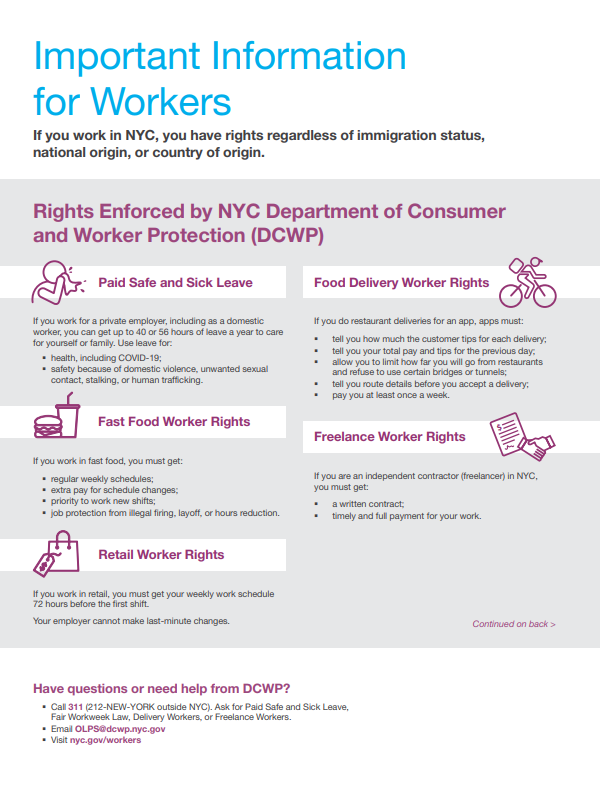
If you work in NYC, you have rights regardless of immigration status, national origin, or country of origin. More information about your rights can be found on MOIA’s Know Your Rights webpage.
Learn about immigrant workers' rights and available resources with this Immigrant Workers factsheet from NYC CHR.
Download this factsheet below:
The Office of Labor Policy & Standards
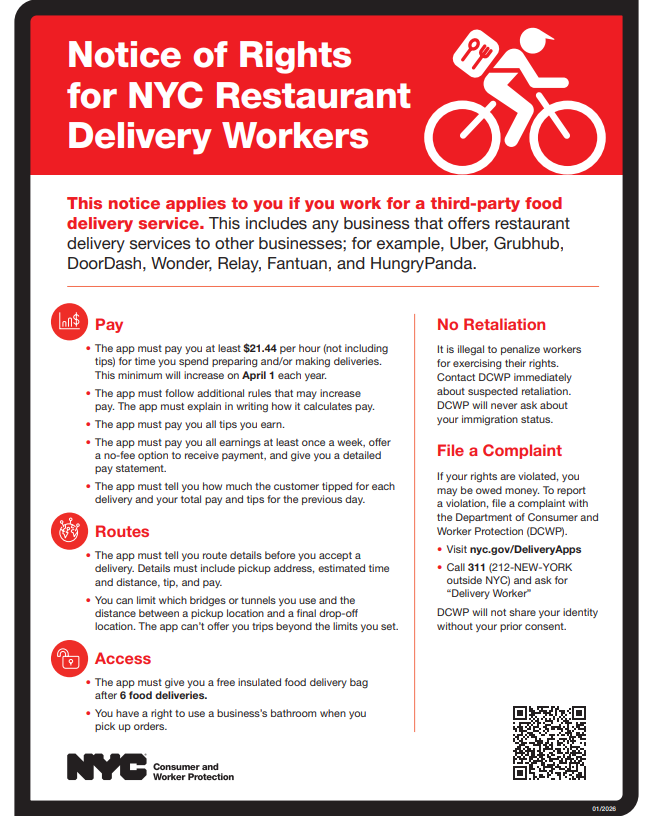
The Department of Consumer and Worker Protection (DCWP) is NYC’s central resource for workers. DCWP protects and promotes labor standards and policies that create fair workplaces to ensure all workers can realize their rights, regardless of immigration status.
- Information regarding workplace protections for specific workers from DCWP include delivery workers (for restaurant, grocery, and other services), paid care workers, temporary construction workers, and others.
For more information your workplace rights or to ask a question, visit nyc.gov/workers.
To File a complaint, visit DCWP | Portal
NYC Human Rights Law
All New Yorkers deserve fairness and respect in the workplace. Employers cannot:
- Pay workers lower wages or no wage because of their immigration status
- Harass or make fun of workers because of their nationality, religious beliefs or attire, accent, or immigration status
- Punish workers for speaking their own language
- Threaten workers about calling the police because of their immigration status
- Refuse to hire someone because of their nationality, religious beliefs, attire or accent
Discrimination
If you are treated differently by an employer because of what country you come from, your immigration status, religious beliefs, or accent, call 311 and say "HUMAN RIGHTS," to report it to the NYC Commission on Human Rights.
It is illegal for an employer to discriminate against you based on your citizenship status, national origin, or other protected ground under the City Human Rights Law. An employer cannot discriminate when:
- Deciding to hire or fire you
- Deciding what to pay you
- Making other work-related decisions (including promotions or discipline).
It is not illegal to refuse to hire you or fire you if you are not allowed to work in this country. However, it is against city and state law for your employer to pay you less than the minimum wage or violate overtime laws because of your immigration status.
An employer cannot pay you less than other workers or treat you differently because of your immigration status. Even if you are undocumented, you are owed equal and humane treatment by your employer.
- Learn more about discrimination and hate crimes
- Learn more about the City Human Rights Law
- Learn more about New York State's laws on minimum wage and overtime
Workers' Compensation
If you get hurt or disabled because of your job, you may be eligible for weekly cash payments and free health care, even if you are paid in cash, paid “off the books”, paid as an independent contractor, or not reported to the government as an employee.
Learn more at the New York State Workers' Compensation Board at (800) 877-1373 or visit the Workers' Compensation Board website.
Workforce1 Career Centers
Immigrants who are allowed to work in this country can get help from some City agencies. Workforce1 Career Centers prepare and connect qualified jobseekers to employment opportunities. Workforce1 Career Centers also connect qualified individuals to occupations training, and provide career services workshops and career advice. Anyone 18 years or older can visit a Workforce1 Career Center. Please note: Valid ID is required to prove your date of birth. Examples include: IDNYC, New York State Driver's License, birth certificate, passport, and more.
Youth Opportunities and Resources
Youth between the ages of 14 and 24 may be able to gain work experience and connect to educational opportunities through the Department of Youth and Community Development (DYCD)'s Summer Youth Employment Program (SYEP).
Youth and Education Resources
In addition, The Office for the Prevention of Hate Crimes works with the New York City Department of Education to develop resources for educators, students, and families on how to prevent hate.
For more information regarding resources please visit The Office for the Prevention of Hate Crimes.