
What you should know
- More than one in three New Yorkers are immigrants, and nearly half of all city residents speak a language other than English at home
- China joins Dominican Republic as the largest foreign-born group in New York City
NEW YORK – Today, Mayor Zohran Kwame Mamdani, Department of City Planning (DCP) Director Sideya Sherman and Mayor’s Office of Immigrant Affairs (MOIA) Commissioner Faiza Ali released the 2026 edition of The Newest New Yorkers, the most comprehensive portrait of the city’s foreign-born residents.
The report, the first update since 2013, is also the first to include an interactive web version, making it easier than ever for New Yorkers to explore population trends and demographic data.
The new report finds that New York City’s immigrant population remains steady at 3.1 million, with new neighborhood hubs emerging across the five boroughs and the city’s foreign-born population continuing to grow more diverse. Immigrants continue to drive New York City’s culture and economy, with foreign-born New Yorkers making up more than one-third of the city’s population and 43% of its workforce. Nearly half of all New Yorkers speak a language other than English at home, and two-thirds of all city residents are first- or second-generation New Yorkers.
“Immigrant New Yorkers are writing the future of this city every day. From the neighborhoods they have built to the small businesses that have opened, from the languages they speak to the communities they sustain, immigrants make New York the city that it is. This report shines a light on how our city is changing and growing and reminds us that our greatest strength has always been the people who come here. As we work to make New York more affordable and more welcoming, we remain committed to ensuring that every New Yorker – no matter where they were born – can build a future here,” said Mayor Mamdani.
“Immigrants are at the heart of New York’s evolution and growth as a city. Across all five boroughs, our city and our neighbors benefit from cultural diversity, small businesses, new languages and cuisines, and more. The Newest New Yorkers is an incredible testament to the communities that are emerging and evolving across the city, and our administration is here to welcome new neighbors no matter their origin,” said Leila Bozorg, Deputy Mayor for Housing and Planning.
“Everywhere you look, every flavor you taste, every song you hear carry through the streets is a reminder that there is no New York City without immigrant New York City. We are proud that the world calls New York City home and will never waver in our commitment to embracing new neighbors and long-time residents alike. This report is yet another reminder that it's not where you're from that makes you a New Yorker – it's where you choose to build a business, a family, and a life,” said Julia Kerson, Deputy Mayor for Operations.
“This detailed report affirms a fundamental fact of life in New York City: immigrant communities are central to who we are and how we grow,” said Sideya Sherman, Director of the Department of City Planning. “The Newest New Yorkers gives rich insight into the remarkable diversity of our city’s immigrant communities, their resilience and evolution across the boroughs, and their essential role in shaping the city’s population and economy. As we celebrate Immigrant Heritage Month, we recommit ourselves to planning for a fairer, more inclusive, and affordable city where all New Yorkers are welcomed, supported, and able to thrive.”
“Our Newest New Yorkers report highlights the essential role immigrant New Yorkers play in shaping the rich diversity of neighborhoods across all five boroughs,” said Mayor’s Office of Immigrant Affairs Commissioner Faiza N. Ali. “The story of New York City is one of immigration, and the contributions of our immigrant communities are woven into the fabric of our daily life. As we celebrate Immigrant Heritage Month, this report underscores the evolving experience of both newly arrived and long-established immigrant New Yorkers and reaffirms our commitment to building a welcoming, safe, and inclusive city where every resident has the opportunity to thrive.”
Queens and Brooklyn continue to have the largest foreign-born populations, though new immigrant enclaves are emerging across the boroughs. Flushing–Murray Hill in Queens remains the neighborhood with the largest immigrant population, followed by Elmhurst and Corona in Queens, East Flatbush and Gravesend in Brooklyn and Washington Heights in Manhattan.
At the same time, foreign-born New Yorkers have settled more broadly across the city over the past decade than in previous years. While some long-established immigrant neighborhoods saw declines in their foreign-born population – including Washington Heights, Manhattan’s Chinatown, Astoria, Sunset Park and East Flatbush – new immigrant hubs have emerged in neighborhoods such as Gravesend and East New York in Brooklyn; Springfield Gardens and St. Albans in Queens; Grasmere and New Springville in Staten Island; and Westchester Square and Bedford Park in the Bronx.
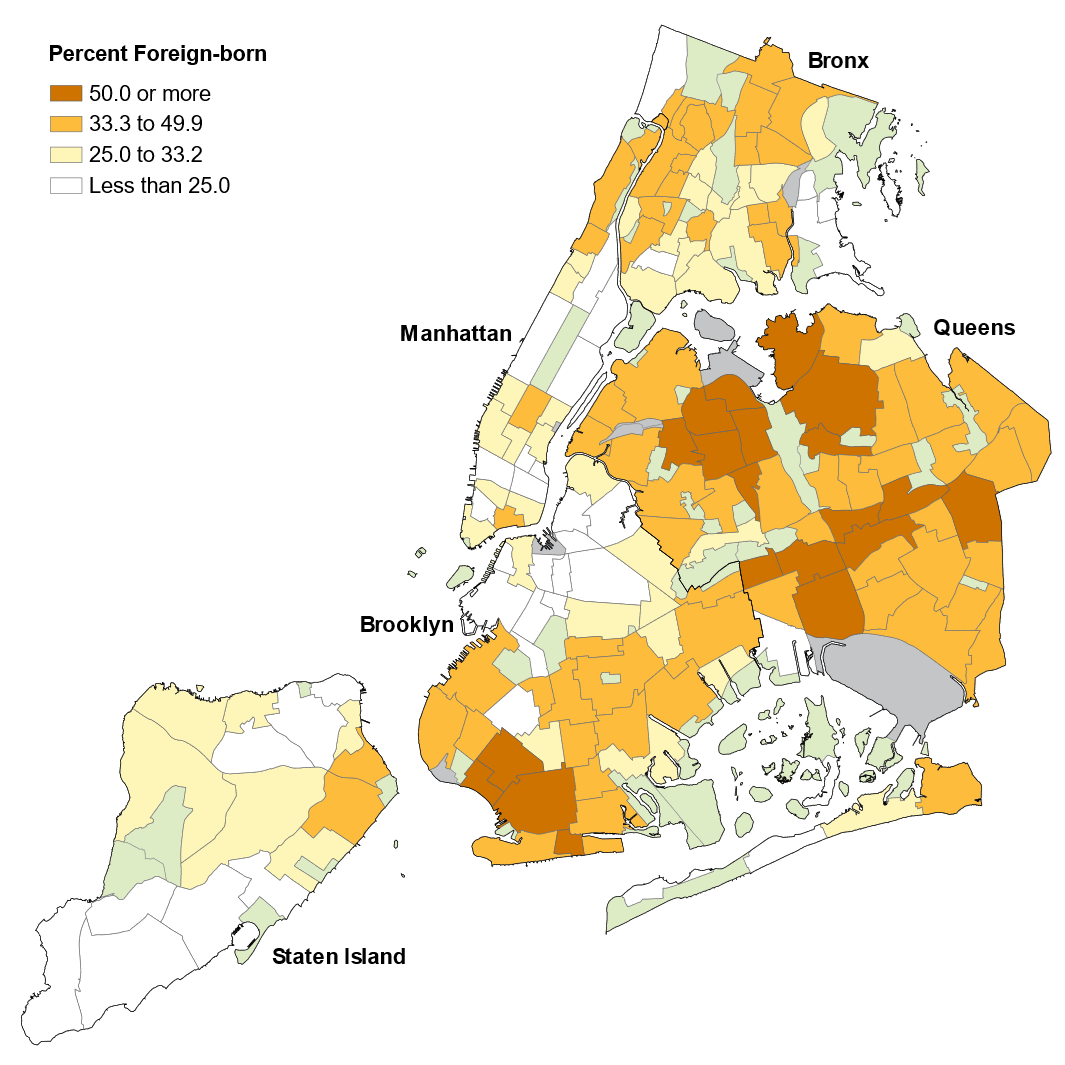
Foreign-born Share of Total Population by Neighborhood, 2019-2023
New York City’s foreign-born population continues to draw from every corner of the globe. After decades as the second-largest foreign-born group, China joined the Dominican Republic as the city’s largest foreign-born population. Jamaica and Mexico followed as the third- and fourth-largest groups.
The 10 largest foreign-born groups also include Bangladesh, which moved up to seventh place, and Colombia and Ukraine, which entered the top 10 for the first time. Other leading countries of origin include Ecuador, Guyana, Haiti, Trinidad and Tobago and India.

The report also examines socioeconomic indicators such as labor force participation and family composition, language diversity, immigration pathways to New York City and migration patterns across the tri-state region. The report draws primarily from the American Community Survey and does not include any personal information or residential addresses.
The full report and interactive tools are available at https://www.nyc.gov/content/planning/pages/our-work/reports/newest-new-yorker. Print copies of the report are available at the CityStore.
###