
What you should know
- “Next Stop: Fast Buses, Better Service” identifies 50 priority corridors for speed improvements, including five next-generation rapid bus routes, saving riders as much as six minutes each ride
- Plan will install shelters and seating at hundreds of bus stops, roll out thousands of new buses, phase in all-door boarding in 2027 and deliver a new, world-class rapid bus route on Flatbush Avenue by 2030
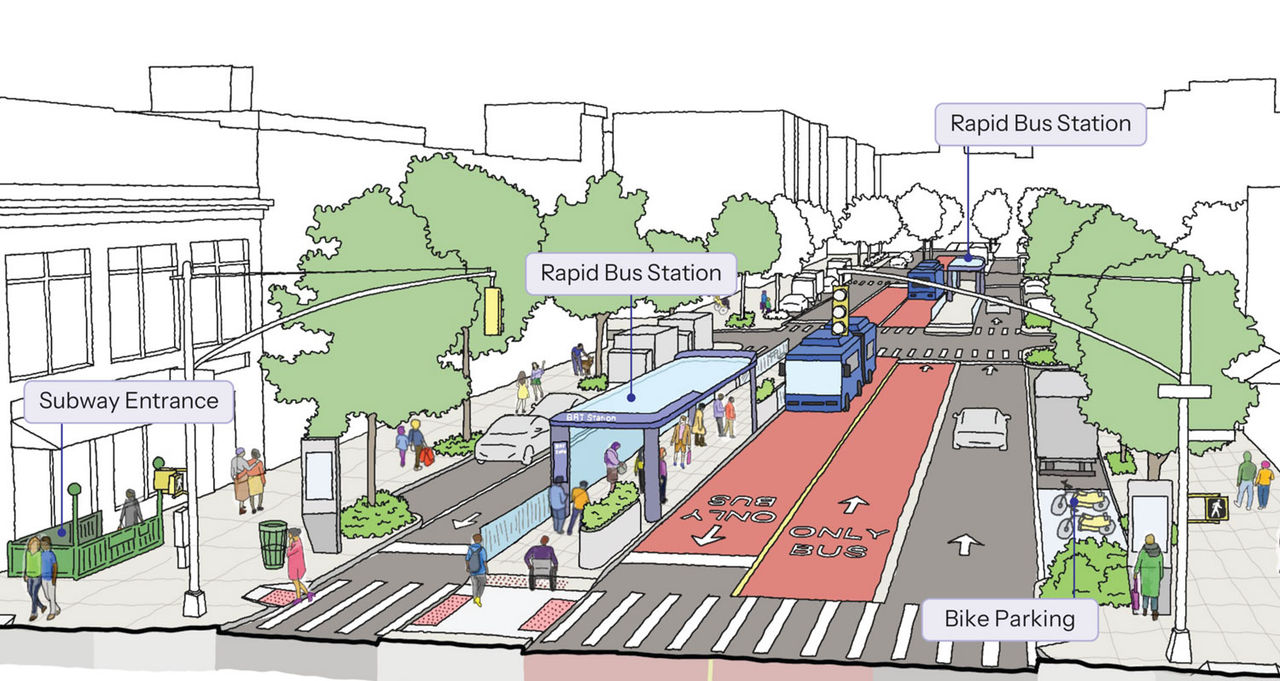
Rendering of a future rapid transit corridor in New York City.
NEW YORK – Mayor Zohran Kwame Mamdani and Governor Kathy Hochul today unveiled Next Stop: Fast Buses, Better Service, a sweeping bus action plan to build the next generation of bus service in New York City.
The plan marks a historic partnership between the New York City Department of Transportation (NYC DOT) and the Metropolitan Transportation Authority (MTA) to transform how New Yorkers experience the city’s buses — with investments that will make service faster, more accessible and more comfortable from curb to destination. The City has committed $254 million in expense funding and $628 million in capital funding over five fiscal years to carry out Next Stop.
Next Stop identifies 50 priority bus corridors for improvements across the five boroughs and launches the City’s next generation of rapid bus service along five key routes. Together, these investments will speed up buses by 20%, shorten commutes by up to six minutes each way, improve reliability, expand accessibility and create a bus system worthy of the city that depends on it.
“For working New Yorkers, every minute matters. But for too long, our buses have been stuck in traffic instead of keeping pace with the city that never sleeps,” said Mayor Mamdani. “When a commute stretches longer than it should, that’s less time with your kids, less time with your loved ones and less time enjoying the greatest city on earth. Together with Governor Hochul, we’re investing in faster, more reliable buses because New Yorkers deserve a transit system that respects their time. This plan will make it easier to get to work, school and home — and build a city that works better for the people who keep it running.”
“Every day, millions of New Yorkers rely on buses to get around this city, but for far too long, making their journeys faster and their lives easier has seemed out of reach. That all changes today,” said Governor Hochul. “New York is in the midst of a transit renaissance, with historic investments being made to improve the lifeblood of our city. Now, working with Mayor Mamdani, we are advancing a bold and ambitious plan to move buses faster, dramatically expand bus priority, reduce delays and make our bus system the envy of the world.”
“For years, we at MTA have wanted more bus lanes, more enforcement of cars and trucks blocking bus lanes. Faster buses. Congestion pricing. But it’s no secret we didn’t have support at the local level,” said Janno Lieber, Chair and CEO of the MTA. “That is not the case anymore. Our partners today — this Governor, this Mayor and this NYC DOT — all want to make sure that riding the bus is always faster than walking. They want to follow through on long overdue commitments to build bus lanes and busways. They will ramp up traffic enforcement to keep streets moving. Buses can only move as fast as traffic allows, so if you are a bus or a bus rider this is terrific news.”
“Next Stop represents a historic partnership to build the fastest, best bus system in our city’s history,” said Deputy Mayor for Operations Julia Kerson. “The plan is designed to deliver for riders, to give time back to our neighbors and to make our bus system easier, more reliable and more comfortable for everyone. It represents a unique spirit of collaboration in which Albany and City Hall do not hesitate to work together to improve working people’s lives. The City has the streets, the State has the buses, and together, we are committed to delivering fast buses and better service for New Yorkers.”
“Too often, New York City’s bus riders have felt like an afterthought. The Mamdani administration is putting the city’s one million daily bus riders front and center through this historic partnership and investment,” said NYC DOT Commissioner Mike Flynn. “Bus service shouldn’t be treated as a second-rate option at the mercy of traffic congestion. It should be a world-class system for a world-class city: fast, comfortable, reliable and convenient enough that every New Yorkers sees the bus as a great way to get around. Next Stop: Fast Buses, Better Service provides the blueprint for transforming our bus system, and we are deeply appreciative of Governor Hochul and the MTA for their strong partnership.”
“The Mayor came in with a mandate for fast and free buses, and today he’s proudly delivering on fast, with a bold plan that will speed up buses for millions of daily riders,” said Elizabeth Adams, Senior Advisor for Fast and Free Buses for Mayor Mamdani. “Thanks to a historic partnership between the MTA and DOT, we are marking a new chapter for bus riders. These improvements will give people real time back in their day for what’s truly needed. The bus is a lifeline for countless New Yorkers and when someone is made late to work, school or to pick up their kids, it can have devastating impacts. Thank you to the advocates and partners who made this plan possible and helped bring this vision forward.”
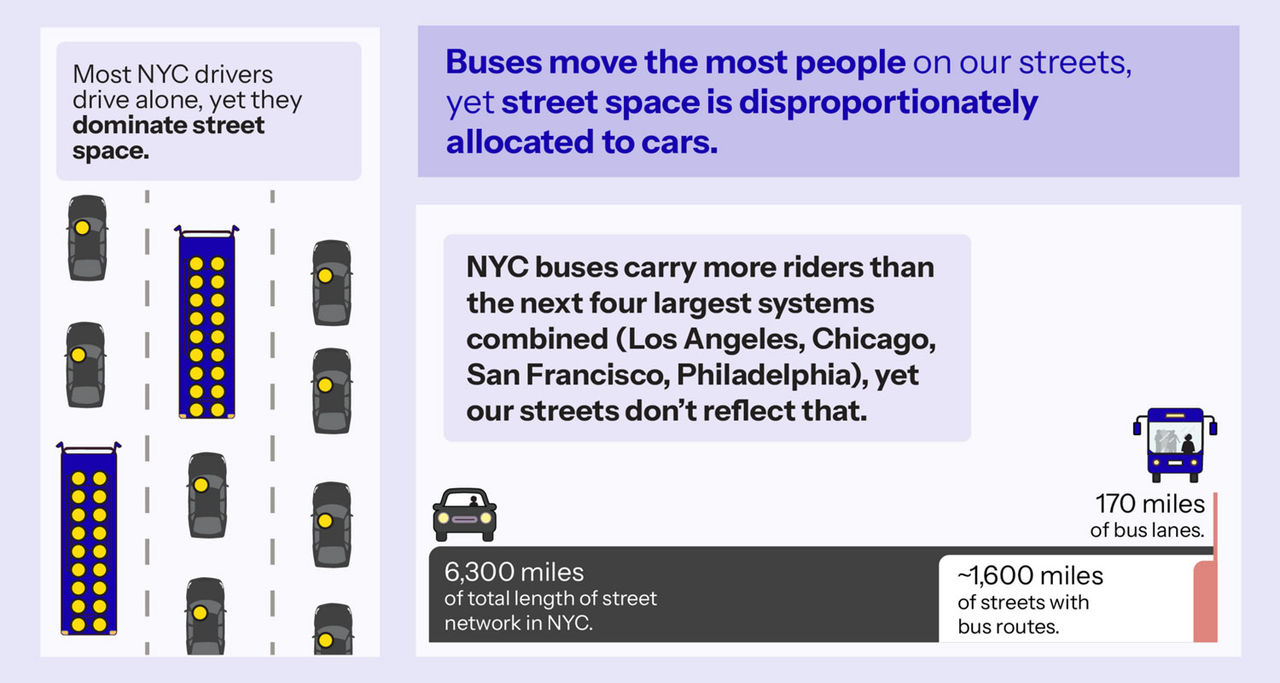
New Yorkers take 2.75 million trips on New York City buses each day, making the system the busiest in the nation — carrying more riders than the bus systems of Los Angeles, Chicago, San Francisco and Philadelphia combined. But New York’s buses remain the slowest of any major U.S. city, averaging just eight miles per hour.
Improving bus service is central to Mayor Mamdani and Governor Hochul’s promise to make New York City more livable for working people. Bus riders are disproportionately working class, women and people of color and are more likely than subway riders or drivers to live in households earning less than $100,000 annually.
Fast Buses and the Next Generation of Rapid Transit
Next Stop: Fast Buses, Better Service identifies 50 priority corridors where NYC DOT and the MTA will target investments to address the city’s slowest and most delay-prone bus routes. Improvements along routes will begin this year.
Five corridors in Brooklyn, Queens and the Bronx have been selected as the first phase of New York City’s next generation of rapid bus routes:
- Tremont/Cross Bronx, the Bronx
- Northern Boulevard, Queens
- Flatbush Avenue, Brooklyn
- Utica Avenue, Brooklyn
- Kensington-JFK, Brooklyn and Queens
These corridors were selected because they connect New Yorkers to jobs, schools, subway service and major destinations while supporting current and future housing and economic growth.
Beginning in 2026, NYC DOT and the MTA will advance these projects with dedicated, protected bus lanes, frequent all-day service, upgraded stations with sheltered waiting areas and public space improvements modeled after the best rapid bus systems around the world.
Reliable Buses
The MTA will work to improve service reliability by ensuring scheduled trips are completed, modernizing depot operations and strengthening bus maintenance.
Through the MTA’s historic $68 billion 2025-2029 Capital Program, fully funded by Governor Hochul and the State Legislature in the FY26 Enacted Budget, the authority will purchase approximately 2,500 new buses, replacing 40% of its aging fleet.
The MTA will also phase in all-door boarding in 2027 with the complete transition to tap and ride, reducing time bus riders are stuck at stops and helping buses move faster throughout the city.
Improving the Rider Experience
The plan recognizes that riders deserve more than a faster trip — they deserve a better one.
To make bus stops safer, more comfortable and more accessible, NYC DOT and the MTA will:
- Expand the bus stop accessibility program to reach 65 stops per year by 2030.
- Install 300 new bus shelters by 2028.
- Add seating at 875 bus stops annually, ensuring every feasible stop has seating by 2035.
- Plant 30 trees at bus stops in 2026 and pilot shelter design improvements for mitigating extreme heat at bus stops.
- Install 90 new Real-Time Passenger Information displays in 2026 and expand to 2,900 displays citywide by 2030.
Keeping Bus Lanes Clear
Keeping buses moving requires keeping bus lanes free of illegal traffic.
Automated Camera Enforcement (ACE) has increased bus speeds by as much as 30% while reducing collisions by 20%.
To build on those gains:
- NYC DOT and the MTA will expand bus-mounted ACE to 25 additional routes each year in 2026 and 2027.
- NYC DOT will install 200 additional stationary bus lane cameras by 2027, an effective program to capture vehicles illegally driving in bus lanes.
- The New York City Police Department (NYPD) will expand targeted bus lane enforcement from 14 to 20 corridors beginning in 2026.
Putting Riders Front and Center
Next Stop: Fast Buses, Better Service also establishes a more robust, rider-centered approach to community engagement.
Working alongside the Mayor’s Office of Mass Engagement (OME) and other City agencies, NYC DOT and the MTA will hold community events, conduct surveys and partner with advocacy organizations and community groups before the projects begin. Public education campaigns will help riders understand upcoming improvements and service upgrades.
To ensure accountability, NYC DOT and the MTA will publicly release performance data within six to 12 months after projects are completed, measuring impacts on travel times, reliability and rider experience while identifying opportunities for further improvements.
“In recent years, then-Assemblymember Mamdani and I worked to deliver the accessible and reliable public transit system New Yorkers deserve through the Fix MTA and Fare Free Bus Pilot Programs,” said New York State Senate Deputy Majority Leader Michael Gianaris. “Today’s announcement will put bus riders in the express lane to improved service. I applaud Governor Hochul and Mayor Mamdani for continuing our work to deliver a better bus system.”
“Every New Yorker deserves a faster, more reliable commute. The Next Stop: Fast Buses, Better Service plan provides a blueprint for improving service, expanding accessibility and keeping our city moving,” said Bronx Borough President Vanessa L. Gibson. “This investment in our bus network will help millions of commuters and demonstrate what is possible when we prioritize efficient, reliable and accessible public transportation. I want to thank Governor Kathy Hochul, Mayor Zohran Mamdani, MTA Chair and CEO Janno Lieber and NYC DOT Commissioner Mike Flynn for their collaboration and leadership in advancing such an ambitious proposal. Together, we are building a bus system that meets the needs of New Yorkers today and for generations to come.”
“Mayor Mamdani and Governor Hochul’s bus action plan will deliver faster, more reliable bus service across the city, returning countless hours to New Yorkers’ lives,” said Brooklyn Borough President Antonio Reynoso. “I am especially happy that Brooklyn will receive three priority rapid bus corridors along Flatbush Ave, Church Ave and Utica Ave — areas that have long been plagued by slow bus service and are each identified as priorities in my 2025 Comprehensive Plan for Brooklyn. This mutual cooperation between the City and the State is essential for delivering results for New Yorkers, and my office looks forward to working with the Mayor and the Governor to ensure the perspectives of Brooklyn riders are incorporated as we pursue these much-needed improvements.”
“More than 800,000 Queens residents ride an MTA bus each day – rivaling the average daily usage of Chicago’s entire mass transit system. For far too long, however, our borough’s working families have rarely received the fast, reliable and efficient service that they have always deserved. At least, until now,” said Queens Borough President Donovan Richards Jr. “From the Queens Bus Network Redesign to the action plan we’re announcing today, we continue to make historic investments in the speed and reliability of our buses. Thank you to Governor Hochul, Mayor Mamdani and all our agencies involved for your partnership in prioritizing these 14 vital corridors in Queens. I look forward to work ahead of finally giving Queens residents that quick and effective bus service they have always deserve.”
“This historic and unprecedented partnership between the City and State has the potential to transform bus service across New York City — including along 12 priority corridors right here in Manhattan," said Manhattan Borough President Brad Hoylman-Sigal. "New Yorkers are far too familiar with watching pedestrians pass them by as their buses crawl through gridlock. The ‘Next Stop: Fast Buses, Better Service’ plan is exactly the kind of bold action Manhattanites need: faster buses, more reliable service and commutes that don’t require the patience of a saint. It also has the potential to dramatically increase ridership by giving New Yorkers the fast, dependable service they deserve. I’m grateful to Governor Hochul, Mayor Mamdani, MTA Chair and CEO Janno Lieber and Commissioner Flynn for forging this partnership and investing in a transit lifeline that 1.3 million New Yorkers rely on every single day.”
“This investment in faster buses and better service across the five boroughs is desperately needed,” said Council Member Tiffany Cabán. “Working class New Yorkers rely on our buses to get to work, to see loved ones and to access services. But when they wait at bus stops, they’re too often encounter buses that are late, slow or don’t show up at all. I’m glad to see that we’re delivering on fast, better buses to serve New Yorkers.”
“This historic partnership between Mayor Zohran Mamdani and Governor Kathy Hochul represents the kind of bold investment New Yorkers deserve,” said Council Member Rita Joseph. “For far too many working families, students, seniors and people with disabilities, buses are not a last resort they are a lifeline. A faster, more reliable, and more accessible bus system means shorter commutes, greater economic opportunity and a stronger, more equitable city. As Chair of the New York City Council Committee on Higher Education, I know that reliable transit is essential to student success. Whether it’s a CUNY student getting to class, a parent commuting to work or a senior traveling to a doctor’s appointment, every New Yorker deserves a bus system that works for them. I applaud Mayor Mamdani and Governor Hochul for advancing this historic vision, and I look forward to working with partners in government to ensure these investments reach every neighborhood and every rider.”
“For hundreds of thousands of New Yorkers, including myself, bus service is the primary way we get to work, school, medical appointments and other locations around the city. Investing in faster, more reliable and more accessible bus service is a commitment to equity, quality of life and the economic vitality of our neighborhoods,” said Council Member Lynn Schulman. “I applaud Mayor Mamdani, Governor Hochul, the MTA and the Department of Transportation for coming together to advance this ambitious vision for the future of our bus system. I look forward to working closely with the MTA, NYC DOT and both the Mayor’s and Governor’s office to ensure the communities in my district are able to experience these improvements. By delivering a better, faster and more dependable bus system, all New Yorkers will benefit.”
"As someone who has lived in and represented a transit desert, I know slow and infrequent bus service does not just cost riders time. It can cost families access to jobs, higher-paying jobs, education, medical appointments and hours they never get back,” said Council Member Amanda Farías. “This plan reflects years of advocacy for more frequent and reliable transit service, work that Mayor Mamdani and I have both been advancing since his time in the State Legislature. I am proud to join the Mayor, Governor Hochul, NYC DOT and the MTA in supporting a plan that moves us closer to delivering on that promise. Faster, more frequent buses are an investment in working families, our local economy and the quality of life of every New Yorker who depends on public transit.”
"Every New Yorker deserves fast, reliable and accessible public transit," said Council Member Shahana Hanif. "In my district, thousands of residents depend on buses every day to get to work, school, healthcare and connect to the subway. By investing in faster, more reliable and more accessible bus service, this plan will make a meaningful difference in people's daily lives while moving our city toward a more equitable and sustainable transportation system. I look forward to working with the City and MTA to ensure these improvements reach the communities that need them most."
“Bus riders across New York organized and won a visionary plan for fast buses and the chance to win back hours of our lives,” said Betsy Plum, Executive Director of Riders Alliance. “By reigniting a real partnership between NYC DOT and the MTA, Mayor Mamdani and Governor Hochul are creating a historic opportunity to make buses dramatically faster and more reliable for the New Yorkers who depend on them every day. Slow buses are not just an inconvenience. They are a barrier to opportunity, a drain on family time and a daily indignity for the New Yorkers who rely on them to reach work, school, childcare, healthcare and other basic needs and opportunities. Getting buses right means getting the basics of city life right. Riders built the power that made this moment possible, and we’ll keep organizing until these promises become real improvements in every borough.”
“The new bus plan from Mayor Mamdani and Governor Hochul sets the bar high — and rightfully so, with the commutes of more than two million riders at stake,” said Ben Furnas, Executive Director at Transportation Alternatives. “Reaching these bold goals along 50 priority corridors is going to take hard work coordinated by both the City and the State, and this plan is a comprehensive vision for how we get there. We’re particularly excited by the focus on Central Brooklyn routes, by citywide all-door boarding and by the commitment to providing seating, shade and shelter universally at every feasible bus stop across our city, so riders will no longer have to stand in the sweltering heat or freezing cold while they wait — and soon, they'll be waiting a lot less!”
“Regional Plan Association congratulates the Governor, the Mayor and the New York City Department of Transportation for advancing this plan to make bus service faster, more frequent and more reliable,” said Kate Slevin, Executive Vice President of Regional Plan Association. “These improvements are long overdue and can’t come soon enough for New Yorkers who depend on buses every day. Faster, more efficient bus service is essential to building a more sustainable, equitable and economically competitive city.”
“For too long, bus riders have endured unbearably slow, unreliable trips, due in part to politics, but that’s about to change,” said Lisa Daglian, Executive Director of the Permanent Citizens Advisory Committee to the MTA (PCAC). “Concrete investments that put bus riders front and center — including bus priority corridors and all-door boarding — will speed up their rides so they can finally move faster than a chicken. We applaud the extraordinary partnership and political will shown by the Governor, Mayor, MTA, DOT and enforcement agencies, which will make a difference in the lives of millions of New York riders.”
“The Center for Independence of the Disabled, New York (CIDNY) supports equitable bus expansion that allows for people with disabilities, seniors and all riders to benefit from experiencing accessible, safe and time-efficient service to and from their destinations,” said Sharon McLennon Wier, Ph.D., MSEd., CRC, LMHC, Executive Director of CIDNY. “The proposed faster bus design in Brooklyn targets neighborhoods where numerous people with disabilities, seniors and riders who use baby strollers and grocery carts. These riders must have a way to onboard and deboard these buses safely. Fast bus service cannot take for granted safe and accessible transit for all.”
“New Yorkers deserve a transit system that keeps pace with how they live, work and age,” said Beth Finkel, State Director of AARP New York. “Improvements that make buses faster, more reliable and more accessible are especially important for older adults and others who depend on public transportation every day. AARP New York welcomes this commitment to strengthening bus service and helping people remain active, connected and independent in their communities.”
“Public transit is one of the most effective ways to reduce emissions while lowering the cost of living and expanding economic opportunity for all New Yorkers,” said Alia Soomro, Deputy Director for NYC Policy at New York League of Conservation Voters. “By investing in faster, more reliable bus service, New York is making it easier for millions of people to choose mass transit over driving, which will reduce congestion and improve air quality in communities across the five boroughs. NYLCV applauds Mayor Mamdani, Governor Hochul and Commissioner Flynn for launching this ambitious plan and looks forward to seeing these improvements delivered for riders.”
“With Next Stop: Fast Buses, Better Service, we at People-Oriented Cities are thrilled that NYC DOT and MTA are committed to truly moving the needle on bus speeds and reliability,” said Walter Hook, Executive Director of People-Oriented Cities. “We look forward to partnering with both agencies to help ensure that buses are meeting the ambitious targets set forth in this report and that the five Rapid Bus corridors reach the level of true, world-class Bus Rapid Transit.”
###