
What you should know
- Investment Launches Brooklyn’s First-Ever Bluebelt to Reduce Stormwater Flooding and Protect Surrounding Ditmas Park, Kensington, Prospect Park South, and Windsor Terrace Communities Against Extreme Weather Due to Climate Change
- Builds on Adams Administration’s Environmental Resiliency Work, Including
$146 Million Plan for Flooding Prevention at Jewel Streets in East New York
NEW YORK – New York City Mayor Eric Adams, New York City Department of Environmental Protection (DEP) Commissioner Rohit T. Aggarwala, New York City Department of Parks & Recreation (NYC Parks) Commissioner Iris Rodriguez-Rosa, and the Prospect Park Alliance (PPA) today announced the city’s plan to protect Brooklyn from flash flooding caused by climate change. The Adams administration has allocated $68 million to build Brooklyn’s first Bluebelt in Prospect Park and continue to restore the park’s lakeshore. The Bluebelt will use nature-based solutions — enhancing the park’s lake and wetlands — to manage intense rainfall. With up to $50 million allocated from DEP for the Bluebelt, this investment complements PPA’s ongoing $20 million lakeshore restoration plan. These actions will help protect Prospect Park, the Prospect Park Zoo, and surrounding neighborhoods against extreme weather events.
“Today’s announcement marks a major step forward in protecting Brooklyn from the growing threat of climate-driven flash flooding,” said Mayor Adams. “By investing up to $68 million to create Brooklyn’s first-ever Bluebelt at the iconic Prospect Park, we’re harnessing the power of nature-based solutions to strengthen the park’s lake and wetlands, and better manage intense rainfall. Working hand-in-hand with the Prospect Park Alliance, this project will safeguard Prospect Park, the Prospect Park Zoo, and the surrounding communities for generations to come. We are proud to make this investment in resilience, sustainability, and the future of Brooklyn.”
“By using Prospect Park to manage stormwater, we’re turning one of Brooklyn’s most cherished public spaces into a powerful tool for climate resilience,” said DEP Commissioner Aggarwala. “This project brings Brooklyn its first Bluebelt and demonstrates how restoring and enhancing the park’s natural drainage not only preserves its scenic waterways but also protects the surrounding neighborhood. Thanks to the partnership with NYC Parks and the Prospect Park Alliance, we are able to implement creative solutions that will benefit both the park and the community.”
“Our public parks are more than just beautiful places to take in the scenery — they are also natural infrastructure making our city more resilient. With this investment, we’re helping protect Prospect Park and the surrounding neighborhoods from flooding, which is critical as climate change leads to more extreme weather events,” said NYC Parks Commissioner Rodriguez-Rosa. “We look forward to working with our partners to bring an inventive Bluebelt system to Prospect Park, complementing the ongoing Lakeshore improvement project, and making ‘Brooklyn’s Backyard’ an integral part of New York City’s sustainable future.”
“Prospect Park plays an essential role in the health and well-being of our community, and through this Bluebelt initiative, it will play an even more important role in protecting our community from severe storms and flooding,” said Morgan Monaco, president, PPA. “This project demonstrates the importance of our city parks and green spaces as a first line of defense against climate change and supports the work we are accomplishing through our Lakeshore restoration, which will greatly enhance Brooklyn's only lake for the benefit of all our visitors.”
The Adams administration’s investment comes after a year-long study by DEP of flooding in the surrounding Brooklyn communities and how stormwater moves through Prospect Park during heavy rain. Together with NYC Parks and the PPA, the nonprofit that operates the park in partnership with the city, DEP studied the park’s landscape and water systems to find ways to improve drainage. The study found that during intense storms, rainwater often rushes over the ground instead of flowing into the park’s 60-acre lake, leading to flash flooding. The 150-year-old lake also has limited capacity, which can cause it to overflow and strain the sewer system.
To address this, DEP is working with NYC Parks and PPA to enhance many original landscape design features, along with adding new ones to adapt for climate change. The improvements will include:
- Lowering Lake Levels Faster: Upgrading the lake’s drainage infrastructure to lower water levels in less than 36 hours, instead of three weeks — giving the park more capacity to handle large storms.
- Using Rain Gardens and a New Pond to Capture West Drive Floodwaters: A new pond and a continuous stretch of planted rain gardens along West Drive will slow and filter rainwater and ultimately drain to the lake after a storm, instead of flooding homes and streets to the south.
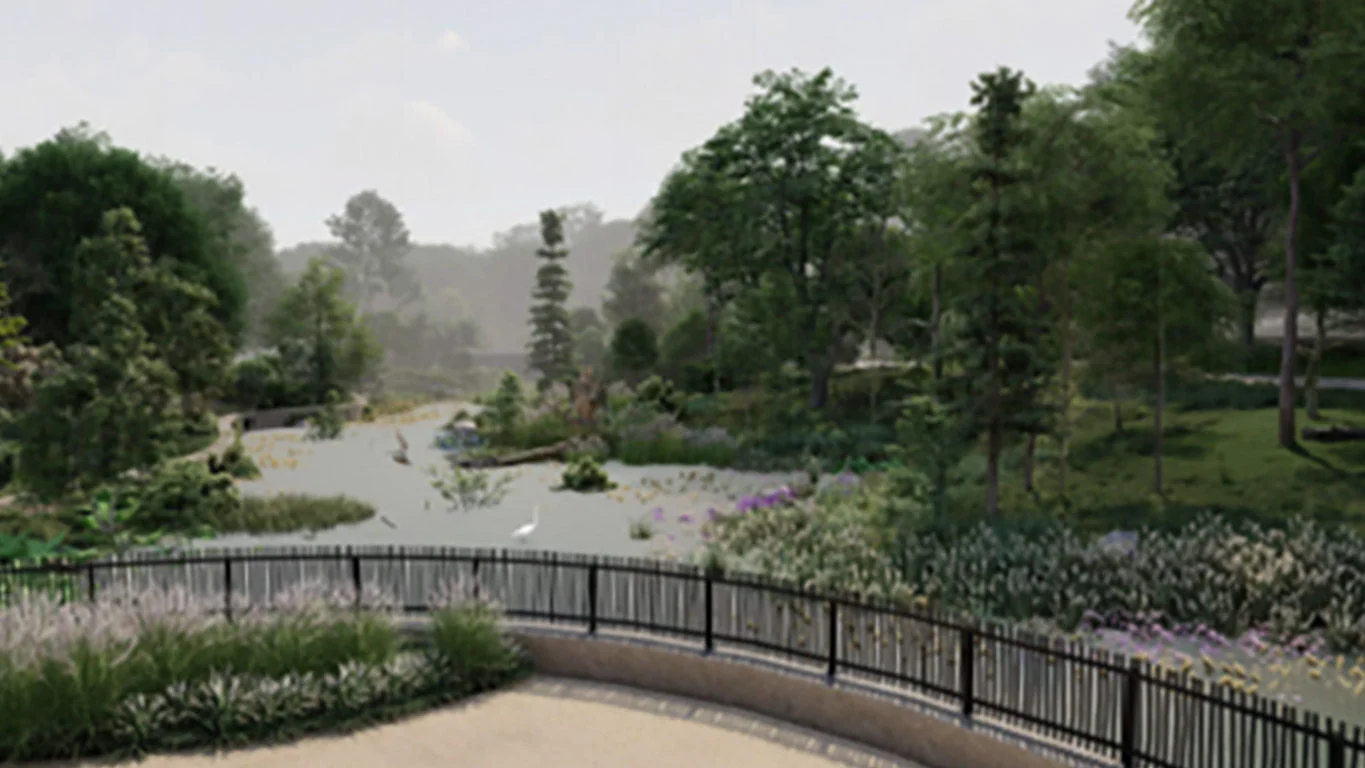
- Reducing Flooding on Flatbush Avenue and Helping Protect the Zoo with a Restored Pond: A new pond north of the zoo, in the location of a historic pond that was later filled in, will collect rainwater off of Flatbush Avenue and help protect the zoo from future flash flooding events like the one that forced it to close after the record-breaking storm in September 2023.

Map of Prospect Park Bluebelt interventions.
DEP first pioneered the Bluebelt system in Staten Island, where it has proven successful at reducing flooding while also creating open green space communities and wildlife habitat. NYC Parks collaborates with DEP on Bluebelt designs in parks to integrate nature-based flood management that improves long-term resiliency and provides ecological, educational, and recreational benefits. Now, Brooklyn will benefit from the same approach. DEP has kicked off the design process with construction anticipated to start in 2029 and be completed in 2032.

Conceptual rendering of restored pond that will drain Flatbush Avenue and help protect the zoo from flash flooding.
Lakeshore Restoration Plan
The project complements Lakeshore — the current restoration of the shoreline of the lake — which the PPA is undertaking through $20 million in funding, including $18 million from Mayor Adams and $2 million from the New York City Council. This project will reconstruct the shoreline of Brooklyn’s only lake to improve its environmental resiliency and enhance the visitor experience. The reconstructed shoreline will closely follow the historic design by park creators Frederick Law Olmsted and Calvert Vaux, and includes new lighting, seating, and viewing areas, as well as green infrastructure for stormwater management, newly landscaped areas to enhance wildlife habitat, and improved ADA access to this important park destination. The project is an extension of the award-winning Lakeside restoration from 2010, which includes the Shelby White and Leon Levy Esplanade with walkways and picnic areas featuring newly placed boulders, native trees, shrubs, and aquatic plants. Additionally, five acres of the lake were excavated to recreate Baier Music Island, which serves as a wildlife habitat.


Lakeshore waterfront restoration master plan and rendering.
About the Bluebelt System
Originally implemented by DEP on Staten Island, the Bluebelt program preserves natural drainage corridors, including streams, ponds, and wetlands, and revitalizes and enhances them to optimize their functions of conveying, storing, and filtering stormwater. Bluebelts have proven to be an excellent mechanism for reducing urban flooding, while creating a rich, natural environment for the local community. As New York City prepares for rising sea levels and heavier rains due to climate change, Bluebelts offer a natural and effective solution for stable and sound stormwater management. As detailed in PlaNYC: Getting Sustainability Done, DEP is working to expand the Bluebelt system where feasible across the five boroughs. The agency currently manages 545 acres of Bluebelts and natural areas in the Bronx, Queens, and on Staten Island.
This announcement follows the Adams administration’s previous investment in combatting flooding in the Jewel Streets neighborhood in East New York, Brooklyn. The $146-million investment is addressing chronic flooding in the neighborhood and installing drainage infrastructure, such as storm sewers and catch basins, at four intersections in the north and south Jewel Streets. These investments have dramatically improved conditions, as the amount of time it takes water to drain at those intersections has plummeted from 60 days to just two days.
“With climate-change fueled superstorms becoming a regular occurrence we must invest in greater resilience now,” said New York State Assemblymember Robert Carroll. “I applaud DEP’s multi-pronged effort to mitigate flooding from the park. I know that many of my constituents will benefit tremendously.”
“Prospect Park is one of the most important green spaces for my district of Crown Heights, Prospect Lefferts Gardens, and Flatbush, and as flooding becomes a more prevalent issue for our neighborhoods, I am encouraged to see this investment in nature-based solutions that protect our communities from rising flood risks,” said New York State Assemblymember Brian Cunningham. “I appreciate the work of DEP, NYC Parks, and the Prospect Park Alliance for driving this plan forward. When we care for the park’s landscape and water systems, we safeguard the homes, streets, families, and vital small businesses surrounding it.”
“Brooklyn deserves a climate infrastructure that is as resilient and forward-thinking as the communities it protects,” said New York City Councilmember Shahana Hanif. “This investment in Prospect Park’s first-ever Bluebelt is a transformational step toward safeguarding Kensington, Prospect Park South, and Windsor Terrace from the devastating flash floods we’ve seen in recent years. By embracing nature-based solutions and restoring the heart of our borough’s most cherished green space, we’re not only preparing for extreme weather, we’re honoring our responsibility to build a greener, more climate-just future for every Brooklynite.”
“Building Brooklyn’s first-ever Bluebelt right here in Prospect Park embraces smart, nature-based solutions that will strengthen our resilience and protect our neighborhoods, from Ditmas Park and Kensington to Prospect Park South and Windsor Terrace,” said New York City Councilmember Rita Joseph. “This $50-million investment, paired with the $20 million lakeshore restoration efforts, represents a commitment to modernizing how we manage stormwater. As a staunch advocate for infrastructure investments that prioritize environmental justice, I am proud to see our city taking bold, forward-thinking action to meet the challenges of climate change head-on.”
“This is a culmination of over a decade of advocacy from Community Board 14 to the Department of Parks and Recreation, to the Department of Environmental Protection and to an array of local elected officials,” said Karl-Henry Cesar, chair, Brooklyn Community Board 14. “This is an exciting plan that promises ecological, environmental, and aesthetic improvements in Prospect Park while simultaneously resolving the long-endured flooding issues affecting our residents, businesses, and other public assets. We are gratified and enthusiastic and are standing by to offer the continued support of CB14.”
###