
 Department of Design and Construction311Search all NYC.gov websites


Joint Bidding in NYC
Upgrading New York City’s infrastructure is an urgent task – one that requires coordinating with the private utility companies whose lines share space beneath the street. In New York City, private utility companies are permitted to locate their lines in the city’s right-of-way but must move and protect those lines to facilitate the City’s work, at their own expense. In practice, this work is often completed by the City’s contractors and reimbursed by the utility companies since only one contractor can hold open street permits at a time.
To streamline coordination and enhance transparency and oversight, the New York State Legislature passed the first Joint Bidding law in 2004 to allow the City to bid public and private utility work under a single contract. The current authorization sunsets in 2026 and must be reauthorized for effective delivery of essential public infrastructure in NYC.
Benefits of Joint Bidding
Utilities and public infrastructure are co-located beneath city streets
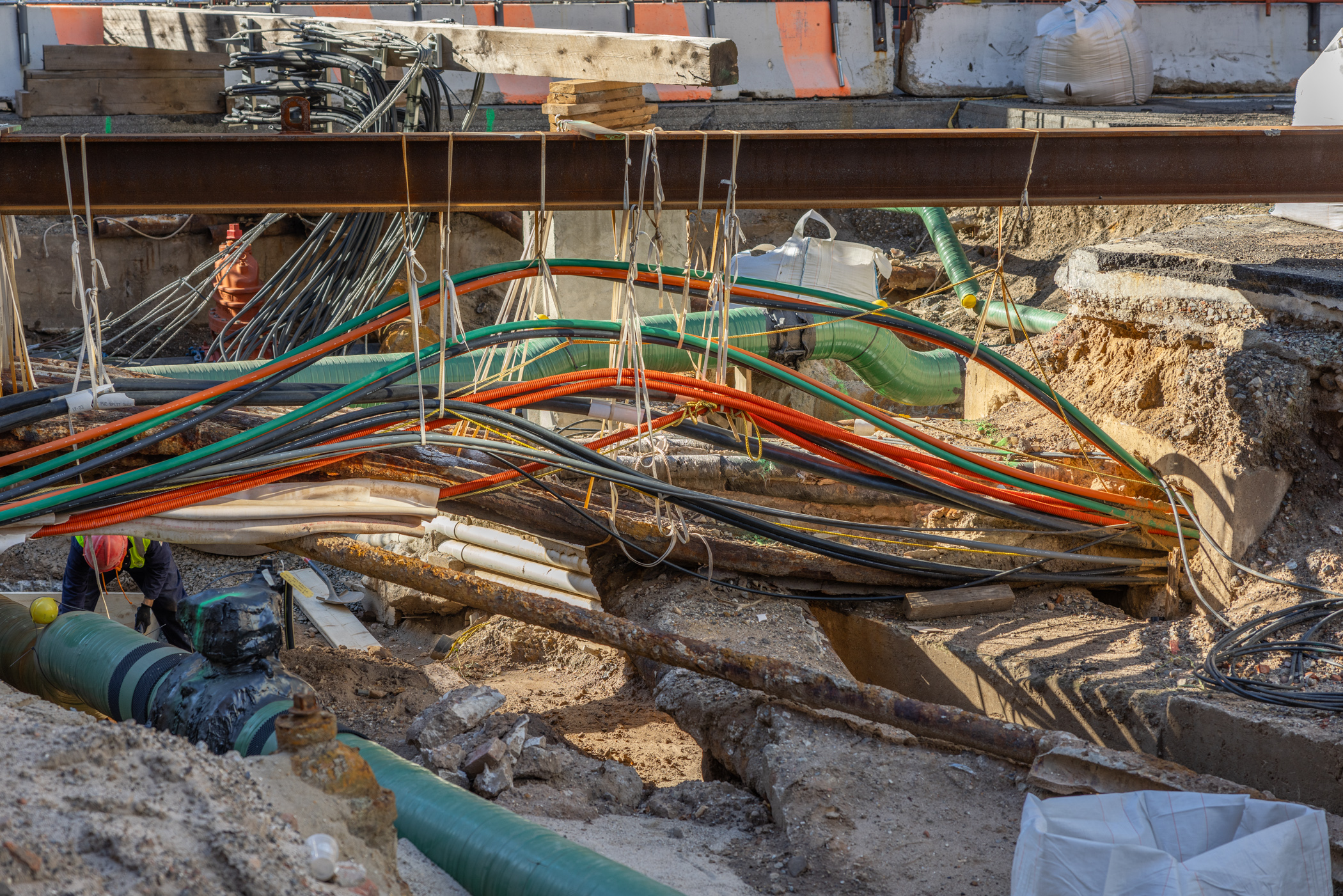
Over 6,000 miles of streets and highways connect New York City’s neighborhoods while carrying the vital infrastructure that provides essential services to 8.5 million New Yorkers. The city’s watermains and sewers share space beneath the roadway with private utility lines like gas, electric, and telecommunications. Built and replaced over decades, City and private utility lines crisscross one another beneath the street, their precise locations often unknown. This complex environment is often known as the “underground spaghetti.”
Coordination between contractors and private utilities can get messy
Before Joint Bidding, under a model called Section U (referring to a section of DDC’s construction contracts), the City’s contractor had to open the street and negotiate directly with the separate utility companies for the cost to move and protect the private lines. This model was time-consuming, with streets sitting open and neighborhoods disrupted while contractors coordinated the utility work during the construction phase and conducted private, closed-door negotiations. The City’s public works projects remained stalled for months and sometimes years, draining taxpayer dollars and impacting communities.
Joint Bidding speeds the process and saves years on projects
The City addressed the problem of lengthy delays by bidding the public work and utility interference work in a single contract, a practice known as Joint Bidding. The private utility companies would continue to pay for the work to protect their lines, but the City would now be able to coordinate and set the terms by including this work in its contracts. By taking individual utility-contractor negotiations out of the equation, the result is a fair, transparent, and consistent process that speeds construction of critical infrastructure.
Joint Bidding works for our partners
From 2024-2025, DDC led an in-depth working group with contractors and private utility companies with the goal of overhauling the Joint Bidding program to address concerns from earlier implementation approaches. Now in its sixth iteration, called Joint Bidding Open Competitive or “JB-OC,” the process includes open competitive bidding for both City and Utility work, where the low bid is determined by the total combined cost. JB-OC includes detailed requirements for utility pre-engineering and lays out detailed processes, roles, and responsibilities for coordination during design and construction. DDC continues to meet regularly with the working group to assess the JB program and approach, and address challenges as they arise.
Joint Bidding Increases Competition and Lowers Costs to Taxpayers
DDC’s 2024 Utility Coordination Report, the first comprehensive analysis in the twenty-year history of the program, found that Joint Bidding saves the City over $107 million per year. While many public infrastructure projects are subject to some level of delay, the average utility-related delay for Section U projects was found to exceed the average recorded for Joint Bidding projects by nearly 300%. Since overhead costs average $200K/month, utility-driven delays on Section U projects cost the City an average of an additional $5.8 million per project, whereas the same delays on Joint Bidding projects added an average of $1.5 million. Further, utility companies share in the cost of project overhead on Joint Bidding projects.
Joint Bidding Helps Small and M/WBE Firms Compete for Contracts
By eliminating closed-door, private negotiations, Joint Bidding levels the playing field and allows smaller firms and M/WBEs to compete and win contracts. Bids are fair, prices are transparent, and projects move faster—allowing contractors and their teams to get the job done and compete for more work.
Authorized by state law since 2004, Joint Bidding must be reauthorized in 2026 for the City to continue using this essential tool.
Read more about Joint Bidding
- December 2025: NYC DDC Utility Coordination Report
- September 2024: NYC DDC Utility Coordination Report
- 2024 Legislation: Reauthorize Joint Bidding
- 2024 Legislation: Joint Bidding Fact Sheet
- 2024 Legislation: Joint Bidding Coalition Letter to State Leaders
- 2023 Court case affirms that Joint Bidding is legal: NY Supreme Court - Joint Bidding
- 2024 Appeal to NYS highest court denied: NYS Court of Appeals
- What's new with Joint Bidding: Joint Bidding 2024 Update
- Joint Bidding Data: 2024 Bid Data Analysis