
 Housing Preservation & Development311Search all NYC.gov websites


Lead-Based Paint

Lead-Based Paint
Lead is a harmful metal that is often found in old paint that can poison people, especially children, when it is ingested. In young children, lead can cause irreversible behavioral and learning problems. Although there are other sources of lead poisoning, lead is often found in paint (it was used to make the paint stronger) used in apartments and residential buildings in New York City built before 1960. When damaged, wet or scraped, old paint turns into dust or chips on the floor. Young children can get dust or paint chip flakes onto their hands, and it can go straight into their mouths. This can lead to young children getting lead into their bodies. Refer to Lead Poisoning: Information for Tenants - NYC Health for more information on lead poisoning.
For a general overview of what landlords must do and what every tenant should know about lead-based paint, download the Lead Paint Hazards in the Home (Peligros de la Pintura con Plomo en el Hogar) pamphlet.
Owner Information
Click a topic, or press the enter key on a topic, to reveal its answer.
Does Local Law 1 Apply to My Building?
Local Law 1 of 2004 requires owners of buildings built before 1960 (or built between January 1, 1960, and January 1,1978, if the owner knows there is lead-based paint) to presume that the paint is lead-based paint, identify and address lead-based paint hazards, particularly in buildings with children under the age of six years old routinely spending 10 or more hours per week (“residing”) in a dwelling unit. The requirement for paint testing applies to these same buildings regardless of whether a child under six currently resides in the building.
- Multiple dwelling buildings (3 or more residential units) built before 1960
- Multiple dwelling buildings built between January 1, 1960, and January 1,1978, if the owner knows there is lead-based paint
- Tenant occupied units in private dwellings (1-2 residential units) built prior to 1960
- Coop/Condos dwelling units not being occupied by the owner or a family member of the owner.
- If a dwelling unit is occupied by a tenant rather than the unit owner, the Annual Notice requirements of Local Law 1 apply, and, if a child under six is determined to reside in the dwelling unit, Local Law 1 requires an annual inspection be performed for common areas and the dwelling unit. Owners who are leasing out their unit should discuss these requirements with their cooperative or condo board and management company to determine the process for the annual notice, inspection, and any repair work that might be necessary. Any repair work must be performed by certified workers using safe work practices pursuant to Local Law 1 of 2004. Owners and management should document all communications and must retain all records of the inspections, and any remediation performed for at least 10 years.
What Is A Lead-Based Paint Hazard?
A lead-based paint hazard exists when there is peeling or disturbed paint on a surface in a building built before 1960 in an apartment where a child under six routinely spends 10 or more hours per week (“residing”) in a dwelling unit unless the surfaces have all been tested and there is less than 0.5 mg/cms2 of lead in the paint. Lead-based paint hazards include:
- Dust from paint, including dust created when doors and windows stick or rub together
- Peeling or damaged paint
- Painted surfaces, such as windowsills, that have been chewed on by children
As a result of the annual notice investigation, anytime the tenant reports a peeling paint condition, or as a result of a violation issued by HPD or DOHMH, a landlord is responsible for properly repairing the lead-based paint hazard. If the landlord does not fix peeling paint or if the work is not being done safely (creating dust that is not contained), the tenant can file a complaint online or call 311.
Required Audit Compliance Documents and Record-keeping
Property owners must maintain specific records to demonstrate compliance with lead-based paint requirements. HPD audits lead-based paint related records to determine a property owner’s compliance with Local Law 1 of 2004, selecting buildings through HPD’s Building Lead Index. HPD also demands these records from owners who have been issued a Commissioner’s Order to Abate (COTA) which DOHMH issues when there is a child with an elevated blood lead level in an apartment where DOHMH has found lead-based paint hazards. In both cases HPD will issue a Record Production Order.
For more details on what documents are expected to be maintained and produced as a result of an audit visit our Required Audit Compliance and Record-Keeping page.
Lead-based Paint Hazard Violations and How to Resolve Them
When HPD identifies a lead-based paint hazard or a property owner fails to comply with local law rules, violations may be issued. These violations carry strict correction requirements and timelines. If property owners fail to act timely, HPD is mandated to attempt to complete the emergency repair. Emergency repairs are billed to the property through the Department of Finance.
View Lead-based Paint Violations – How to Correct and Certify Corrections for detailed information on lead-based paint hazard violations, and how to correct and certify them
What Is A Lead-Based Paint Hazard?
A lead-based paint hazard exists when there is peeling or disturbed paint on a surface in a building built before 1960 in an apartment where a child under six routinely spends 10 or more hours per week (“residing”) in a dwelling unit unless the surfaces have all been tested and there is less than 0.5 mg/cms2 of lead in the paint. Lead-based paint hazards include:
- Dust from paint, including dust created when doors and windows stick or rub together
- Peeling or damaged paint
- Painted surfaces, such as windowsills, that have been chewed on by children
As a result of the annual notice investigation, anytime the tenant reports a peeling paint condition, or as a result of a violation issued by HPD or DOHMH, a landlord is responsible for properly repairing the lead-based paint hazard. If the landlord does not fix peeling paint or if the work is not being done safely (creating dust that is not contained), the tenant can file a complaint online or call 311.
Owner Information
Because of the danger posed by lead-based paint, property owners of buildings built before 1960 (or built between January 1, 1960, and January 1,1978, if the owner knows there is lead-based paint) must presume that any paint in the building is lead-based paint UNLESS
- the paint has tested negative for lead by a lead inspector certified by the Federal Environmental Protection Agency and
- the owner has been granted an exemption by HPD based on the results of that testing and any subsequent abatement work.
By August 2025, property owners were required to test all painted surfaces one time for lead in apartments and common areas of a building built prior to 1960. This requirement must also be met if the rental building was built between 1960 and 1978 in cases where owner has actual knowledge of lead-based paint. Visit Paint Testing Requirements, and Exemptions for more information on this requirement.
If there is lead-based paint or the paint has not been tested (and so under the law it is presumed to have lead), the property owner must:
- Monitor painted surfaces and repair the paint properly if it is peeling in apartments with children under six and in common areas of the building.
- This monitoring includes a process of annual notices and investigations.
- Repairs must be done following federal and city regulations, including hiring certified firms/workers who follow prescribed safework practices, more details can be found by viewing our Safework Practices page. These requirements differ depending on whether:
- Remove lead-based paint from doors and windows (as well as make other repairs as described below) when:
- apartments become vacant or
- a child under the age of six comes to reside or routinely spends 10 or more hours per week
- Maintain records related to all of the above activities for at least 10 years.
Guidance on Turnover and units with children under six years old can be found by visiting our Required Correction at Turnover and in Child-Under-6 Units page.
Penalties may be significant for failing to conduct any of the above activities or keeping records about that compliance.
Tenant Information
Click a topic, or press the enter key on a topic, to reveal its answer.
Lead Poisoning and Lead-based Paint Safety
Although paint is the most common source of lead poisoning, you can learn more about other sources of lead exposure and lead poisoning by visiting the Dept. of Health’s website
You can also be proactive in keeping your child safe from lead-based paint. In any building built before January 1, 1960, if there is a child under the age of six residing in the apartment, tenants should:
- Inform your landlord that there is a child under the age 6 residing or routinely spending 10 or more hours per week in your dwelling unit.
- You should receive an Annual Notice from your landlord asking if you have a child under six routinely spending 10 or more hours a week in your apartment every January. Return the annual notice by February 16th so that your landlord knows they have to inspect the unit for lead-based paint hazards.
- Allow access to your landlord to complete inspections for lead-based paint hazards or conditions that may create them at least once a year.
- Wash floors, windowsills, hands, toys, and pacifiers often.
- Report any peeling paint or leaks to your landlord so that the surface can be repaired immediately anytime you see it throughout the year.
- If dust is being created during construction work, ensure your child is not in the work area and ensure that the workers are keeping that area separated from the rest of your apartment. Report dust created by this type of work that is not contained and/or is not cleaned daily, file a complaint online or call 311
- If work on a painted surface was completed in your unit, the landlord or an HPD staff person will take a clearance test called a dust wipe to make sure no lead dust remains. Allow them access to re-inspect the work after it is completed.
- Remind your doctor to test your child for lead poisoning at ages one and two.
Complaints
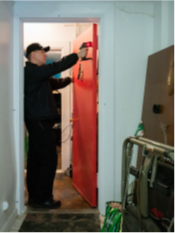
Tenants can file a complaint with HPD about any condition which may cause peeling paint or peeling paint itself; if a child under the age of six resides in the apartment in a building built prior to 1960, HPD will consider the complaint to be a lead-based paint complaint. Your immigration status does not affect your filing a complaint to 311 and is free of cost to the tenant. HPD will attempt to schedule an appointment for an inspector to conduct a lead-based paint inspection. The property owner is responsible for any repairs to address violations.
A lead-based paint inspection requires the inspector to look in every room for any paint that is peeling or otherwise coming loose from the surface on ceilings, walls, doors, windows, and other painted surfaces. The inspector will test peeling paint using an x-ray fluorescence machine (XRF), which measures the lead content in the paint. Only paint that is peeling will be tested. If lead-based paint is found on these peeling paint surfaces and the tenant has not already had their child’s blood lead level tested or spoken with the Department of Health and Mental Hygiene (DOHMH) about having a blood test, the tenant should call 311 to find out more about this testing or visit Lead Poisoning: Information for Tenants - NYC Health for more information. A health care provider or the DOHMH can recommend the next steps if it is determined that a child has an elevated blood lead level.
If the tenant does not indicate there is a child under the age of six residing in the apartment when the complaint is filed, but the inspector confirms there is a child under the age of six residing in the apartment at the time of the inspection, the inspector will conduct a visual paint survey for paint that is peeling without the XRF machine. If peeling paint is found, another inspector may return to the apartment within the following two weeks to conduct a second inspection that includes the XRF machine to determine if the paint meets the definition of lead-based paint. If this follow-up inspection cannot be performed, a violation will be issued based on the previous visual survey as a presumed lead-based paint hazard.
HPD sends tenants a letter with the results of the XRF testing showing if there is lead on the tested surfaces.
Repairs
A landlord is responsible for properly repairing lead-based paint hazards whether there is a violation or not and conducting any work which disturbs a painted surfaces of unknown lead content using certified contractors and safe work practices. If the landlord does not fix peeling paint or if the work is not being done safely (if the work is creating dust that is not contained), the tenant should file a complaint online or call 311.
If HPD issues a violation and the landlord does not complete the repair, HPD will send a qualified inspector to see what needs to be done, hire a certified contractor to make the repair, and follow up the repair with an inspection to collect dust samples to ensure that no lead dust remains after the work is completed. All these steps are necessary to protect your child; you should make every effort to give the inspector access to re-inspect to make sure the work is done properly, and it is safe for your family. If work to address any lead-based paint hazard is completed by HPD, the results of any clearance tests will also be sent to you.
Local Law 1 of 2004 requires that owners follow and retain evidence that safe work practices were used for all repair work in a dwelling unit or building common area where a child under the age of six resides when more than two square feet of lead-based paint or paint of an unknown lead content is disturbed.
Leases
When you are signing a lease, property owners are required to provide:
- The Lease/Commencement of Occupancy Notice for Prevention of Lead-Based Paint Hazards (Spanish | Español)) to new tenants as a form of inquiry if a child under the age of six will live or regularly be spending 10 hours or more per week in the unit
- The Lead Paint Hazards in the Home (Spanish | Español) pamphlet. Property owners must also certify on this notice that they have performed the required turnover work prior to occupying the unit by the new occupants. This notice is also required at lease renewal. Tenants may request a copy of the documentation to show the required work was completed.
Property owners must also certify on this notice that they have performed the required turnover work prior to occupying the unit by the new occupants. This notice is also required at lease renewal. Tenants may request a copy of the documentation to show the required work was completed.
HPD Trainings, Guidance and Additional Resources
Click a topic, or press the enter key on a topic, to reveal its answer.
Bulletins
2026
May 2026 Lead Bulletin for Property Owners
January 2026 Lead Bulletin for Property Owners
2025
December 2025 Lead Bulletin for Property Owners
October 2025 Lead Bulletin for Property Owners
July 2025 Lead Bulletin for Property Owners
April 2025 Lead Bulletin for Property Owners
Get Ahead of Lead Webinars
Get Ahead of Lead Webinars
- Lead-Based Paint Basics: An Overview of New York City's Requirements for Building Owners
- Lead-Based Paint Annual Notice and Recordkeeping: An Owner's Guide to Compliance in NYC
- Lead-Based Paint Abatement and Stabilization: Required Correction at Turnover and in Child-Under-6 Units
- Safe Work Practices in NYC: Knowing When and How to Use Certified Contractors when Working with Lead-Based Paint
- An Owner's Guide to the Lead-based Paint Exemption Requirements and Application Process
- HPD Lead-Based Paint Violations: Understanding the Basics of Lead Violations and How to Clear Them
- HPD Lead-Based Paint Violations: Understanding Work and Documentation Dates
- Required Lead-Based Paint Testing for All Rental Units in NYC
Additional Resources
Lead Hazard Reduction and Healthy Homes Program
-
The Lead Hazard Reduction and Healthy Homes - Primary Prevention Program (PPP) offers federally-funded grants for reduction of lead-based paint hazards to owners of eligible residential buildings constructed prior to 1960.
The primary purpose of the program is to assist owners in reducing lead-based paint hazards in order to prevent lead poisoning of occupants – especially children. Peeling or cracking lead paint is the most common cause of lead poisoning in young children, who can swallow lead dust that comes from windowsills, floors, and toys. Lead poisoning can cause learning and behavioral problems in children.
J-51 Reform
Real Property Tax Law § 489(21) and New York City Administrative Code § 11-243.2 have established the J-51 Reform tax incentive program (“J-51 R Program”), which offers an as-of-right real property tax abatement for residential rehabilitation of Class A multiple dwellings. J-51 R Program benefits are available to projects completing work after June 29, 2022, and on or before June 29, 2026.
Local Law 1 and Rules
Local Law 1 and Rules
- Local Law 1 of 2004, as amended: Article 14 of Title 27 of the New York City Administrative Code
- Chapter 11 of Title 28 of the Rules (and Amendments) of the City of New York
- Local Law 31 of 2020
- Local Law 111 of 2023
- Local Law 122 of 2023
- Local Law 123 of 2023
- Local Law 127 of 2023
- Local Law 66 of 2019: Amendment to the Definition of Lead-based Paint under Article 14 of the Housing Maintenance Code
American Legal Publishing provides free access to view and search more than 2000 municipal codes nationwide. Please browse the American Legal Publishing’s Code Library to access Local Law 1 of 2004, and its amendments, as incorporated into the New York City Administrative Code. Local Law 1 of 2004 is New York City’s comprehensive law concerning the prevention of childhood lead poisoning through the remediation of lead paint hazards in housing, which became effective on August 2, 2004. Also included are the rules and amendments of the NYC Childhood Lead Poisoning Prevention Act of 2003; proposed and adopted by the New York City Department of Housing Preservation and Development. Please consult your legal advisor for legal interpretations of Local Law 1 of 2004 and other code material.
HPD Annual Reporting on Lead-Based Paint
Click a topic, or press the enter key on a topic, to reveal its answer.
Annual Report
Within four months after the close of the fiscal year, HPD provides to the City Council a written report on HPD's implementation of Local Law 1 of 2004 during the preceding year. The report includes an analysis of the program, a detailed statement of revenue and expenditures, and a statistical section designed to provide a detailed explanation of HPD's enforcement, including information about complaints, inspections, violations, certifications of corrections, and work orders.
- Lead-Based Paint Annual Report FY2025
- Lead-Based Paint Annual Report FY2024
- Lead-Based Paint Annual Report FY2023
- Lead-Based Paint Annual Report FY2022
- Lead-Based Paint Annual Report FY2021
- Lead-Based Paint Annual Report FY2020
- Lead-Based Paint Annual Report FY2019
- Lead-Based Paint Annual Report FY2018
- Lead-Based Paint Annual Report FY2017
- Lead-Based Paint Annual Report FY2016
- Lead-Based Paint Annual Report FY2015
- Lead-Based Paint Annual Report FY2014
- Lead-Based Paint Annual Report FY2013
- Lead-Based Paint Annual Report FY2012
- Lead-Based Paint Annual Report FY2011
- Lead-Based Paint Annual Report FY2010
- Lead-Based Paint Annual Report FY2009
- Lead-Based Paint Annual Report FY2008
- Lead-Based Paint Annual Report FY2007
- Lead-Based Paint Annual Report FY2006