
 Landmarks Preservation Commission311Search all NYC.gov websites



FOR IMMEDIATE RELEASE: April 7, 2026
CONTACT: lpcpressoffice@lpc.nyc.gov, (212) 669-7938
LPC Designates Three Buildings in Manhattan and Brooklyn Linked to New York City's Rich Immigration History
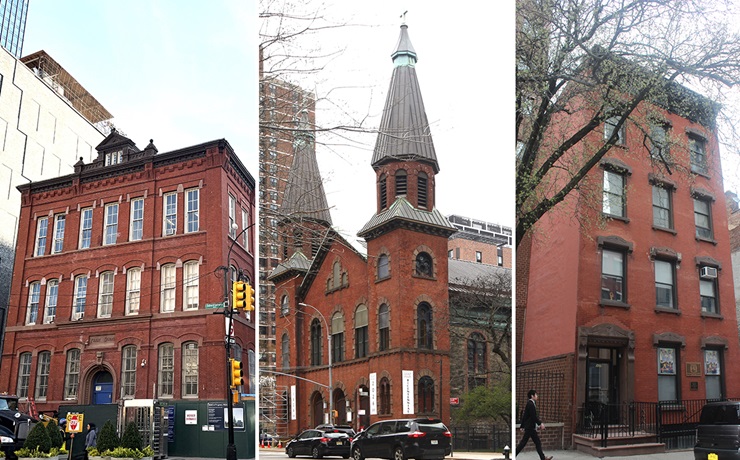
L-R: Public School 15 Annex; Church of Saint Mary; Lithuanian Alliance Building
The Commission voted today to designate the Public School 15 Annex in Brooklyn, the Church of Saint Mary on Manhattan’s Lower East Side, and the Lithuanian Alliance Building in Chelsea as individual landmarks
New landmarks reflect the history of immigration in New York City and the diverse immigrant communities who have helped define and shape the city
NEW YORK – Today, the New York City Landmarks Preservation Commission (LPC) voted to designate three buildings linked to New York City’s immigration history as individual landmarks: Public School 15 Annex at 372 Schermerhorn, Brooklyn; the Church of Saint Mary at 440 Grand Street on the Lower East Side, and the Lithuanian Alliance Building, located at 307 West 30th Street in Chelsea.
The Public School 15 Annex was built in 1889 to serve Brooklyn’s growing population at the time, including its expanding immigrant community. In the 1920s, the Annex became home to the influential Girls’ Continuation School, a pioneering institution that expanded educational, economic, and social opportunities for young women, many of whom were first- and second-generation Americans from Lithuania, Italy, Poland, Ireland, and the Netherlands.
The Church of Saint Mary is the oldest Roman Catholic church building on Manhattan’s Lower East Side, embodying the history and diversity of immigration to the neighborhood and the city as a whole. Constructed in 1833, it was central to the earliest Catholics who came to New York from Ireland, and continues to be an important community institution to more recent Catholic immigrants, including many from Spanish-speaking communities who make up the majority of the parish today.
The Lithuanian Alliance Building dates to 1876-1877 and reflects the residential development of the Chelsea neighborhood at the end of the 19th century. Since 1910, it has served as the headquarters of the Lithuanian Alliance of America, a fraternal society established to support new immigrants, and the nation’s oldest continually operating Lithuanian organization, creating an important hub for Lithuanian culture that continues to thrive today.
“Immigrants built New York City. Their stories live in every block, every neighborhood, every corner of the five boroughs. Today, I’m proud to recognize three more sites that carry that legacy forward—places that, for generations, have opened their doors to newcomers and helped define what it means to belong in the greatest city in the world,” said Mayor Zohran Kwame Mamdani.
“These newly designated landmarks shine a much-deserved light on the history of immigrant communities in New York City. I’m grateful to the LPC, their staff, and the communities who have lifted up the histories of the Public School 15 Annex, the Church of Saint Mary, and the Lithuanian Alliance Building and hope New Yorkers will appreciate their histories for decades to come,” said Leila Bozorg, Deputy Mayor for Housing and Planning.
“New York City’s history is the history of immigration, and the three landmarks designated today provide a tangible connection to places that helped communities establish roots and create lasting opportunities,” said Landmarks Preservation Commission Executive Director Lisa Kersavage. “The designation of these architecturally distinctive buildings are part of the Commission’s ongoing commitment to ensuring that our landmarks tell the story of all New Yorkers.”
“Public School 15 Annex, the Church of Saint Mary, and the Lithuanian Alliance Building reflect the strength and resilience of New York City’s diverse immigrant communities whose contributions have helped shape our city in dynamic social, cultural and economic ways,” said Landmarks Preservation Commission Vice Chair Angie Master. “As an immigrant myself, I am proud to welcome these three new individual landmarks that honor these important immigrant histories and ensure that they are preserved and protected for future generations.”
“St. Mary’s Church tells the story of Lower Manhattan. It is one of New York City’s earliest Catholic parishes, built by and for immigrants, and it has remained a vital institution on the Lower East Side for nearly two centuries,” said New York City Councilmember Christopher Marte. “From its roots in the Irish immigrant community to its role today serving many Spanish-speaking parishioners, St. Mary’s reflects the history, resilience, and diversity of our neighborhood. This landmark designation is a recognition that this history matters and must be preserved.”
“I am grateful that we are preserving the stunning facade of the Public School 15 Annex,” said New York City Councilmember Lincoln Restler. “The creative reuse of this site to meet our housing crisis while protecting this architectural gem is a win for our community. Thank you to the team at LPC and Alloy for their work on this.”
“The decision to designate the Lithuanian Alliance building as the New York City individual landmark not only recognizes its architectural and cultural significance but also strengthens a vital link between Lithuania and the United States,” said Consul General of Lithuania in New York Dovydas Spokauskas. “Just as our relations developed into a deep strategic partnership, the Lithuanian Alliance building became a beacon from which our heritage is shared with the City. I deeply appreciate the efforts of the Landmarks Preservation Commission and the Lithuanian Alliance leadership that made today’s landmark decision possible.”
“Lithuanian Americans in New York love and cherish their only Lithuanian-owned building in the greater New York City area. Being recognized by the New York City Landmarks Commission is a great honor and one that recognizes our efforts to preserve the building as it was when we acquired it in 1910,” said Lithuanian Alliance of America Board Member Danius Glinskis. “Landmark status will strengthen our efforts to continue to preserve our building for the Lithuanian community far into the future.”
"For more than a century, the PS 15 Annex has stood in the heart of Downtown Brooklyn as a community anchor, making it well deserving of landmark designation," said Alloy CEO Jared Della Valle. "When we first started working on this site 10 years ago, we committed to preserving the PS 15 Annex and over time, our connection to this historic building has only strengthened. From its wealth of original details to its ornate architecture, the PS 15 Annex is an important symbol of public education in New York City and deserves to be protected for generations to come."
“For two centuries, St. Mary’s has held a central role for immigrants on the Lower East Side, with new arrivals including the Irish, Germans, Latinos, Asians and others all making their mark,” said Lower East Side Preservation Initiative President Richard D. Moses. “We’re so happy to have been able to work with parishioners and City Council Member Marte to spread the word on the church’s important history, and thrilled that the Commission has now landmarked this spiritual and architectural beacon to make sure it can serve generations to come.”
Public School 15 Annex
A red-brick Romanesque Revival building with Queen Anne details, the Public School 15 Annex was constructed in 1889 by architect James Naughton, who designed more than 100 schools while serving as Brooklyn’s superintendent of schools, including many others designated as individual landmarks such as Brooklyn’s Boys High School and Girls High School.
Originally built as an extension of the original Public School 15, the Annex became home to a series of schools that expanded pathways to independence, skill development, and economic mobility for women. In 1927, the Brooklyn Girl’s Continuation School established its headquarters in the Annex, offering practical and professional instruction to teenage girls, many from immigrant communities, at a time when educational opportunities were often limited by gender and economic circumstance. Students received instruction across a range of fields, including garment manufacturing, nursing, bookkeeping, homemaking, and beauty skills. The school also helped advance newly-enacted child labor laws requiring continuing education for those over the age of 14 by enabling its students to attend classes while holding outside employment. Both the Girls’ Continuation School and the adult continuation school that operated in the building through the 1940s provided new opportunities for education and autonomy for young girls and women.
The Church of Saint Mary
The Church of Saint Mary is the home of Manhattan’s third-oldest Catholic parish, founded in 1826 to serve the rapidly growing Irish immigrant population of the Lower East Side. After anti-Catholic and anti-Irish sentiment led to the destruction of the parish’s first home in a former Presbyterian church, the parish built what would become the Lower East Side’s first Roman Catholic Church building at 440 Grand Street, completing it in 1833. The parish thrived on the Lower East Side and in 1864 hired architect Patrick Charles Keely, a renowned cathedral designer and Irish immigrant, to expand the church and update its facade. Less than a decade after its first expansion, the parish once again needed more room and completed a second expansion of the church building in 1871, designed by architect Lawrence J. O’Connor.
With its impressive brick facade, original fieldstone side walls, dual bell towers, and late 19th-century stained-glass, the Church of Saint Mary remains a striking example of Romanesque Revival architecture, and an important reminder of New York City’s early Catholic history and the Lower East Side’s rich immigrant heritage. Today, the church continues to serve as a vital community institution for more recent generations of Catholic immigrants, including many from Spanish-speaking communities.
Lithuanian Alliance Building
The Lithuanian Alliance Building, a neo-Grec-style structure built in 1876-77 at 307 West 30th Street, reflects the nineteenth-century residential development of Manhattan’s Chelsea neighborhood. The site also holds significant cultural importance as the longtime headquarters of the Lithuanian Alliance of America, which has played a vital role supporting Lithuanian immigrants and the Lithuanian American community. Like many fraternal alliances of its time, the Lithuanian Alliance was founded to help fellow immigrants weather the difficulties of life in the United States, offering financial assistance in the form of insurance policies, health benefits, and loans, while also seeking to preserve and promote Lithuanian cultural heritage.
In 1910, the Lithuanian Alliance purchased the West 30th Street property, selecting the site for its proximity to Ellis Island, and the building has served as a hub of Lithuanian cultural life for more than a century. From 1910-1971, it housed the printing operations for Tevynė, the Alliance’s weekly newspaper covering Lithuanian news for immigrants. In 2018, the Lithuanian Alliance completed a thoughtful restoration of its headquarters, and in 2022 the building was listed on the National Register of Historic Places.
Landmarks Preservation Commission Public Hearing/Meeting Videos
All LPC Public Hearing/Meetings are livestreamed via YouTube.
- Click here to view the video of today’s LPC Public Meeting at which the Commission voted to designate these three buildings.
- Click here to view the 3/10/26 LPC Public Hearing at which the Commission heard public testimony on the three buildings designated today.
- Click here to view the 12/02/25 LPC Public Meeting at which the Commission heard the LPC Research Department presentation on the three buildings designated today.
###
About the Landmarks Preservation Commission (LPC)
The Landmarks Preservation Commission is the mayoral agency responsible for protecting and preserving New York City’s architecturally, historically, and culturally significant buildings and sites. Since its creation in 1965, LPC has granted landmark status to more than 38,500 buildings and sites, including 1,473 individual landmarks, 125 interior landmarks, 12 scenic landmarks, and 159 historic districts and extensions in all five boroughs. For more information, visit LPC's website and connect with us at Facebook, Instagram, X (Twitter), and LinkedIn.