




DEP Announces Highest Value Watershed Protection Land Purchase in New York City’s History
December 22, 2025
Acquisition Emphasizes DEP’s East-of-Hudson Source Water Protection Efforts Ahead of New Filtration Avoidance Determination
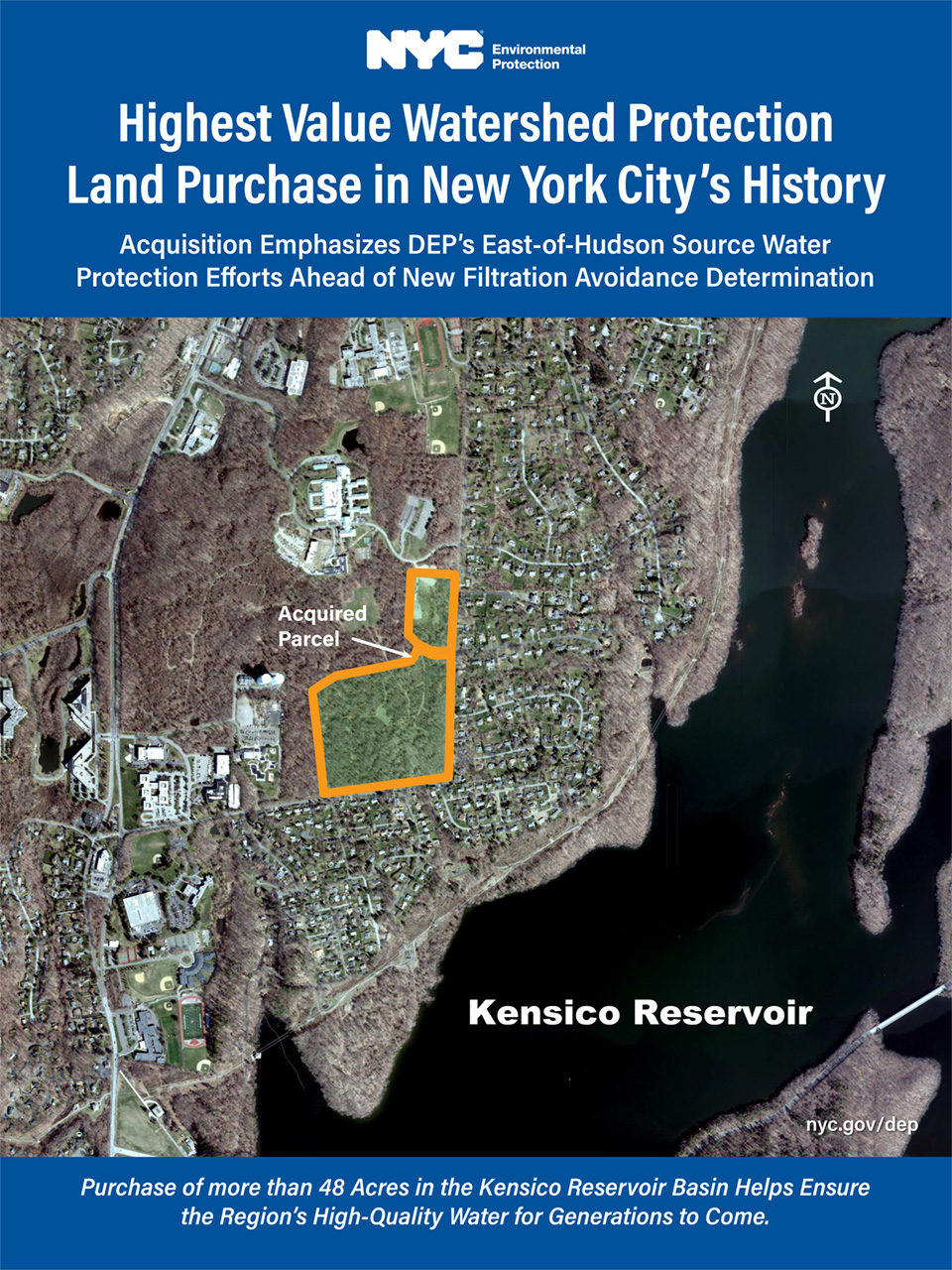
$12.56 Million Purchase of More Than 48 Acres in the Kensico Reservoir Basin Helps Ensure the Region’s High-Quality Water for Generations to Come
Mount Pleasant, NY—The New York City Department of Environmental Protection (DEP) today announced the highest value watershed land purchase ever made to protect the City’s drinking water supply. The $12.56 million acquisition of more than 48 acres near the Kensico Reservoir in Westchester County is consistent with the agency’s evolving science-based priorities in water quality protection efforts and a major investment in safeguarding clean, high-quality water for generations to come.
The newly purchased land sits within the Kensico Reservoir watershed—a critical point in the City’s water system where nearly all drinking water from upstate reservoirs flows before reaching consumers’ taps. Protecting land in this area helps prevent pollution from reaching the water supply and reduces the need for costly treatment.
“This is a truly historic investment to protect high quality of the pristine unfiltered water that New York City is famous for,” said DEP Commissioner Rohit T. Aggarwala. “As climate change and development create new challenges, we are focusing our resources where they will have the greatest impact on water quality. Protecting land near Kensico is one of the smartest ways we can do that.”
This purchase is the single most expensive land acquisition DEP has ever made for watershed protection. Over nearly 200 years, New York City has acquired or protected more than 200,000 acres of land across its upstate watershed, primarily in the Catskill Mountains, where most of the City’s drinking water originates. All of that water ultimately passes through the Kensico Reservoir on its way to homes and businesses across the region.
DEP already owns land along the entire shoreline of the Kensico Reservoir and several nearby parcels. Adding this forested 48-acre property increases protection of natural streams and hillsides that help filter stormwater before it reaches the reservoir. The purchase aligns with a recent recommendation from the National Academies of Sciences, Engineering and Medicine to prioritize investments in land parcels that offer the greatest water-quality benefits.
Since the late 1980s, Federal rules have required municipal surface-water supplies to be filtered and disinfected. New York City and select other municipal water supplies have been able to achieve a waiver to filtration—known as a Filtration Avoidance Determination (FAD)—when extraordinary efforts are undertaken to protect the water supply at its source. New York City’s most recent 10-year waiver is up for renewal at the end of 2027. Building a filtration plant for the entire supply from the Catskills would surpass the largest capital investment the City has ever undertaken.
“Clean, safe drinking water is vital for all New Yorkers,” said New York Senate Majority Leader Andrea Stewart-Cousins. “This historic $12.5 million purchase near the Kensico Reservoir is a major step in protecting our water supply for generations to come. It not only safeguards New York City’s drinking water but also strengthens local communities in Westchester by preserving the natural resources that keep our region healthy. I commend the DEP for its leadership in watershed protection and for making smart policy decisions grounded in science that benefit our communities and support the health of our environment.”
“The Kensico Reservoir is one of the most critical pieces of water infrastructure in our region, supplying clean drinking water not only to New York City, but to Westchester residents every day,” said Westchester County Executive Ken Jenkins. “This historic land acquisition is a smart and forward-looking investment that protects water quality at its source and safeguards public health for generations to come. Westchester County applauds New York City, the Department of Environmental Protection and environmental advocates for continuing their commitment to protecting the Kensico Reservoir and clean and fresh drinking water.”
“Preserving the land near our reservoirs is an important tool in our efforts to protect New York’s drinking water,” said Assemblymember MaryJane Shimksy. “By purchasing this 48-acre parcel, DEP can mitigate any increase in pollutants in the Kensico Reservoir, while also preserving Hawthorne’s natural beauty. It’s an investment that will benefit the people of New York City and the Town of Mount Pleasant now and in the long term.”
“The Town of Mount Pleasant is proud to maintain a strong and collaborative relationship with the NYC Department of Environmental Protection, united by our shared commitment to protecting the Kensico Reservoir watershed,” said Mount Pleasant Supervisor Carl Fulgenzi. “This acquisition, 48 acres of the former Legionaries property is especially meaningful to us and puts this property back on the tax rolls after many years. Our community also receives water directly from the Kensico outlet works, and the preserved land will also create valuable new green space for our residents. We deeply appreciate both the land protection efforts and the ongoing infrastructure investments that NYC DEP continues to make in our community. These actions reflect their dedication to safeguarding the watershed and ensuring the delivery of the highest‑quality drinking water.”
“Riverkeeper applauds the Department of Environmental Protection for having the forward-looking vision to make this major land purchase to protect the most sensitive and critical reservoir in its water supply system,” said Riverkeeper President Tracy Brown. “Land conservation is the most effective way to safeguard water quality over the long term. At a time of intense development pressure in the Kensico Reservoir basin, this bold action will add enduring protection for public health in America’s biggest city.”
“The Kensico Reservoir plays a strategic role in delivering water from six large Catskill Mountain reservoirs to more than 9 million downstate New Yorkers. But the lands surrounding the Kensico, if not protected from development, can funnel pollution directly into the reservoir itself, jeopardizing drinking water quality,” said Eric A. Goldstein, New York City Environment Director at NRDC (Natural Resources Defense Council). “Today’s acquisition represents a wise investment that will help to safeguard New York drinking water quality for generations to come.”
“Clean drinking water is our most precious resource, and the protection of our watersheds represent the first line of defense against contamination, said Julie Tighe, President of the New York League of Conservation Voters.” This historic land purchase is a major win for public health and we applaud Commissioner Rit Aggarwala and the Department of Environmental Protection for their ongoing commitment to safeguarding water quality for millions of New Yorkers.”
DEP is closely monitoring potential risks to water quality, including climate-driven extreme weather, droughts, and changing regulations. These efforts help ensure that the City remains ahead of emerging challenges, particularly in Westchester and Putnam counties, where development pressures and evolving water quality concerns require proactive and adaptive management.
The Kensico Reservoir, located just north of White Plains, has supplied water to New York City since 1915. It can hold up to 30 billion gallons of water and typically handles about 90 percent of the City’s total drinking water supply, as well as water for much of Westchester County.
About the NYC Department of Environmental Protection
DEP manages New York City’s water supply, providing approximately 1 billion gallons of high-quality drinking water each day to nearly 10 million residents, including 8.5 million in New York City and more than a million in counties north of the City. The water is delivered from a watershed that extends more than 125 miles from the city, comprising 19 reservoirs and three controlled lakes. Approximately 7,000 miles of water mains, tunnels and aqueducts bring water to homes and businesses, and 7,500 miles of sewer lines and 96 pump stations take wastewater to 14 in-city treatment plants. DEP also protects the health and safety of New Yorkers by enforcing the Air and Noise Codes and asbestos rules. For more information, visit nyc.gov/dep, like us on Facebook, or follow us on X.