




In Recognition of National Lead Poisoning Prevention Week, NYC DEP Expands Free Lead Pipe Replacement Program
October 21, 2025
Eligible Bronx Homeowners Encouraged to Sign Up Now—Queens and Brooklyn Next in 2026
DEP Awarded $72 Million to Replace Lead Service Lines in Low-Income and Environmental Justice Communities
To mark National Lead Poisoning Prevention Week, the New York City Department of Environmental Protection (DEP) is expanding its free lead service line replacement program to reach more Bronx neighborhoods—with Queens and Brooklyn next in line for 2026. DEP has received $72 million in funding through the federal Bipartisan Infrastructure Law to remove lead water service lines from private properties in low-income and environmental justice neighborhoods.
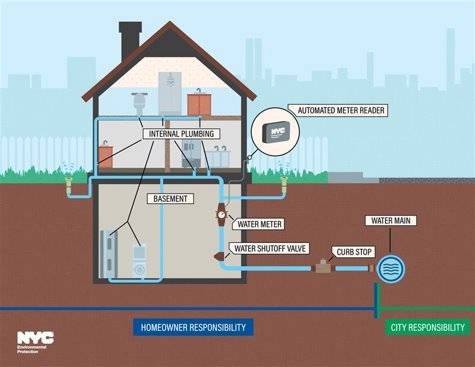
Water service lines connect homes to the City’s water mains. These lines are privately owned, meaning property owners are normally responsible for replacing them—a job that can cost upwards of $10,000. DEP’s program offers to replace lead or galvanized steel lines with new copper pipes at no cost for eligible homeowners. Additionally, any lead service lines discovered during DEP’s water main replacement projects are being replaced free of charge too.
“As we mark National Lead Poisoning Prevention Week, I’m proud to point out that New York City has never had a case of lead poisoning traced to drinking water. Our delicious, world-renowned tap water is delivered lead-free, but lead in homeowners’ pipes and service lines can increase the risk of lead exposure,” said DEP Commissioner Rohit T. Aggarwala. “Eligible property owners are strongly encouraged to take advantage of this free program and have DEP install safe, new copper service lines—protecting their drinking water and saving them money.”
“The Department of Environmental Protection’s free lead service line replacement program is a life-saving initiative, offering a critical service that is keeping our most vulnerable residents safe from the harmful effects of lead poisoning in our borough,” said Bronx Borough President Vanessa L. Gibson. “Lead exposure is not only dangerous but is also completely preventable. With initiatives like this, we’re giving property owners the resources they need to eliminate avoidable lead hazards and safeguard public health.”
The program currently serves parts of the Bronx and is expanding to Community Board 12. Next up is Flushing, Queens, in early 2026, followed by Borough Park, Brooklyn, in fall 2026. Only property owners who receive a DEP postcard or flyer are currently eligible to participate. To check eligibility or view the City’s service line map, visit nyc.gov/leadpipe.
New York City’s water is delivered lead-free and meets or exceeds all federal and state health standards. However, private service lines made of lead can increase the risk of exposure through household plumbing. Lead poses serious health risks, especially to young children and pregnant women. DEP strongly encourages property owners with lead service lines to replace them and reduce the risk of exposure.
DEP offers free lead test kits to anyone concerned about potential lead levels in their home’s water. Each kit includes simple instructions for collecting a sample and a pre-paid shipping label to send it to a lab for analysis. Results are mailed back within 30 days. To request a kit, call 311 or visit nyc.gov/dep/lead.
About the NYC Department of Environmental Protection
DEP manages New York City’s water supply, providing approximately 1 billion gallons of high-quality drinking water each day to nearly 10 million residents, including 8.5 million in New York City. The water is delivered from a watershed that extends more than 125 miles from the city, comprising 19 reservoirs and three controlled lakes. Approximately 7,000 miles of water mains, tunnels and aqueducts bring water to homes and businesses throughout the five boroughs, and 7,500 miles of sewer lines and 96 pump stations take wastewater to 14 in-city treatment plants. DEP also protects the health and safety of New Yorkers by enforcing the Air and Noise Codes and asbestos rules. For more information, visit nyc.gov/dep, like us on Facebook, or follow us on X.