




New York City Council Committee on Environmental Protection, Resiliency, and Waterfronts Stormwater Resiliency in a Changing Climate
October 22, 2025
Good afternoon, Chair Gennaro and members of the Committee on Environmental Protection, Resiliency, and Waterfronts. I am Beth DeFalco, Deputy Commissioner of Public Affairs and Communication at the Department of Environmental Protection (DEP). I’m joined by Acting Deputy Commissioner Mike Farnan, who leads our Bureau of Water and Sewer Operations (BWSO); Assistant Commissioner Wendy Sperduto, our chief engineer who oversees engineering and capital planning; and Assistant Commissioner Melissa Enoch, who oversees green infrastructure and sustainability. We appreciate the opportunity to speak about stormwater resiliency and the legislation before you today. When the Commissioner testified on Flooding and Stormwater Infrastructure in 2024, he outlined five realities, which have shaped everything DEP has done since:
- We are now living through the climate impacts scientists warned us about.
- Some impacts will continue to surprise us — because climate change brings more extremes and less predictability.
- Our infrastructure can’t evolve as quickly as the climate is changing.
- Everyone has a role to play — DEP can’t solve flooding and resiliency challenges alone.
- And finally, resilience comes with a cost—paid for through water rates—so we must invest wisely to make every dollar count.
Three years later, all five lessons have proven true. We’ve made progress—but the pace of climate change means we can’t slow down.
Living in a Changed Climate
Every New Yorker has been feeling the effects of climate change. In 2020, the U.S. National Climate Assessment officially moved New York City from a “coastal temperate” to a “humid subtropical” climate zone—essentially, we’ve moved 500 miles south without leaving home. That means hotter summers, more intense storms, and heavier rainfall.
We’ve recently experienced some of the most extreme rainfall events in our city’s history. The four storms with the highest hourly rainfall rates (at Central Park) in the last 50 years have all occurred since 2021:
- September 1, 2021 (Hurricane Ida): 3.47 inches
- July 14, 2025: 2.08 inches
- September 29, 2023: 1.87 inches;
- August 21, 2021 (Hurricane Henri): 1.84 inches
These intense rain events strain the capacity of our sewers, which were not designed to manage this sort of inundation. Until 2022, DEP’s standard was to design infrastructure to the “5-year storm” but that storm was based on historical data. This meant that projects were designed to handle at first a 1.75″ and more recently a 1.85″-per-hour storm. Prior to 1980, when DEP was formed, each borough established its own stormwater standard, and in some cases allowed developers to build without installing stormwater systems. Given that most of our infrastructure is more than 50 years old, large parts of Brooklyn and Queens have smaller sewers, contributing to more frequent flooding events. Some parts of the City—mostly on Staten Island and Southeast Queens—are just now beginning to get storm sewers.
In addition to being more intense, the storms we experience now have different patterns than the ones we’re accustomed to. Traditionally, the most extreme storm we would routinely face was a nor’easter. Nor’easters are large, so they would be predictable, and they would cover the whole city more or less uniformly. Our new storms are more tropical in nature. They are hyper-local, hyper-intense, of very short duration, and, unfortunately, very hard to predict.
Infrastructure Can’t Evolve As Quickly As The Climate Is Changing
Taking office soon after Hurricane Ida, this administration has made one of its top priorities addressing stormwater resilience. This initiative has required several significant changes in how DEP approaches planning work.
The first was to look ahead instead of back. Since we are building infrastructure for the next 50 years, not the last 50 years, we have to plan for the climate of the future, not that of the past. As a result, we now use the New York Panel on Climate Change’s 5-year storm as expected in 2080 as our design standard. This standard is 2.15″ per hour, which equates roughly to the historical 10-year storm for NYC.
The second was to create our own internal infrastructure to undertake smart stormwater planning. DEP built a digital model—essentially a digital twin—of the sewer system, to help pinpoint the most impactful interventions. Flooding may occur at one location, but the cause of that flooding may be upstream or downstream. The model now allows us to understand that.
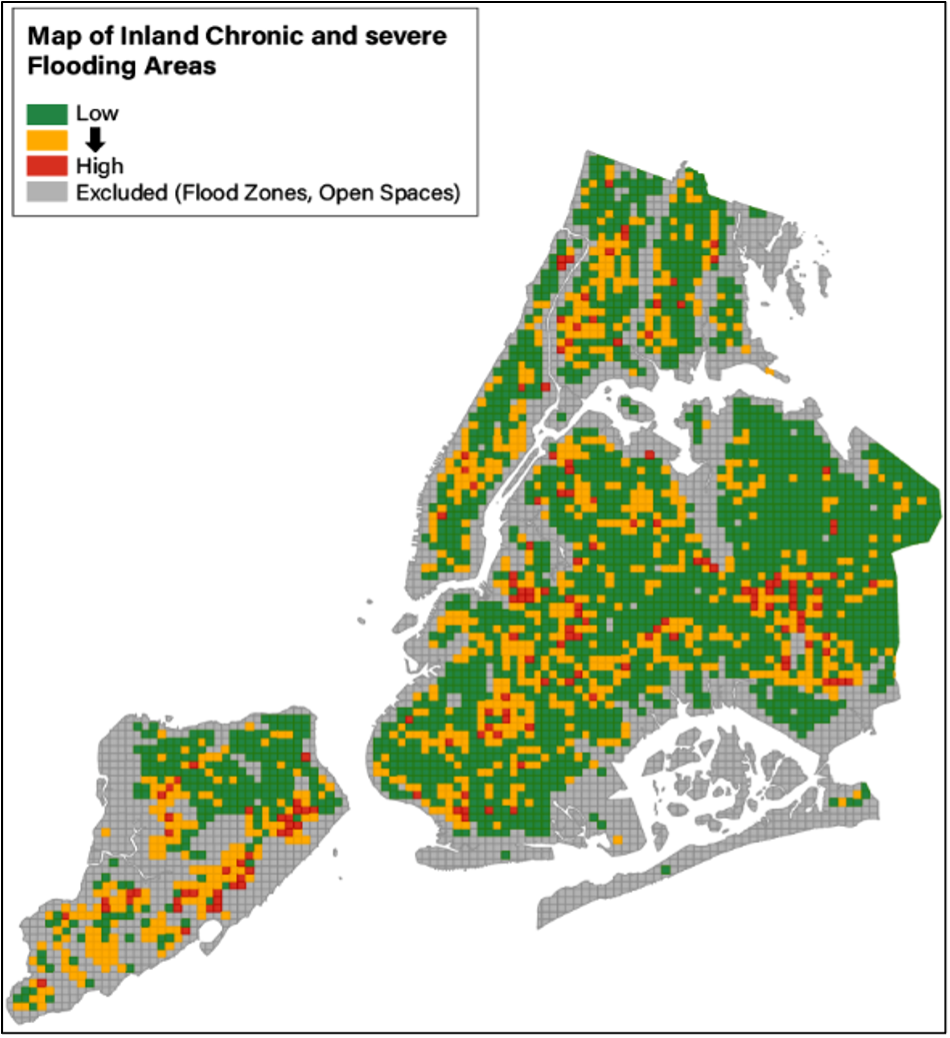
Third, teams used the model to identify the locations that will experience the most impactful flooding in a 2.15″ storm. Based on that information, we created a prioritized list of 86 locations across the City that have the highest need. This work is laid out in the 2024 Stormwater Analysis, which is available on the DEP website.
Finally, DEP has integrated planning across green and gray infrastructure. At each of these locations, we are looking at all potential solutions on an equal footing. Not only does the terrain, soil, and existing infrastructure in each location shape what is possible, but different solutions may take more or less time to construct. DEP is developing a citywide stormwater resilience strategy, building on what’s in PlaNYC. A big step forward has been breaking down silos between our green infrastructure and gray infrastructure teams.
Historically, they worked separately—one focused on rain gardens and permeable surfaces, the other on sewers and drainage pipes. Now, they’re working side by side to find the smartest mix of both.
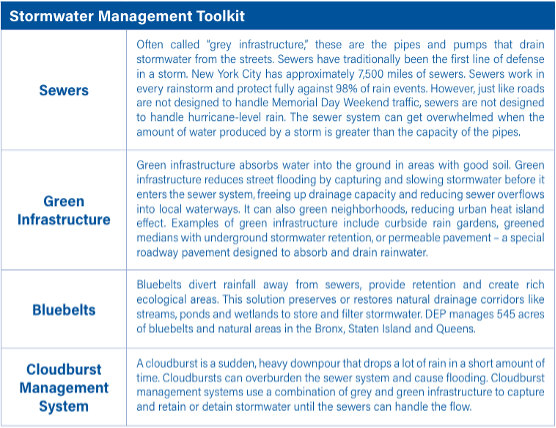
The 2024 Stormwater Analysis offered four neighborhood case studies of this new approach to planning: Dyker Heights, Knickerbocker, Kissena Park, and Jewel Streets. The engineering teams examined which unique set of tools would best serve each of those locations. Each location has unique challenges and solutions, but a few key lessons stand out:
- When large trunk sewers have unused capacity, upgrading smaller local pipes to connect into that capacity can make a big impact.
- Green and gray infrastructure are most powerful when they work together.
- Green infrastructure is often faster and cheaper to install—but it can’t handle every storm or every location.
- In some neighborhoods, expanding traditional sewers is still the best option.
This analysis is just the beginning of a comprehensive Stormwater Master Plan that will guide future engineering, budgeting, and investment priorities. We will continue to keep the Council and the public informed as that Plan takes shape. We will issue reports regularly starting in 2027 and will launch the stormwater analysis dashboard this coming summer to publicly track the status of various planning initiatives.
Work Underway
So far, I’ve been discussing DEP’s new approach to planning, but DEP has also been hard at work in the field undertaking construction as well. Since 2022, DEP has constructed:
- 170 stormwater management systems—underground tanks, porous pavement and rain gardens—on public properties including schools, parks and NYCHA developments;
- 2,890 rain gardens and infiltration basins we’ve installed in sidewalks;
- 36 green infrastructure practices such as storage systems, porous pavement, rain gardens or green roofs that we have incentivized on private (non-City) properties through grants.
In August, we completed construction on the City’s first cloudburst project at NYCHA’s South Jamaica Houses. This fall we are initiating construction on two additional cloudburst projects at Rufus King and Archie Spigner parks.
Since 2022, we have also installed over 200 (221) sewer sensors around the City placed in service so we can observe levels inside the sewers. These sensors tell us where and when capacity is reached, information we use to inform project planning.
DEP has been prioritizing projects within our capital plan based on which locations have the biggest challenges and most immediate needs. The 2024 Stormwater Analysis is a roadmap for these priorities. Already, significant work is underway for three of the four neighborhoods that were highlighted in the analysis:
- A $390 million investment (from DEP and DOT) in Bushwick in Brooklyn will address chronic flooding around Knickerbocker Ave. by expanding the sewer under Knickerbocker Ave. so that it has nine times its current capacity.
- Design is currently underway for work in Dyker Heights in Brooklyn that will upsize key pipes to improve drainage capacity in the area.
- A Bluebelt is being considered for Kissena Park in Queens. DEP is working closely with Parks on a potential bluebelt and holds regular community meetings to seek feedback and keep local electeds updated.
As we have repeatedly said, however, the climate is changing faster than our infrastructure can change. The unfortunate reality is that planning, designing, procuring, and constructing these projects takes usually 7 to 10 years. The Knickerbocker Avenue project, for example, will only enter service in 2037.
Everyone Has A Role To Play
The long timeline to re-engineer our sewer system for our new climate is one reason that stormwater has to be thought of as a shared responsibility. In 2022, DEP implemented the Unified Stormwater Rule, which requires property owners—including city agencies such as Parks, DOT, and DDC—to build onsite stormwater management into new construction and renovation projects. Stormwater Pollution Prevention Plans (SWPPPs) have been a concern for some developers as these requirements extend timelines and add costs, but we cannot be serious about addressing stormwater if we are not serious about requiring property owners to help.
Similarly, we need New Yorkers to recognize that protecting their lives and property is a shared responsibility. That’s why we’ve been working with communities across the city through our “Flooding 101” sessions, helping residents prepare for and recover from storms. These sessions include demonstrations of basic equipment—such as flood alarms—that homeowners can install to protect themselves.
While a lot of stormwater planning requires construction, DEP’s maintenance crews have also been doing tremendous work to ensure we get full capacity from the infrastructure we do have. Since 2023, BWSO has been using a data-driven, catch basin inspection schedule that prioritizes basins where maintenance is most often required. Because of this approach, and the new catch basin trucks added to the fleet this year, 98% of the more than 87,500 catch basins DEP inspected in FY25 were functional. BWSO has also cut down a backlog of 5,000 uncleared catch basins to less than 1,000 across the city’s 154,000 total. That’s a big win for stormwater management and it is a key reason that, despite the heavy rain that caused flooding at one subway station during the storm on July 14, we got very few reports of basement flooding or sewer backups that day.
Resilience Comes With A Cost
Most of DEP’s work, including our capital work, is funded by water and sewer rates. There is a direct, almost one-to-one correlation between the revenue we collect and the work we are able to do. Planned capital work is one of the factors taken into consideration when the Water Board considers rate increases every year.
As the Commissioner has discussed before, we are constantly thinking about how we can use our resources most effectively. Our resources are finite. Making sure we get the most out of them is one way we keep rates down. We always consider trade-offs and opportunity costs when we decide to allocate resources to one thing over another. We ask that the Council thinks about these trade-offs as well when considering legislation that would mandate expenses. Each new requirement takes resources away from our other work (or requires rates to be increased—or both).
Legislation
Int. 403
The first bill on the agenda today is Int. 403. Int. 403 would require quarterly reporting on the inspection, cleanup, maintenance, and repair of catch basins and would require all catch basins in the city to be inspected once or twice every year.
There are 150,000 catch basins around the city. For a few years, we were required to inspect them all annually. We found that doing so was not necessary and was not an effective use of inspectors’ time. BWSO used the results of the annual inspections to create the four-tiered inspection schedule that they are following now. As I mentioned, this schedule has proven to be very effective. More than 87,500 catch basins were inspected last year and 98% of them were functional.
A targeted, efficient, and effective catch basin inspection schedule allows staff to use its time where it is most needed, such as in repairing broken catch basins more quickly or doing other needed system maintenance.
It is difficult to compare year-to-year data about catch basins and SBUs because they are so driven by rainfall, but when comparing FY2025 with recent years with similar rainfall (FY2016 and FY2023), FY2025 saw fewer SBU complaints, fewer catch basin complaints, and faster resolution times.
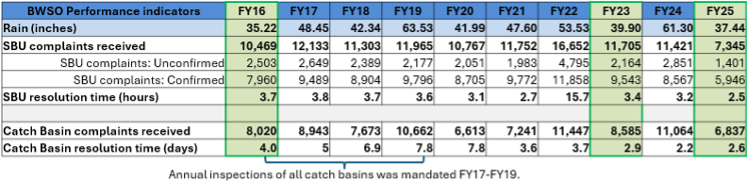
These are all encouraging indicators about the catch basin inspection schedule and the overall prioritization of sewer maintenance resources. We’re happy to work with the bill sponsor to codify a catch basin inspection and reporting schedule, but we don’t think the schedule laid out in the bill is the way to go.
Int. 1352
Int. 1352 would prohibit downspouts from being connected to a sewer line during construction or renovations for certain properties in combined sewer areas. This is an issue that the Commissioner has discussed before. Increasingly, with the intense rainstorms we are seeing, homes are experiencing sewer backups not because the sewer is full but rather because the rush of water from the roof creates an internal backup. Further, any water we can keep out of the sewers both creates capacity that we sorely need and helps to reduce combined sewer overflows. So, we are grateful for this bill to shine a light on this concern.
That said, we have discussed this legislation with Chair Gennaro’s staff and would like the opportunity to further assess the initiative. The challenge is that the water from a disconnected downspout has to go somewhere. On a single-family lot with a yard, this may not be a problem. In denser areas of the city, these disconnections must be planned carefully so that they do not create a flood. We would like to work with Chair Gennaro and his staff to consider this question, develop guidelines for property owners and consider what should be mandated. We have discussed including this initiative as a component of the Stormwater Master Plan. The Department of Buildings will also speak about this bill.
While downspout connections are legal in the combined sewer areas of the City, they are illegal in those parts of the City that are separately sewered. DEP is beginning to alert homeowners in the separately sewered areas of the City that such connections to the sanitary sewer are illegal and must be corrected. We are starting this outreach in Midland Beach in Staten Island, because this neighborhood is experiencing an increase in sewer back-ups due to these connections. DEP has developed a website with directions and guidance on how to disconnect and a portal for the homeowner to self-certify the fix when it has been made. Our goal is not to issue citations or fines, but rather to ensure that stormwater is kept out of the sanitary system. We invite the Council’s partnership to reach out to homeowners about this.
Int. 1395
Int. 1395 would require DEP to construct five “green climate screens” across the city in a two-year pilot project. The technology proposed is a new technology; as far as we know, the only example of this on earth is one constructed in Denmark in 2019. Denmark has not done more than this first installation, because they have not found a second appropriate location. It seems likely that the technology has not proven very valuable, or they would have prioritized more installations. Further, it seems that only one company makes this equipment, so legislation mandating that DEP pilot it seems inappropriate. This may be an appropriate use for Council Member funds if a location were identified, but given that we have identified a $30 billion program for stormwater resilience that must be our top priority, this bill’s mandate seems like an unwise distraction.
DEP is now in our third year of the Environmental Tech Lab, a partnership with the Partnership for New York City that helps DEP identify and pilot new technology in a systematic way driven by the agency’s needs. We would be happy to connect the provider of this technology with that program so it can compete on its merits, but we must oppose this legislation that mandates a pilot of a specific technology.
Int. 1397
The Department of Buildings is here to testify about Int. 1397. After that, my colleagues and I will be happy to answer any questions that you have.