
 NYC Housing Authority311Search all NYC.gov websites



Chapter 4: Waiting List Management
-
Overview
NYCHA maintains its public housing waiting list in accordance with the following guidelines:
-
- All applicants and transferees in the pool are maintained in order of preference and priority as described below;
- Applicants with the same level of preferences and priorities are then ranked by date of application; and
- All applicants must meet applicable income eligibility requirements as established by HUD.
-
Key Acronyms
-
- HUD: U.S. Department of Housing and Urban Development
- NYCHA: New York City Housing Authority
-
Adding Applicants to Waiting Lists
Applicants who NYCHA determines eligible for housing (i.e., approved application and eligibility interview) and existing residents who have been approved for transfer are referred to as “certified.” NYCHA assigns certified applicants and transferees by apartment size to the following certified waiting lists:
-
-
-
General Population Waiting List
-
-
Used for general population housing developments or for all general population properties of a consolidation (i.e., no specific population designated);
-
-
-
Elderly Waiting List
-
-
Used for housing developments, buildings within a development, or properties of a consolidation that are specifically for people who are elderly. NYCHA periodically obtains permission from HUD to treat specific housing developments and properties as housing designated for elderly populations only;
-
-
-
Accessible Waiting List
-
-
Used for developments with accessible apartments for people with mobility impairments;
-
-
-
Borough Waiting List
-
-
Used for certified applicants and transferees eligible for Borough choice only, for vacancies at any appropriate development in the assigned borough; and
-
-
-
Development Waiting List:
-
-
Used for certified applicants and transferees eligible for Development choice only, for vacancies in the assigned development.
-
Local Preferences and Priorities
An applicant’s place on the wait list is determined in part by NYCHA-defined preferences and priorities, which are described below. An applicant’s individual attributes determine whether the applicant is eligible for these preferences and priorities. The preferences and priorities can help an applicant advance on the wait list over other applicants who do not qualify for the preferences and priorities. Applicants with the same level of preferences and priorities are then ranked by date of application.
-
-
-
Preferences
-
-
NYCHA has two local preferences:
-
-
-
- Single member households (i.e., one-person households): An elderly person or person with disabilities will be selected for eligibility interviews over other single member households who are not elderly or disabled, except emergency applicants, who will be taken in order of priority regardless of age or disability; and
- New York City residents: Applicants who live, work, or will work within the five boroughs of New York City will be selected for eligibility interviews before applicants who do not live, work, or will work in New York City.
-
-
-
-
-
Priorities
-
-
Within the New York City resident preference described above, NYCHA has adopted a Working Family Priority and a Need-Based Priority (discussed below), which it uses to rank each applicant based upon information in the application. If an applicant qualifies for both types of priority, NYCHA assigns both priorities to the application, and whichever causes the applicant to be selected for an eligibility interview is the applicant’s final priority.
-
-
-
The Priority Codes
-
-
-
-
-
-
Working Family Priorities
-
-
-
Working family priorities apply only to applicants who are New York City residents — as defined in the table below.
For this section, “Income Tier” means the income level of each applicant which NYCHA uses to advance its goal of income mixing and of avoiding concentrations of extremely low-income families in any one or all of the NYCHA developments.
Additionally, the “area median income” varies by household size and is revised periodically to reflect economic data and income levels for admission to public housing as established by federal guidelines. When HUD makes changes to area median income, NYCHA publishes the changes on its website. The relationship between area median income and NYCHA’s Working Family priorities is explained below.
|
PRIORITY CODE |
WORKING FAMILY PRIORITIES |
|
The applicant or co-applicant must live, work, or will be working in New York City to qualify for a Working Family Priority |
|
|
W0 |
Department of Homeless Services Referral
Additional referral requirements may apply pursuant to agreement between Department of Homeless Services and NYCHA. |
|
W1 |
Low-Income Limits – Family gross annual income is from 51% to 80% of area median income. |
|
W2 |
Very Low-Income Limits – Family gross annual income is from 31% to 50% of area median income. |
|
W3 |
Extremely Low-Income Limits – Family gross annual income is at or below 30% of area median income AND meets the “Working Family" definition below: One (1) Person Household The sole member is currently employed or self-employed at least 20 hours per week, or is receiving disability benefits, or is 62 years or older. Two (2) Person or More Household
|
|
W9 |
Applicant or co-applicant who is the head of household or co-head of household at either a NYCHA public housing or Section 8 apartment |
-
-
-
-
Need-Based Priorities
-
-
-
|
PRIORITY CODE |
NEED-BASED PRIORITIES |
||||||
|
The applicant or co-applicant must live, work, or will be working in New York City to qualify for a Need-Based Priority. |
|||||||
|
N0 |
City Referred Homeless or Risk of Homeless
|
||||||
|
N1 |
Victim of Domestic Violence (see Appendix A, Glossary)
|
||||||
|
N4 |
|
||||||
|
N8 |
No Need-Based Priority
|
||||||
|
W9 |
Applicant or co-applicant who is the head of household or co-head of household at either a NYCHA public housing or Section 8 apartment. |
||||||
-
-
-
Order of Apartment Assignment
-
-
Current residents with approved transfer requests that are of highest priority T0 are housed before applicants and other transferees on the wait lists (refer to Chapter 10, Transfers, for more information). All other residents and applicants are offered apartments by rotating among the five categories below:
-
-
- Transferees who are in under-occupied, including extremely under-occupied apartments;
- Transferees who are in over-crowded, including extremely over-crowded apartments;
- Transferees other than the two categories above;
- Working Family Priority applicants; and
- Priority W0
- Priority W1
- Priority W2
- Priority W3
- Priority W9
- Need-Based Priority applicants
- Priority N0
- Priority N1
- Priority N4
- Priority N8
- Priority N9
-
Among all transfer categories, NYCHA selects intra-development transfers of equal priority by certification date before inter-development transfers eligible for that apartment size.
The table below provides a visual of this order of apartment assignment.
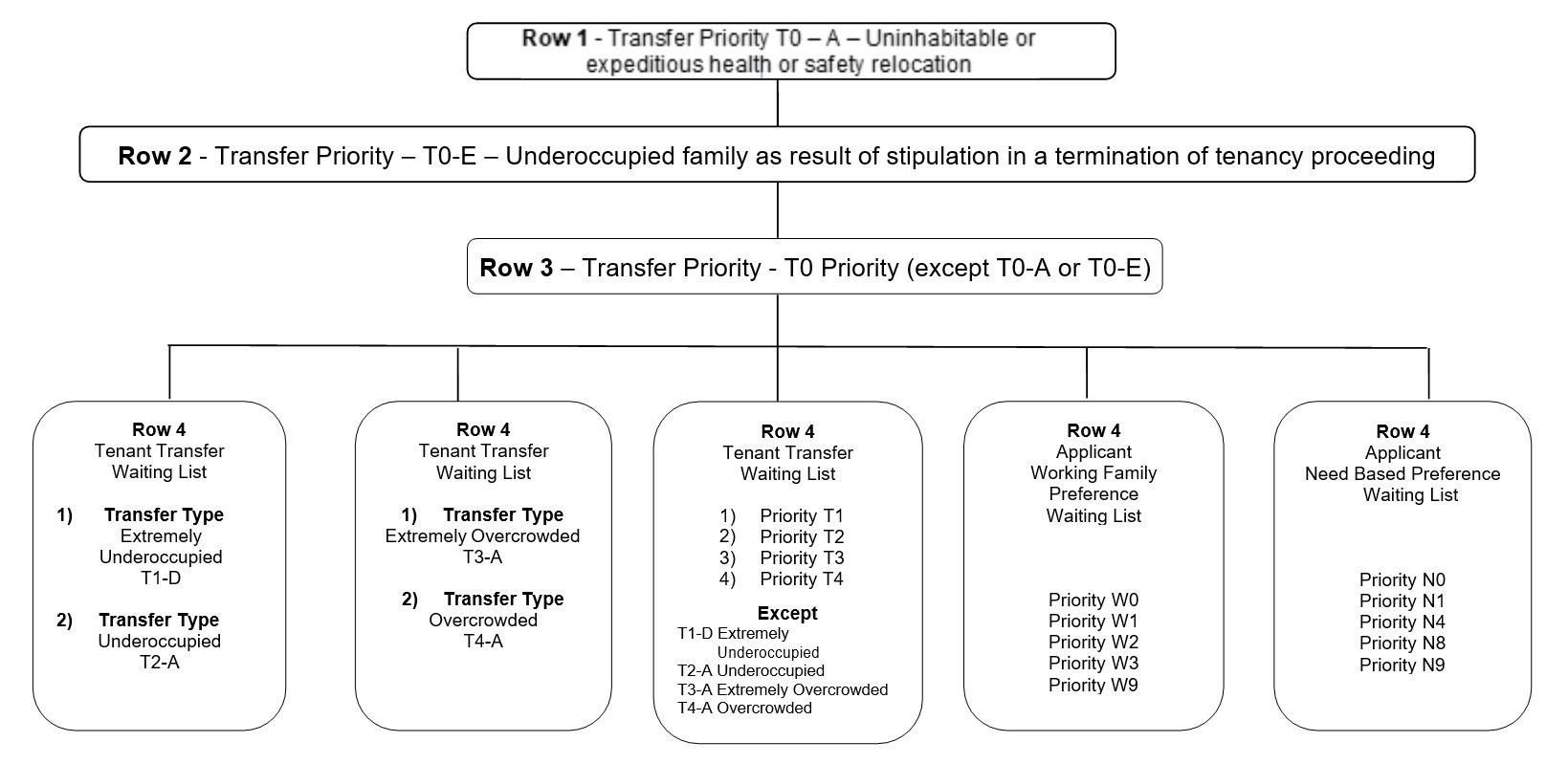
Refer to Chapter 5, Resident Selection and Apartment Offers, for more details.
-
Opening and Closing the Waiting List
From time to time, NYCHA may close the public housing waiting list in whole or in part. NYCHA announces the closing of the waiting list with a press release, on its website, and by other means.
If NYCHA determines that an existing waiting list that has previously been closed does not contain an adequate pool to fill anticipated vacancies, NYCHA notifies the public of its intention to re-open the waiting list with a press release, on its website, and by other means.
-
Outreach
If there is an inadequate pool of applicants to fill actual or anticipated vacancies at a development, NYCHA may reach out to certified applicants or transferees from other waiting lists who meet the outreach development’s eligibility criteria. These certified applicants and transferees are notified that they can request to be added to the outreach development’s waiting list. If this effort does not generate sufficient interest to meet the needs of the outreach development, NYCHA may market the outreach development to generate interest of new applicants.
-
Refreshing Applicant Information on Waiting List
-
-
-
Annual Canvass
-
-
NYCHA conducts an annual canvass of all certified applicants and transferees on the development or borough waiting list to ensure continued interest in remaining on the waiting list. The canvass letters are sent to applicants and transferees throughout the year based on the certification date.
The applicant or transferee may respond by mail or online via NYCHA’s Self-Service Portal. If, after 30 calendar days, the applicant or transferee does not respond, they are reminded by e-mail or automated phone call, if contact information is available, to respond to the canvass.
If there is no response by mail or online within 60 calendar days of the mailing of the canvass letter, the applicant or transferee request is closed.
-
-
-
Active Certified Applicants and Transferees on Waiting List for More than Two Years
-
-
Active certified applicants and transferees who have been on the certified waiting list for more than two years without any apartment offers may request to move their application or transfer request to another development or borough waiting list. These requests can be made either online at NYCHA’s Self-Service Portal or by contacting the Customer Contact Center. Active certified applicants and transferees on accessible waiting lists may change their selection at any time.
-
Removal of Application from Waiting List
NYCHA removes applications from the waiting list if an applicant or transferee:
-
- Indicates they are no longer interested in public housing or a transfer;
- Does not appear for a scheduled eligibility interview and fails to contact NYCHA to reschedule within 90 calendar days of the scheduled eligibility interview;
- Does not submit required additional information within 90 calendar days of the date requested;
- Does not satisfy debts, including but not limited to rent owed to NYCHA or to another public housing agency in connection with any assisted housing program within 90 calendar days of date NYCHA notifies the applicant of the requirement to satisfy the outstanding debt(s);
- Does not select a development from among those provided to the applicant by NYCHA as anticipating vacancies. The applicant has 30 calendar days after receiving this information from NYCHA to make their selection;
- Rejects two apartment offers (for applicants who may not select developments and for applicants for accessible apartments), unless an exception described in Chapter 5(h), Refusal of Apartment Offer applies;
- Rejects an apartment offer (for applicants who may select a development) from the development to which the applicant has been certified, unless a temporary emergency prevents a move at the time of the offer; or
- Does not respond within 45 calendar days of notification that the applicant was selected for an apartment. NYCHA form 070.083 Inactive File Letter is mailed advising the applicant that the application has been removed from the waiting list due to failure to respond.
An applicant or transferee whose application or transfer request has been closed and who still wishes to be considered for public housing must wait a year after removal from the waiting list to file a new application or transfer request. NYCHA makes exceptions to this for VAWA cases and reasonable accommodations. A new transfer request may be submitted without time restriction if it is for a reason different than the original request. The new application or transfer request will be considered according to its date of receipt. Information contained in a closed application may be used to verify information contained in subsequent applications.
Effective: 1/1/24
Last Revision: 12/15/23