




2026 Citywide Indicators Report
Message from the Director
The Mayor’s Office of Contract Services (“MOCS”) oversees New York City’s procurement portfolio and works to make contracting with the City more fair, transparent, and efficient. In FY26, the City procured nearly $35.9 billion in goods and services through more than 209,000 transactions, reflecting the scale and importance of procurement to the City’s ability to deliver services to New Yorkers.
This year, the City continued to make progress in expanding opportunities for diverse businesses and strengthening the timeliness of the procurement process. The City awarded more than $2.5 billion in contracts to Minority and Women-Owned Business Enterprises (M/WBEs), the highest M/WBE award total on record. The City also increased the share of contracts registered within 30 days of their start date from 66% in FY25 to 68% in FY26. MOCS worked closely with our human service agency partners through the annual HHS Timely Registration initiative to support timely contract registration and help nonprofits access funding more quickly and reliably.
The FY26 Indicators Report highlights both the progress made and the areas where continued attention is needed. While cycle times improved for Competitive Sealed Bids, cycle times for Competitive Sealed Proposals increased this year, underscoring the importance of identifying opportunities to streamline the procurement process while maintaining the review and oversight necessary to protect public funds and ensure effective contracting.
By modernizing systems, strengthening partnerships, and advancing reforms, MOCS is working to ensure that City procurement supports effective service delivery, expands opportunities for diverse vendors, and provides greater transparency and accountability. In partnership with City agencies, vendors, and other stakeholders, I look forward to continuing this important work in the year ahead.
Kim L. Yu Director of MOCS and City Chief Procurement Officer
Executive Summary
The procurement system of the City of New York (“NYC” or “the City”) affects almost every aspect of City government and public life. In Fiscal Year 2026 (FY26), the City procured almost $35.9 billion dollars of goods and services from outside contractors, ranging from nonprofits providing community services, to construction firms, to goods suppliers, that ensured that City agencies run smoothly and deliver on their missions.
MOCS is the oversight and service agency dedicated to ensuring that the procurement system is equitable, transparent, and efficient for all, and that the City is following the procurement rules laid out by the New York City Charter and the City’s Procurement Policy Board (“PPB”) Rules. City procurement offices at each agency are responsible for protecting against waste, fraud, corruption, and abuse, as well as ensuring fair competitive access. Altogether, the procurement system promotes the delivery of direct services and goods to New Yorkers that help maintain the City’s infrastructure, secure the operation of City government, and advance community programs.
As an oversight and service agency, MOCS provides strategic partnership throughout the citywide procurement process for all mayoral agencies and leads procurement reform to make it easier to do business with the City. Additionally, we maintain and enhance the city’s digital procurement system, PASSPort, which is a cloud-based software platform that provides a single, centralized environment for completing procurement activities. We continue to make system improvements in PASSPort to make contracting and subcontracting easier and more streamlined for City agencies, public and private vendors, and others who rely on the procurement process.
Using data from PASSPort, the City’s Financial Management System (FMS), and other sources, MOCS annually releases this Citywide Indicators Report to provide insight on Mayoral agencies’ procurement data and performance. This reporting builds transparency into the use of taxpayer dollars for the public, helps agencies manage their performance, and provides useful data on how we can make the process more efficient.
The Citywide Indicators Report for FY26 provides information on the City’s procurement spending from July 1, 2025, to June 30, 2026, and demonstrates the impact of that procurement.
Key Takeaways:
- In FY26, the City procured nearly $35.9 billion worth of goods and services through over 209,000 transactions. This represents a 15% decrease in total dollar value relative to FY25 ($42.3 billion), and nearly a 6% increase in number of transactions relative to FY25 (198,000).
- Spending on Human Services contracts totaled $17.8 billion, representing 50% in total City spending and was the highest industry for FY26. This was a 14% increase from FY25. The next second-highest industry spending was for Professional Services, totaling $6.8 billion and 19% of total City spending.
- The City awarded over $2.5 billion in contracts to minority and women-owned business enterprises (M/WBEs) in FY26. This was the highest award total on record to M/WBEs and the third consecutive year of record-setting growth.
- In FY26, 68% contracts were registered within 30 days of contract start date, an increase from 66% in FY25, underscoring the City’s progress in strengthening timely procurement practices.
- In FY26, the median end-to-end cycle time for Competitive Sealed Bids (CSB) improved to 282 days, down nearly 10% from FY25 (312 days). Competitive Sealed Proposals (CSP), which are used for procurements requiring more complex evaluation and selection processes, had a median cycle time of 527 days in FY26, compared to 386 days in FY25.
Report Structure
Below is an outline organizing how to use this report:
This section covers transactions that provided direct services to New Yorkers, helped maintain the City's infrastructure, and secured the operation of City government.
This section outlines key metrics of procurement performance, Retroactivity, Competitive Sealed Bid (CSB) and Competitive Sealed Proposal (CSP) Cycle Times, and Payment Processing Time.
This section outlines some of the key initiatives that impact human service providers, as well as human service agency procurement performance.
This section includes reports based on Local Law 1, which sets goals to increase M/WBE utilization in City Contracting, and additional analysis on the City's efforts to promote diversity in procurement.
Construction Indicators Report
This section details the construction contracts registered in FY26 and highlights the top five City construction agencies.
This section details how City procurement impacts New York City residents in ways beyond fulfilling agency missions.
This section includes the Glossary, Indicators Appendices with the underlying data, and past fiscal year Indicators reports.
Section 2: How the City Spends its Money
New York City is one of the largest procuring entities in the country. The City procures goods and services through tens of thousands of transactions each year. These transactions provide direct services to New Yorkers, help maintain the City's infrastructure, and secure the operation of City government. The following procurement indicators are citywide in scope and include all Mayoral agencies.
Procurement by Industry
New York City categorizes procurements in six major industry categories: architecture/engineering, construction, goods, human services, professional services, and standardized services. See the Glossary for definitions of each industry. See Appendix C for agency-by-agency breakdowns of procurement by industry.
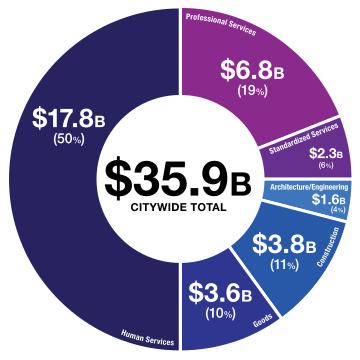
- Construction awarded 3.8 billion dollars at 11 percent of Citywide total
- Human Services awarded 17.8 billion dollars at 50 percent of Citywide total
- Professional Services awarded 6.8 billion dollars at 19 percent of Citywide total
- Standard Services awarded 2.3 billion dollars at 6 percent of Citywide total
- Goods awarded 3.6 billion dollars at 10 percent of Citywide total
- Architecture and Engineering awarded 1.6 billion dollars at 4 percent of citywide total
- The Citywide total for awards was 35.9 billion dollars
Procurement by Method
The Procurement Policy Board (PPB) Rules lay out the different methods for purchasing new goods and services, and the procedures that must be followed to continue or modify existing contracts. See the Glossary for definitions of each procurement method. Agency procurement professionals select the appropriate procurement method based on each Agency's business needs and the City's procurement rules. When Agency procurement professionals choose a procurement method, they must consider the industry the scope of work falls under, the dollar amount needed for the procurement, and other factors. See Appendix A for agency-by-agency breakdowns of procurement by method.
Small purchase and micropurchase methods make up the majority of procurement transactions and are for the purchase of goods, services and construction below certain dollar value limits. The value limit for goods and all services contracts is $20,000 or less, and for construction contracts it is $35,000 or less. Other common non-competitive procurement actions are Line-Item Appropriations, also known as the City Council Discretionary Contracts, which are discretionary awards to nonprofit organizations made by City Council members.
In terms of dollar value, Competitive Sealed Bids (CSB) and Request for Proposals (RFP), also known as Competitive Sealed Proposals (CSP), are the two most common types of competitive procurements. The M/WBE Small Purchase method is a procurement tool that allows agencies to directly contract with minority- and women-owned business enterprises up to a defined dollar threshold. In FY24, MOCS worked with City and State partners to raise the threshold for this method further from $1 million to $1.5 million, a big win for M/WBEs across the City.
Procurement by Size
Procurements are tracked by contract size, ranging from smaller contracts under $100,000 to contracts valued at over $25 million. These include both new contracts and amendments to existing ones. See Appendix B for year-to-year totals of individual agencies.
Top 10 Agencies by Procurement Values
The top ten agencies account for the vast majority of the City’s procurement activity each year. These agencies process most of the City’s largest contracts and collectively represent the bulk of procurement value.
Top 10 New Contracts by Value
P-Card Purchasing
Purchasing Cards (“P-Cards”) are tools that agencies can use to quickly purchase goods and service under the micropurchase dollar limit, which is currently $35,000 for construction-related procurements and $20,000 for all other procurements. P-Card purchases do not need to process through the City’s Financial Management System.
In addition to tracking how much agencies spend using P-Cards, the City also tracks how much of that spending goes to M/WBEs through the M/WBE transaction amount and M/WBE utilization rate.
City Council Discretionary Contracts
Each year, New York City Council (City Council) designates discretionary awards to nonprofit organizations through Schedule C of the City's expense budget and throughout the fiscal year in monthly Transparency Resolutions. Each nonprofit that applies for funding is vetted by the City Council. In addition, MOCS reviews the eligibility of organizations by checking for an approved HHS or Discretionary Prequalification Application in PASSPort and completed Capacity Building Training. MOCS does not review awards made by City Council directly to City agencies or governmental organizations, nor discretionary funding through capital funds.
Effective FY24, most agencies process the registration of discretionary awards, i.e., line-item appropriations, in PASSPort through multiyear discretionary award contracts. This recent reform (PDF) allows organizations to enter one three-year contract per City agency, eliminating the need for registration in the outyears should the organization receive awards within the contract’s maximum reimbursable amount. With a registered contract in place, providers are able to begin budgeting and invoicing more immediately after award clearance in the new fiscal year, saving nearly nine months of processing time.
This year’s table reflects an update in the methodology following the multiyear reform by looking at contract registrations across both FY24 and FY25. Registered values stand for cleared award amounts only, not contract maximum reimbursable amounts, which otherwise contain funding buffers. Discretionary awards that are not registered by agencies in the designated fiscal year may be registered in the next.
Additionally, with the introduction of the FY26 Discretionary Grant Pilot, the City aims to streamline the award process and help our smaller nonprofit partners get paid faster without the need for contract processing.
Section 3: Procurement Performance
MOCS is committed to building a procurement system that works better for New Yorkers, through increased transparency and accountability. While the previous section provided information on how City contracts are awarded, this section demonstrates the City's performance on two key procurement indicators – Retroactivity, Cycle Time, and Invoice Cycle Time.
These metrics give valuable insight to the public and agencies on the duration of the procurement process and areas where additional process reform could bring greater efficiency.
Retroactivity
A contract is considered late or "retroactive" when its start date occurs before the contract is registered by the City Comptroller. Retroactivity can cause cash flow and service continuity issues because the City cannot pay vendors prior to registration, and late registration can drive up the City's costs, as vendors increase their bid prices to account for anticipated delays.
The City aims to register all contracts before their start dates and closely monitors retroactivity by fiscal year and by industry to identify areas for improvement.
Competitive Sealed Bid and Competitive Sealed Proposal Cycle Time
One of the most important performance metrics that the City uses for procurement is the contract cycle times, which track how long it takes for a contract to get registered, from start to finish. For this report, MOCS tracks the cycle times of the two main competitive procurement methods, which are the competitive sealed bid ("CSB") and the competitive sealed proposal ("CSP"), also known the Request for Proposals ("RFP").
There are many rules and laws that vendors and agencies must follow to ensure competition throughout the process, which result in longer cycle times that are often necessary to ensure a fair, transparent, and equitable procurement process. However, as the report below will show, there is large variation between how long it takes contracts to get registered, indicating that there is room for improvement across the City in reducing cycle times. The City is committed to making this process faster and more predictable for our contracting partners.
This section reports the end-to-end median cycle times of all CSBs and CSPs by agency and by industry, and by the five procurement steps: presolicitation ("PSR"), solicitation, evaluation, award, and registration. Details on how each step of the procurement process are defined in PASSPort can be found at the bottom of this section.
Competitive Sealed Bid Cycle Time
CSBs are most commonly used to purchase goods, construction services, and standard services. Upon the collection of final bids, the contract is awarded to the vendor that bid the lowest price and is responsive and responsible.
The chart below shows how the median cycle time for CSB has changed each fiscal year by procurement step.
The chart below shows the median CSB cycle time by agency for this fiscal year compared with last fiscal year.
The table below shows how the median cycle time for CSB varies by industry.
Competitive Sealed Proposals/Request for Proposal Cycle Time
Agencies use CSPs/RFPs when factors beyond cost must be considered in a competitive procurement, resulting in an award to the responsive and responsible bidder whose proposal will be the most advantageous to the City. Agencies may consider factors such as quality, vendor capacity, experience, or creativity, along with cost while evaluating the proposals. CSPs are typically used for procuring human services, professional services, and architecture/engineering services.
The chart below shows how the median cycle time for CSP has changed each fiscal year by procurement step.
The chart below shows the median CSP cycle time by agency for this fiscal year compared with last fiscal year.
The table below shows how the median cycle time for CSP varies by industry.
| Phase | Start Date | End Date |
| Pre-Solicitation Review (PSR) | Draft Creation (Task Initiated Date) | RFP Publication Begin Date (First Round) |
| Solicitation | RFP Publication Begin Date (First Round) | Latest Bid/Proposal Due Date |
| Evaluation | Latest Bid/Proposal Due Date | Select Award Date (Task Validated Date) |
| Award | Select Award Date (Task Validated Date) | Date the contract was submitted to OAISIS (Task Initiated Date) |
| Registration | Date the contract was submitted to OAISIS (Task Initiated Date) | Date the contract was registered in FMS |
Payment Processing Time
The City is committed to processing payments to contractors as efficiently as possible while maintaining appropriate review and controls in accordance with City requirements. These requirements ensure that public funds are used accurately, with proper authorization, and consistent with the terms of City contracts. Local Law 175 requires that MOCS reports citywide payment processing time annually.
Payment processing time, also called invoice cycle time, measures the time between the Prompt Payment Date and the Ok-to-Pay Date in PASSPort, and provides a consistent way to track payment processing performance over time.
Section 4: Human Services
HHS Timeliness Prompt Payment Report
The City seeks to achieve 100% timeliness in contract registration, especially for HHS contracts. When a contract is registered late, it can cause cash flow and service continuity problems because the City cannot issue reimbursements or advances to providers prior to contract registration, even if the services have already begun. To address this cash flow issue, the City has the Returnable Grant Fund (RGF), which provides interest-free loans that help human services providers bridge the gap in funding while awaiting contract processing and registration (see section below for more details).
However, the City recognizes that on-time registration is a preferred solution to the RGF. The City has measures in place to make sure providers are paid in a timely fashion, including through Section 4-12 of the Procurement Policy Board (PPB). Section 4-12 authorizes the City Chief Procurement Officer to authorize interest payments to providers for late registration of HHS contracts, if it has been determined that the agency is generally submitting contracts in an untimely manner.
HHS timeliness is measured differently than retroactivity, which was covered earlier in this report. Retroactivity is based on when the contract is registered, while HHS Timeliness is based on when an agency submits a contract to the Comptroller.
For HHS Timeliness, a contract action is considered on-time if it is submitted to the Comptroller before the contract start date; the action is considered late if it is submitted to the Comptroller after the contract start date. However, we consider contracts that are submitted to the Comptroller within 30 days of the start date to be substantially in compliance. The Section 4-12 rule applies to all human service contracts, including new awards and extensions, but excludes City Council discretionary contracts, which, by definition, are untimely as they are not designated by Council until after the start of the fiscal year.
Please see below for the analysis of this year's HHS contracts by agency.
FY27 HHS Timely Registration Initiative
MOCS manages a yearly cross-collaborative effort across human services agencies to ensure the timely registration of their Human Services Procurement Plan actions, including both new solicitations and continuation actions, for the coming fiscal year. MOCS expanded this year’s initiative to cover contracts with a start date from July 1 through August 1, allowing capture of critical procurements like the Comprehensive After School System of New York City (COMPASS). The "FY27 Human Services Timely Registration Initiative" set milestones, timelines, and a regular reporting structure to hold agencies accountable for the on-time submission of over 900 FY27 July 1st and over 300 August 1st COMPASS planned actions.
Although this initiative tracks HHS timeliness based on when a contract is submitted to the Comptroller, the universe of contracts differs from the HHS Timeliness Prompt Payment report. Most importantly, the Prompt Payment report tracks the on-time submission of human service contracts registered in FY26 regardless of contract start date, while this initiative tracks the on-time submission of contracts for the current fiscal year only (FY27). Additionally, while the report encompasses all FY26-registered HHS contracts, the initiative tracks the subset of contracts included in the Human Service Procurement Plans that agencies must publish each year. These differences in timeframes and the universe of contracts mean that the timeliness percentages will be different; however, we can expect to see the FY27 initiative's performance reflected in next year's Prompt Payment report.
For this year’s initiative, MOCS introduced tiered performance tracking and enhanced contract upload and reporting for agencies, as well as regular one-on-one provider outreach. With a similar volume of tracked July 1st actions to the previous fiscal year, the City saw 79% on-time submission to the Comptroller by July 1, 2026. While slightly lower than last year’s collective performance, some agencies exceeded their year-over-year performances despite volume jumps between 500-1,000%. The initiative also saw its strongest first-week performance to date following the opening of the pre-preprocessing window in mid-May. By September 1, 2026, 96% of planned July 1st actions had been submitted for registration, equaling last year’s initiative closeout; concurrently, 82% of planned August 1st COMPASS actions had been submitted. The City’s timely registration efforts facilitate agencies’ ability to issue advances on registered human services contracts, delivering upfront cash flow.
FY26 Returnable Grant Fund Initiative - Updated
The RGF provides interest-free loans to help human services providers bridge the gap in funding while awaiting contract processing and registration. Created in 1992, the Fund is run in partnership with MOCS and the Fund for the City of New York (FCNY).
As detailed in the chart below, in FY26, the RGF made 336 loans to 187 providers totaling $103,392,810. While both the total value of loans and number of providers remained relatively stable from last fiscal year, the number of loans issued increased by about 10%. The size of individual loans ranged from $2,249 to $4,565,096, with an average loan amount of $307,717, showing diversity in the program size and provider need.
The Fund continues to be a stable resource for the City’s human services partners. As observed last fiscal year, the number of returning applicants (those that applied for and received loans in both FY25 and FY26) remained around 30%. This consistency reflects the revolving nature of the sector’s cash flow needs, particularly as improved timely registration efforts facilitate access to advances.
Section 5: M/WBE Partners
Economic Opportunities for M/WBEs under Local Law 1 of 2013
New York is committed to encouraging a competitive and diverse business environment— one that truly reflects the makeup of this City. The Minority and Women-owned Business Enterprises (M/WBE) Program was created to address the documented disparity between City contract awards to specific ethnic and gender groups and the representation of those groups within the New York City regional market. Overall, the M/WBE Program, led by the citywide M/WBE Director, seeks to increase the contracting opportunities and participation among City-certified M/WBE firms.
The City continues to diligently work and partner with our City-certified M/WBE firms to help alleviate market disparities and provide necessary goods and services across the City.
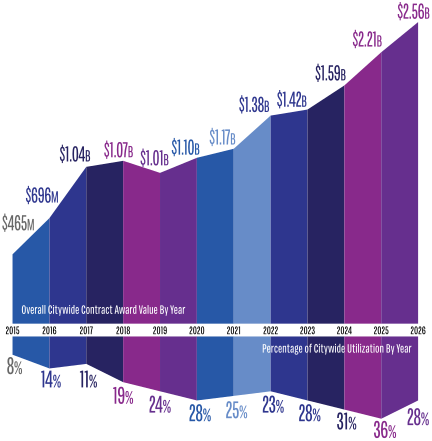
- 465 million dollars FY 2015
- 696 million dollars FY 2016
- 1.04 billion dollars FY 2017
- 1.07 billion dollars FY 2018
- 1.01 billion dollars FY 2019
- 1.10 billion dollars FY 2020
- 1.17 billion dollars FY 2021
- 1.38 billion dollars FY 2022
- 1.42 billion dollars FY 2023
- 1.59 billion dollars FY 2024
- 2.21 billion dollars FY 2025
- 2.56 billion dollars FY 2026
Economic Opportunities for M/WBEs - Reference Notes
- Section 6-129 of the New York City Administrative Code establishes Citywide participation goals for M/WBEs for standardized, professional, and construction services contracts, regardless of value, and for goods contracts valued under $1 million. These may include subcontract awards made on prime contracts awarded prior to July 1, 2013 that are not subject to the law. ⤣
- Under Section 6-129(q) of the New York City Administrative Code (NYC Admin. Code), agencies are not required to set participation goals on the following types of contracts: (1) those subject to federal or state funding requirements which preclude the City from imposing goals; (2) those subject to federal or state law participation requirements for M/WBEs, disadvantaged business enterprises, and/or emerging business enterprises; (3) contracts between agencies; (4) procurements made through the United States General Services Administration or another federal agency, or through the New York State Office of General Services or another state agency, or any other governmental agency; (5) emergency procurements; (6) sole source procurements; (7) contracts for human services; and (8) contracts awarded to nonprofit organizations. ⤣
Prime Contract M/WBE Utilization
In City contracting, a prime contract is the agreement directly between an entity and a City agency for the provision of goods or services. The term "prime" is most commonly used when an entity or contractor that has entered into an agreement with a City agency also engages subcontractors to carry out the responsibilities of the contract.
Prime contract awards that are subject to the LL1 program are tracked to measure how many are awarded to certified M/WBEs. For additional details on the information presented in this table, please refer to Appendix G.
Prime Contract M/WBE Utilization - Reference Notes
- P-Card purchases were not included in FY26 prime contract award count but were instead counted separately. ⤣
Subcontract M/WBE Utilization
In City contracting, a subcontractor is a person who has entered into an agreement with a contractor to provide services or perform work that is required as part of a contract with a City agency. Many M/WBEs use subcontracting opportunities as a point of entry into City contracting and M/WBE subcontracting participation goals are set as material terms on applicable prime contracts to ensure access to City work. The participation goals are set in relation to the scope of work required by the contract and the availability of M/WBEs that can perform the work.
For additional details regarding information presented in the table below, please refer to Appendix I.
Large-Scale Contract Approvals
Pursuant to LL1, City agencies are required to obtain approval by the City Chief Procurement Officer (CCPO) before soliciting procurements anticipated to be valued at more than $10 million. The CCPO is required to review the procurements in order to evaluate whether it is practicable to divide the proposed contracts into smaller contracts, and whether doing so will enhance competition among M/WBEs. A full list of these determinations is included in Appendix J.
Large-scale contracts concentrate the City’s business in the hands of a few large vendors and create fewer opportunities for smaller, less established businesses (like M/WBEs) to compete for contracts. Agencies work to identify opportunities to break up large procurements and pursue other contracting arrangements to meet their needs. This is a component of the City’s work to expand opportunities for M/WBEs.
Large Scale Contract Approvals - Reference Notes
- Under Section §6-129(h)(2)(e) of the NYC Admin. Code, agencies are not required to obtain CCPO approval for capital projects valued over $25 million and contracts excluded under Section 6-129(q) of the NYC Admin. Code. ⤣
- Approvals that occurred in FY26 but have not yet resulted in the release of any solicitation are reported only after the contract is awarded in order to protect the integrity of the bidding/proposal process. ⤣
Waivers, Modifications, and Noncompliance
A vendor that plans to submit a bid or proposal in response to a solicitation for a contract that is subject to M/WBE participation goals may seek to request a reduction in the goals by filing a waiver request with the contracting agency during the solicitation stage. The agency and MOCS then review and evaluate the extent to which the vendor's business model and subcontracting history is consistent with this request. The Agency and MOCS also consider the availability of M/WBE vendors when determining whether to grant a waiver request. In order to qualify for a waiver, a vendor must show both the capacity to execute the contract with less subcontracting than projected and legitimate business reasons to do so.
Waivers may be granted only to vendors that demonstrate both the capacity to perform the prime contract without subcontracting and a prior contracting history of doing similar work without subcontracting, taking into consideration the total number of M/WBE vendors which are able to perform work on the specific contract. As waivers must be applied for in the solicitation phase, vendors who bid or propose with a waiver request might not end up winning the contract award.
M/WBE Small Purchase Method (SP)
Pursuant to the PPB Rules, agencies may use the M/WBE Small Purchase (“M/WBE SP”) method to make purchases for goods, services, or construction from any City-certified M/WBE up to and including the maximum amount authorized by the City Charter without a formal competitive process where there are available City-certified M/WBEs to provide such goods, services or construction that meet the need of the agency. Purchases made under this method are not subject to the formal competitive bid or proposal requirements set forth elsewhere within the PPB Rules.
To increase M/WBE utilization and to support the City’s goal of increasing awards to M/WBE vendors, agencies use the M/WBE SP method to award contracts to M/WBE vendors wherever practicable.
The City successfully advocated for State legislative reform to increase the M/WBE SP method threshold in recent years. The first increase was from $500,000 to $1 million in Fiscal Year 2023 (January 2023), and the second increase took the threshold from $1 million to $1.5 million in Fiscal Year 2024 (December 2023). The chart below demonstrates how these reforms to the threshold have provided increased opportunities to M/WBEs and helped to increase the contract value that is procured using this method.
This chart outlines the usage of this procurement method across industries in FY25.
M/WBE Retroactivity
New York is committed to expanding contracting opportunities for City-certified Minority and Women-owned Business Enterprises (M/WBEs). Timely contract registration is an important part of that effort, as delays in registration affect a contractor’s ability to receive payment and may create cash flow challenges.
This section examines retroactivity among M/WBE prime contracts. Retroactive contracts are those whose start dates occur before registration with the Comptroller.
Section 6: Construction Indicators
The construction industry is one of the largest procurement categories for the City. The chart below details the construction industry contracts registered in FY26 and highlights the top five City construction agencies by dollar value of construction contracts. This section will also provide details about Construction-specific topics, including Project Labor Agreements, the Apprenticeship Program Directive, and Construction and Design Change Orders.
Project Labor Agreements and Apprenticeship Program Directive
A Project Labor Agreement ("PLA") is a pre-hire collective bargaining agreement with one or more labor organizations that establishes the terms and conditions of employment for applicable construction projects. Since 2009, the City and the Building and Construction Trades Council of Greater New York and Vicinity (BCTC) have entered into PLAs for certain renovation and rehabilitation of City-owned buildings and structures, as well as certain specified new construction projects and design build projects. The PLAs create direct labor cost savings, ensure a reliable source of skilled and experienced labor, permit flexibility in work schedules, and avoid many potential causes of project delays, such as labor strikes, which are prohibited by PLAs. The PLAs also contain unique provisions to help small, M/WBE construction firms. All prime contractors and subcontractors on projects subject to a PLA must agree to the terms of the PLA by signing a Letter of Assent prior to award of the project. Currently, the City continues its efforts in negotiating and entering into new PLAs with the BCTC for upcoming City construction projects, including design-build infrastructure projects, which include Borough-Based jail construction projects.
Apprenticeship is the process of learning a skilled trade through on-the-job training plus related classroom education. Apprentices are able to earn full journeyworker wages as training is completed. The Apprenticeship Program Directive requires that certain construction and construction-related maintenance contractors have apprenticeship agreements appropriate for the type and scope of work to be performed that have been registered with, and approved by, the New York State Department of Labor. This requirement expands the pool of work available to graduates of state approved apprenticeship programs, provides ready sources of trained workers to City construction contracts, reduces turnover, and provides clear pathways to stable careers in the construction industry, all while apprentices earn wages and benefits. The Apprenticeship Program Directive applies to individual construction contracts and construction-related maintenance prime contracts valued above $3 million (and subcontracts on such projects valued at or above $2 million) that use apprenticeable construction-related trade classifications.
Note that while all PLA projects include Apprenticeship by default, the apprenticeship values reported herein are for contracts where only Apprenticeship applied and which were not also subject to PLA.
Change Orders: Cycle Time and Volume
Change orders are agency-authorized, written documents that allow for modifications of a contract while the contract is being performed. Change orders are used to adjust the value of the contract or the time for performance and are classified as either Construction Change Orders (CCO) or Design Change Orders (DCO), depending on the scope of work. Change orders allow the vendor to complete work included in the scope of the contract. They also allow the agency to make non-material changes to the scope, such as accounting for site conditions that were unknown at the time of contracting.
The values reported in all charts and tables do not include no-cost change orders.
The values reported in both tables do not include no-cost change orders.
Design-Build
Design-build is an alternative project delivery method in which a single entity provides both design and construction services under a single contract. The goal of the design-build method is to foster better coordination and collaboration, increase efficiency, and reduce construction risk. Certain City agencies have authority to use design-build and may register design-build contracts or related change orders as part of this process. To learn more, visit the Department of Design and Construction’s Design-Build webpage.
Section 7: Accountability and Governance
The management of public resources and procurement decisions directly impacts New York City residents, our local environment, and our neighborhoods.
Below are additional FY26 reports, ranging from environmental initiatives to operational and compliance reports. These reports reflect the City’s ongoing commitment to ensuring transparency, legal accountability, and ethical governance in City procurement.
Reducing The Environmental Footprint of New York City
Environmentally Preferable Purchasing
The City's Environmentally Preferable Purchasing (EPP) laws were designed to minimize the environmental harm caused by the City in its role as a consumer of goods. This multi-faceted procurement program established environmentally preferable standards to address a host of environmental concerns including energy and water use, air quality, greenhouse gas emissions, hazardous substances, recycled and reused materials, and waste reduction. Pursuant to Local Laws 118, 119, 120, 121, and 123 of 2005, and Local Law 111 of 2021, City agencies are required to meet environmentally preferable purchasing standards, such as minimum recycled content, when purchasing particular categories of goods and services and through certain construction contracts.
All EPP reports required by law can be found in Appendix E.
Preferred Source
While satisfying the procurement needs of City agencies, the Preferred Source program creates job opportunities for disabled and incarcerated New Yorkers who otherwise might not be able to find work, empowering them with dignity and a sense of purpose. To advance special social and economic goals, all state agencies, political subdivisions, and public benefit corporations are required to purchase approved products and services from preferred sources if their offering meets the agency’s needs. New York State’s Preferred Source requirements were established by Section 162 of the New York State Finance Law. Purchases from preferred sources take precedence over all other sources of supply and do not require competitive procurement methods. The list of preferred sources is maintained by New York State’s Office of General Services.
In FY26, the City purchased almost $88 million of goods and services from New York State preferred source vendors. City law1 requires a report detailing the City’s procurement of products and services offered by preferred sources.
The full report on Preferred Sources is available in Appendix F.
Preferred Source - Reference Notes
- Section 6-136 of the New York City Administrative Code (Local Law 125 of 2013) ⤣
Public Notice
As of May 21, 2025, the City transitioned from Public Hearings for proposed contract awards to a more accessible online process: Public Notice and Comment. With this new format, New Yorkers can share their views by submitting comments online to the contracting Agency. This reform saves an average of 20 days on every applicable project timeline.
Public Comment periods invite the public to share their views on proposed City contracts. City agencies must hold a Public Comment period on most proposed contracts for more than $100,000. The City Record posts notice of contracts at the start of the comment period to give the public time to share their feedback. City agencies must consider comments before they make their final contract award.
Please see Appendix L for the contract awards, amounts, and notice dates of all contracts that conducted public notice and comment in FY26.
Pre-audit and Post-Audit Reviews
MOCS did not perform pre-audit or post-audit reviews of contracts in FY26.
CCPO Delegations and Revocations
The City Chief Procurement Officer (“CCPO”) may delegate certain procedural authorities to agency chief contracting officers (“ACCO”) and may revoke such authorities as needed.
Please see Appendix M of CCPO delegations to agencies in effect in FY26.
Section 8: Appendices
Glossary
The Glossary defines relevant key City procurement and contract registration terminology.
Visit Agency Acronyms for a list of City agencies and websites.
Indicators Appendices
Fiscal 2026 Agency Procurement Indicators Report Appendices
Appendix A - Agency Procurement by Method (Excel)
Appendix B - Agency Procurement by Size of Contract (Excel)
Appendix C - Agency Procurement by Industry (Excel)
Appendix D - City Council Discretionary Contracts (Excel)
Appendix E - Environmentally Preferable Purchasing (Excel)
Appendix F - Preferred Source (Excel)
Appendix G - Prime Contract M/WBE Utilization (Excel)
Appendix H - M/WBE Participation Goals (Excel)
Appendix I - M/WBE Subcontracting on Primes (Excel)
Appendix J - Large Scale Registrations (Excel)
Appendix K - M/WBE Waiver Requests and Determinations (Excel)
Executive Summaries Archive
Fiscal Year 2025 Executive Summary (PDF)
Fiscal Year 2024 Executive Summary (PDF)
Fiscal Year 2023 Executive Summary (PDF)
Fiscal Year 2022 Executive Summary (PDF)
Fiscal Year 2021 Executive Summary (PDF)
Fiscal Year 2020 Executive Summary (PDF)
Fiscal Year 2019 Executive Summary (PDF)
Fiscal Year 2018 Executive Summary (PDF)
Fiscal Year 2014 Executive Summary (PDF)
Fiscal Year 2013 Executive Summary (PDF)
Fiscal Year 2012 Executive Summary (PDF)
Fiscal Year 2011 Executive Summary (PDF)