Commission on Government Efficiency

Contents
Public Engagement & Participation
Question 1: Streamline Process for Using Public Space for Uses like Ramps, Benches, and Cafes
Question 3: Speed up Street Safety Projects, Office Leasing, and Activation of City Land
Disposition of development rights from landmarks
Disposition to neighboring property owners without an auction
Question 4: Simplify Building Permitting
Question 5: Require Contributions to the Rainy Day Fund to Ensure Sufficient Budgetary Reserves
Proposals for Future Consideration
Ethics, oversights, and investigations
Duplicative reporting requirements
Making OMB oversight more efficient
Additional procurement changes
This report was voted on by the Commission on Government Efficiency on July 23, 2026 and unanimously approved.
Introduction
Charter Revision Commissions are temporary bodies authorized to review the New York City Charter and recommend amendments. The Charter defines the structure of New York City government, outlines the powers and responsibilities of agencies, and establishes the processes through which government services are delivered. Any changes proposed by a Charter Revision Commission must be approved by New York City voters through a citywide referendum before being adopted. Convened by Mayor Zohran Kwame Mamdani in May 2026, the Commission on Government Efficiency (COGE) was charged with reviewing the entire City Charter to identify ways to improve efficiency, modernize city government, and ensure government keeps pace with New Yorkers’ needs. In June and July 2026, COGE hosted a round of public hearings across the five boroughs and solicited public comments from residents, community organizations, business groups, elected officials, and subject matter experts. In July 2026, the Commission released a preliminary report[1] summarizing feedback from New Yorkers and identifying areas for further exploration. Within the core themes identified across the testimony— unlocking public space, acceleration, modernization, and fiscal stability—COGE worked to elevate the strongest ideas, carefully evaluating each recommendation to ensure it was achievable within the City Charter and would help the City operate more efficiently. This document serves as COGE’s final report. It reflects the Commission’s consideration of public input, careful deliberation, and a comprehensive review of the City Charter. Based on that process, the Commission has decided to submit five proposed Charter amendments to New York City voters. Together these proposals would:
· Streamline the approval process for pedestrian ramps, benches, and sidewalk cafés;
· Modernize city contracting to expand opportunities for small businesses and nonprofit organizations;
· Accelerate road safety projects and the activation of underutilized city property;
· Simplify the building permitting process; and
· Require contributions to the rainy day fund to strengthen long-term fiscal resilience.
Members of COGE
Patrick Gaspard
Chair Patrick Gaspard is a former American diplomat and long-time New Yorker who previously served as president of the Center for American Progress. Gaspard has served as executive director of the Democratic National Committee, United States Ambassador to South Africa, President of the Open Society Foundation, and Executive Vice President of 1199SEIU Healthcare Workers East. A close aide to former President Barack Obama, Gaspard worked as Associate Personnel Director of President-elect Obama’s transition team and Director of the White House Office of Political Affairs for the Obama administration. Gaspard’s career in New York City included working on David Dinkins’ Mayoral campaign and serving as special assistant in the Office of the Manhattan Borough President, special assistant in Dinkins’ mayoral office, and chief of staff in the New York City Council.
Emma Wolfe
Vice Chair Emma Wolfe serves as Senior Vice President for Operations and Chief of Staff to the President of New York University. Before working in higher education, she spent two decades working in city and state government and on local, state, and federal political and advocacy campaigns. Emma was previously the Vice President for Government and Community Relations at Dartmouth. Prior to that inaugural role, she was the first Senior Advisor to the President for External Relations and Leadership Development at Barnard College. During Bill de Blasio’s New York City Mayoral administration, Emma served as the Director of Intergovernmental Affairs and then as Chief of Staff and Deputy Mayor for Administration. She also serves on the board of FPWA.
Susan Kang
Secretary Susan Kang is an Associate Professor of Political Science at John Jay College of Criminal Justice. Her research and areas of expertise include international relations, international political economy, labor and human rights and international law. She currently serves as an editor of research journal Global Constitutionalism, and is the former co-chair of the Labor Project, an American Political Science Association Related Group. She is the author of Human Rights and Labor Solidarity: Trade Unions in the Global Economy, and a member of the NYC chapter of the Democratic Socialists of America. She is the co-author of a book on policing of protest forthcoming with Stanford University Press and is a member of the executive council of the Professional Staff Congress/CUNY.
Marco A. Carrión
Marco A. Carrión is the President of the Consortium for Worker Education and former Commissioner of Community Affairs for New York City. Prior to joining the Consortium, Carrión served as Executive Director of El Puente, a human rights organization operating in New York City and Puerto Rico. Carrión has also worked as political director for Central Labor Council, representing 1.5 million members across 300 local unions, as Chief of Staff for State Senator Gustavo Rivera, and served in senior roles for two governors. He is a Bronx native and currently resides in Brooklyn.
Henry Garrido
Henry A. Garrido is the executive director of District Council 37. Since his election to executive director in 2015, Garrido has prioritized expanding member participation, including the DC 37 Union Strong organizing campaign, which has led to the highest union membership in DC 37’s 80 year history. Prior to serving as executive director, Garrido was the union’s associate director. Garrido is an international vice president of the American Federation of State, County and Municipal Employees (AFSCME), co-chair of the Municipal Labor Committee, a trustee on the City of New York’s Workforce Investment Board, an advisory board member of the New York City Independent Budget Office, and serves on the board of the New York City Employees Retirement System (NYCERS).
Kapil Longani
Kapil Longani is the Senior Vice Chancellor for Legal Affairs and General Counsel for the State University of New York. Longani has extensive experience in federal, state and local government and governance. His career includes serving as Chief Counsel to the Mayor of New York City, and Senior Counsel to Ranking Member Elijah E. Cummings for the Committee on Oversight and Government Reform in the U.S. House of Representatives where he served as the Democratic staff’s lead investigator in several high profile investigations including the Flint water crisis and the federal government’s response to Hurricane Maria in Puerto Rico. Prior to his work in Congress, Longani served as an Assistant US Attorney for the District of Columbia, a litigator with Skadden in New York City, and helped implement South Africa’s post-Apartheid Constitution. Longani also serves as a Commissioner on the NYC Commission on Human Rights, and on the boards of Good Shepherd Services, the Coalition for Asian American Children and Families, and the National Endowment for Financial Education.
Ruth Messinger
Ruth Messinger is a longtime civic leader, Jewish social justice activist and former Manhattan Borough President (1989-1997). Messinger served as a City Councilmember, representing Manhattan’s West Side (1977-1989), and was the Democratic Party candidate for Mayor in 1997 after 20 years in elected office. She led the American Jewish World Service, an international human rights organization, as president and CEO for nearly two decades and is now the organization’s Global Ambassador. A third generation New Yorker, Messinger worked as a social worker, community school teacher, neighborhood organizer, college administrator, and global human rights activist. She has taught at various NYC colleges and is currently teaching policy and politics at Hunter College. Messinger has been an advisor to the Center for Social Responsibility at the Meyerson JCC and is now part time faculty at The Jewish Theological Seminary of America; a consultant and teacher for Elluminate, a program for social justice entrepreneurs; an immigration advocate and activist; and the co-chair of the Board of the Interfaith Center for NY.
Theodore Moore
Theodore Moore is the Executive Director of ALIGN, setting the organization’s strategic vision for worker power and climate justice, leading engagement with campaigns and movement partners, and supervising a team of 10 staff members. Moore brings close to 20 years of movement and political advocacy experience to the position, most recently serving as New York Immigration Coalition’s (NYIC) Vice President of Policy & Programs. Previously, he was a Senior Policy Analyst for NYC Council Speaker Melissa Mark-Viverito, with The Working Families Party (WFP), and was among the original staff of ALIGN in 2012. Moore serves on several boards including Riders Alliance, New Yorkers United for Child Care and PowerSwitch Action. A lifelong resident of Brooklyn, Moore was born and raised in East Flatbush and now calls Bed-Stuy home.
Ana Oliveira
Ana Oliveira is the President & CEO of The New York Women’s Foundation. Oliveira has worked in health and human services for over two decades, including as the Executive Director of Gay Men’s Health Crisis and leading innovative community-based programs at Samaritan Village, the Osborne Association, Kings County and Lincoln Hospitals. Oliveira has also served as a member of the New York City HIV Planning Council, in the New York City Commission on AIDS, chaired the NYC Commission for LGBTQ Runaway and Homeless Youth, and Co-Chaired Mayor Bloomberg’s Young Men’s Initiative.
Dawn Pinnock
Dawn Pinnock is the President and CEO of the Center for Urban Community Services, one of New York City’s leading social service organizations. Prior to joining CUCS, Pinnock served as Commissioner of the NYC Department of Citywide Administrative Services and has over three decades of experience working to modernize government operations across New York City. Pinnock co-chaired the City’s first Pay Equity Cabinet, helped lead the City’s Task Force on Racial Inclusion and Equity, served on the Board of the Mayor’s Fund to Advance New York City, and oversaw initiatives that reduced carbon emissions and created safer, more sustainable city operations. Pinnock also serves on the NYC Public Schools’ Pathways Industry Commission, and as a Board Trustee for Metropolitan College of New York.
Carlina Rivera
Carlina Rivera is a former New York City elected official and current President and CEO of the New York State Association for Affordable Housing (NYSAFAH), where she leads the largest statewide coalition of affordable housing stakeholders in the country to drive faster development and long-term preservation across the five boroughs. As a New York City Council Member, Rivera helped secure millions of dollars in funding for housing preservation and production over her eight years in office. Rivera began her career in after-school programming for high-needs schools and served as Director of Programs and Services at the nonprofit Good Old Lower East Side (GOLES). Rivera also served as an officer of Manhattan Community Board 3 and as Legislative Director for Council Member Rosie Mendez.
Esther Rosario
Esther Rosario is Executive Director of Climate Jobs New York, a coalition of labor unions leading the fight for an equitable, resilient, and unionized clean energy economy. CJNY’s mission is to educate, organize, and advocate for a clean energy future at the scale that climate science demands and one that creates and protects good union jobs, centers working people, and builds stronger, more resilient communities across New York State. Ms. Rosario also serves as the Policy Director for the Building and Construction Trades Council of Greater New York. Prior to joining CJNY, Esther served as Chief of Staff to the New York State Senate Labor Chair, where she helped lead successful campaigns to raise the minimum wage, expand access to child care, strengthen prevailing wage standards in renewable energy, and advance critical worker protections statewide. Her earlier roles include Press Secretary for the NYC Mayor’s Office of Immigrant Affairs and Policy Analyst in the Office of the Deputy Mayor for Health and Human Services. Esther also served in the Peace Corps in Colombia, where she collaborated with local leaders and international partners to develop sustainable community programs.
Marc V. Shaw
Marc V. Shaw is a longtime New York State and City government official who has served as New York City First Deputy Mayor and Deputy Mayor for Operations to Mayor Bloomberg, NYC Budget Director, NYC Finance Commissioner, and Finance Director for the NYC Council. Shaw is currently Chair of the Advisory Board and Senior Advisor at the CUNY Institute for State & Local Governance. At CUNY, his experience includes serving as Senior Advisor to the CUNY Chancellor and Senior Vice Chancellor for Budget, Finance and Financial Policy. Shaw also served as a Senior Advisor to the Governor on MTA finances, Executive Director and Chief Operating Officer for the MTA from 1996 to 2001, and earlier in his career served on the New York State Senate Finance Committee.
Barika X. Williams
Barika X. Williams is a New York City housing expert and Executive Director of the Association for Neighborhood & Housing Development (ANHD), where her work focuses on advancing equitable community development strategies that empower marginalized communities. Prior to joining ANHD, she served as Assistant Secretary for Housing for the State of New York, worked in real estate development in Washington, DC, and published at the Urban Institute. Williams served on the inaugural US Treasury Advisory Committee on Racial Equity (TARCE), and has presented nationally and internationally on neighborhood and economic justice.
Kathryn Wylde
Kathryn Wylde is an urban policy expert and widely recognized New York civic and business leader. For fifty years, Wylde has played a central role in building and maintaining New York’s thriving economy, as well as the revitalization of the city’s neighborhoods, development of affordable housing, reform of the public education system, modernization of the public transit system, and advancing public health and safety. Wylde recently stepped down after 25 years as President and CEO of the Partnership for New York City, the city’s preeminent business organization. She is a Senior Strategic Advisor to Invariant, a top Washington D.C.-based public affairs firm, a member of the Advisory Board of the NYC Independent Budget Office, and a member of the NYS Financial Control Board. She serves on the boards of the NYC Economic Development Corporation, the New York State NYC Regional Economic Development Council, the Fund for Public Schools, the Manhattan Institute, Invest Puerto Rico, and the Partnership Fund for New York City. She writes a regular column for Crain’s New York Business and is a frequent spokesperson on issues that impact the city and state.
 |
Thank You to Mayor Mamdani
The COGE Commissioners extend their sincere gratitude to Mayor Mamdani for the opportunity to serve in this important role. The Commissioners took seriously their charge to modernize government and weighed each piece of public testimony against that remit. They interrogated the ideas of City agencies, small businesses, nonprofits, and everyday New Yorkers with equal rigor. They asked questions of the oldest testifiers and the youngest, of testifiers with decades of government experience and those with none. They wrestled with ideas that they knew from their combined centuries of government experience to be recurring challenges of every mayoral administration and with new ideas they had never heard before. The COGE Commissioners engaged thoughtfully throughout the summer, and they are deeply grateful to the mayor for appointing them and allowing them the honor of proposing revisions to the New York City charter.

Thank You to COGE Staff
The COGE Commissioners extend their gratitude to the staff of the commission. The COGE staff served with diligence and grace.
The staff managed the logistics of hearings in 10 different public buildings, two in each borough, ensuring clear signage, welcoming the public, making it easy for people to testify, handling complex technical set-ups and challenges, preparing Commissioners, and ensuring each three-hour session ran smoothly.
They also did extraordinary background work for each of the proposals included (and for some others that were not included), providing extensive research on the history of each issue, helping Commissioners pursue specific interests in government efficiency, and facilitating discussions with subject matter experts and key City personnel.
The staff produced both a draft and final report that are analytic, comprehensive, and easy to digest, and that should be extremely useful to the public who will be asked to vote on many of the Commission’s recommendations.
While Commissioners are grateful to the many City workers across agencies and offices who contributed to the COGE’s work, they would like to thank in particular: Caty Bartholomew, Aneesh Bhoopathy, Adam Brodheim, Michael Deeter, Sallimatou Diaby, Anna DiGiuseppe, Sarah Gastelum, Spencer Goldberg, Kary Hudson, Alex Jonlin, Jaslin Kaur, Ed Kiernan, Monica Klein, Annie Levers, Katie MacDougall, Solomon Medintz, Fiona Peach, Dora Pekec, Eric Phillips, Emilia Rowland, Sajan Shah, Mariana Silfa, and Jimmy Wyderko.
As Executive Director, Ann Cheng deftly managed a complex enterprise with steady judgment and curiosity, and we are grateful for her leadership. Chief of Staff Daniel Bonthius and General Counsel Clava Brodsky more than fulfilled their remits with determination and know-how. We are thankful for their service, and for the work of every staff member who contributed to the Commission.
With thanks,
The Commissioners
Public Engagement & Participation
In early June, COGE began gathering New Yorkers across the city to participate in a transparent, engaging process. People from across the five boroughs met in auditoriums, conference rooms, and municipal buildings to reimagine how city government can work better for everyone.
COGE took on a comprehensive external engagement approach to reach people from all corners of the city. Through digital media, press outreach, and a rebranded website, COGE brought people from all five boroughs to its hearings—restaurant owners in Queens, civic associations in the Bronx, and residents of DHS shelters in Manhattan shared their ideas. Elected officials also distributed information about the hearings to their constituents, as did community boards and community leaders. The participation of such a wide swath of New Yorkers is a testament to New Yorkers’ eagerness to engage with local government and work together to cut red tape.
Staff reached out to small businesses and chambers of commerce to understand the barriers they face engaging with government. They reached out to Business Improvement Districts and nonprofits that help to maintain public spaces. Industry advocates were engaged, with associations from varied parts of the private sector attending multiple hearings. Wherever COGE went, nonprofits and community-based organizations were also eager to share their ideas. Good government groups were represented at many hearings, as were budget thought leaders. The Commission engaged with elected officials, and multiple council members testified both in their boroughs and elsewhere.
COGE especially sought City workers’ perspectives, knowing they are the experts in the processes they run and that meaningful City government improvements require the input of its workers and in partnership with labor. In order to extend a clear invitation to City workers and private sector labor alike, the Commission took a few steps. First, the Commission chairs sent a letter to the Municipal Labor Council to encourage participation in the process. Second, COGE’s Executive Director presented at multiple Municipal Labor Council meetings to hear from union leaders and encourage them and their members to come to and participate in COGE’s hearings. Third, the Commission sent a letter to the Central Labor Council formally inviting their participation to specifically relevant hearings and gave initial briefings and invitations to specific hearings. From the very first hearing, members of labor unions were both in the audience and represented in the Commission membership. In addition to these steps by the Commission, the Mayor sent a letter to all City workers inviting them to participate in the COGE process.
COGE also deeply values accessibility and offered both in-person and virtual options for attendance at each public hearing. ASL interpretation, live translation, and accessible seating arrangements were made for each hearing to ensure that everyone could fully participate without barriers. Multi-lingual hearing notices were distributed via multi-lingual press publications.
COGE held two public input sessions in each borough, offering opportunities for both in-person and virtual testimony. The Commission welcomed more than 1,220 attendees to its public meetings and hearings. Over the course of its work, 264 individuals provided live testimony, and the Commission received and reviewed 625 submissions of written testimony. To ensure transparency, the Commission is publishing all hearing notices, links to video feeds, and full transcripts of each hearing. The Commission is deeply grateful to everyone who participated in this process by testifying at public hearings or submitting written comments. We appreciate the time, thoughtfulness, and expertise they shared, and we thank them for helping to educate the Commission and inform its deliberations.
· 1236 people attended public meetings and hearings
· 264 people testified
· 25 hours of testimony
· 636 submissions of written testimony
Executive Summary
New York is the envy of other cities. Across five boroughs we speak 800 languages. Our metro area is responsible for 9% of the entire U.S. economy. We educate both two-year-olds and PhDs. Babies are born in City-run hospitals and nonagenarians socialize in our senior centers. Every day hundreds of thousands of public servants pick up the trash, put out fires both literal and figurative, teach our children, and captain our ferries. The marvel and miracle that is New York City is possible in part because of City government, and that government structure is laid out in the City Charter.
COGE was charged with reviewing the entire City Charter for ways to modernize City government and improve its efficiency. In some ways, this mandate is not new. In 1934, in the midst of the Charter Revision Process that brought us the modern charter we have today, Mayor LaGuardia discussed his desire to cut red tape: “It’s easier to exchange a prisoner of war than it is to transfer a stenographer from the Tax Department to the Water Department.”[2] Today the New York City Charter contains neither a Tax Department nor a Water Department, but a government that cannot seem to get out of its own way remains the butt of countless jokes. COGE has heard of internal review processes that take months and bounce from agency to agency and department to department, of burdensome paperwork that stymies small business and cultural institutions, of reporting requirements that gobble up staff time, and of out-of-date rules that make City government challenging to navigate. The Commission listened carefully to all of these concerns as they considered how the Charter could be revised to solve them.
While listening to calls to speed up, COGE was also clear: speed cannot come at the cost of workers, safety, or quality. COGE took seriously its commitment to the labor force, both public and private sector, and specifically formulated recommendations that preserve all existing labor standards including existing standards regarding prevailing wage, human rights compliance, labor peace agreements, and labor and human rights disclosures in procurement.[3] True efficiencies are gained not by shortchanging workers, but by listening to their expertise. COGE is proud to have done that listening in every borough. As government does more and faster, it must also remain stable and strong, which requires strong fiscal controls to prepare for the future. And setting government up for future success requires pivoting government towards innovation, harnessing the creativity of New Yorkers and City workers in new ways. Government cannot innovate without its people, but government can and must provide societal scaffolding for innovation.
This is the final report of the Commission on Government Efficiency (COGE), the 2026 Charter Revision Commission. COGE has heard a wide range of ideas for Charter reform from experts, practitioners, advocates, and New Yorkers across all five boroughs. Through extensive public engagement, thoughtful deliberation, and a review of the entire City Charter, COGE has developed proposed reforms that address key areas of government operations, including contracting, permitting, land use, transportation infrastructure, and the establishment of reserve policies for the City’s rainy day fund. While most of these proposals will take the form of ballot questions, COGE additionally recommended, and the City is adopting, a number of internal reforms to agency processes that will make government more efficient.
The ballot questions, together with internal reforms targeted at the inefficiencies that COGE sought to reduce, will:
· Cut the eight-month outdoor dining application process by 75% to two months
· Save small businesses thousands of dollars
· Cut contracting times for certain nonprofit contractors by more than half from 13 months to six
· Speed up street safety and infrastructure projects including bike and bus lanes by at least 33%
· Reduce time for sale of small plots of City land from seven months to 90 days
· Bring 40 construction permits and approvals from 18 separate offices and agencies into one place
· Establish a reserves target of 12% and service standards for the Office of Management and Budget
This executive summary covers both the ballot questions and the related internal reforms. It also previews the final chapter of the report, in which the commission summarizes issues COGE heard about but is not addressing, and the Appendix, which describes further non-Charter-based improvements that are targeted at the same inefficiencies that the ballot questions seek to address.
Question #1: Streamline Process for Using Public Space for Uses like Outdoor Dining, Ramps, and Benches
· Cuts the eight-month outdoor dining application process by 75% to two months
· Saves small businesses up to $1800 on application requirement costs and thousands of dollars of staff time
New York City is an outdoor city. Our streets and sidewalks are where New Yorkers connect and congregate, escaping small apartments and office buildings for block parties, bike rides, and public concerts. And our public spaces are enhanced by private uses that serve residents and visitors alike. Buildings may install planters to improve streetscapes, restaurants may operate outdoor dining areas, and property owners may construct accessibility ramps, stoops, benches, or other structures within the public right-of-way. However, the process for approving construction of these critical street enhancements is too long. It takes up to eight months for a restaurant to open outdoor dining. Other small businesses and buildings that seek to use public space encounter similar delays.
Because outdoor dining and structures like benches and planters are built on City streets, they generally require permission from the Department of Transportation (DOT). This permission takes the form of a ‘revocable consent’--a right, revocable by the City, to use public space for certain purposes. While it is essential that the City retain oversight of its property, the Commission received compelling testimony that the Charter provisions governing revocable consents have created an unnecessarily lengthy, expensive, and administratively burdensome process.[4] Administrative requirements delay projects, increase costs for applicants, particularly small businesses, and consume significant City resources without providing commensurate public benefit.[5] In addition to complaints about the complexity of the process, the Commission heard particularly compelling testimony highlighting the substantial fees associated with the publication requirement for revocable consents and the general lack of attendance at the public hearings, despite the aforementioned publication requirements.[6]
In the first ballot question, the Commission proposes an amendment that would streamline the process to use public space for uses like outdoor dining, ramps, benches, and planters. The Commission’s proposal would modify the revocable consent process in three ways. First, it would combine the sidewalk café and roadway dining revocable consent process into a single application. This would ensure that a single outdoor dining operation no longer needs to have multiple public hearings (including the doubled expense of public hearing requirements) because currently the two applications frequently proceed on different timelines. Second, the proposal would remove the City Council’s little-used authority to put sidewalk café applications to a vote by the full City Council. Over the last decade this power was only used 10 to 15 times per year, with only a handful of applications denied, but adds up to 30 days to the process whether applications are called up or not. Finally, this amendment simplifies and modernizes the public notice requirements by removing the requirement for publishing newspaper advertisements in advance of a hearing, making a public hearing discretionary, and directing DOT to facilitate additional community input through more modern means of notice.
In addition to the ballot changes, the Commission is pleased to recognize that DOT will launch an initiative to clear the backlog of revocable consent applications such that, by Spring 2027 — the time the ballot measure goes into effect, if adopted — the final processing phase will be approximately 14 days, down from today’s 60-90 days.
Taken together, the changes in ballot question #1 and the internal reforms are anticipated to cut the current process time by 75% and save small businesses thousands of dollars in combined advertisement costs and staff time per application. Without changing the ability of the City to revoke a consent at any time, ballot question #1 will speed the process of enlivening city streets.

Question #2 and related non-Charter reforms: Reform the Contracting Process to Improve Procurements, including for Small Business and Nonprofits
· Ballot question reforms will save up to 30 days on procurements
· Once implemented, non-Charter internal reform to process for City Council non-profit discretionary awards is expected to cut timeline from 10 months to six
· Once implemented, non-Charter internal reform to restructure certain nonprofit contracting to use umbrella agreements is expected to, once umbrella agreements are established, cut procurement times from 13 months to six months
New York City’s lengthy contracting process means everything from housing to after school takes too long to deliver. Procurement – that is, the purchase of goods, services or construction – in the City of New York affects almost every aspect of City government and public life. In Fiscal Year 2025, the City procured goods and services from outside contractors worth $42.3 billion – nearly 40% of the City’s budget.[7] The City relies on vendors to provide a wide array of City services, from afterschool programs to landscaping to software development. The City’s infrastructure, from wastewater treatment systems to parking garages to solar panels built atop our cultural institutions, are largely built through contracted labor.
The City also purchases numerous goods, from pencils to fire hoses to vehicles.
COGE received overwhelming testimony about the City’s chronic delays both entering into contracts and paying its contractors. The Commission heard from non-profits decrying the cumbersome process and describing the substantial financial precarity they find themselves in when doing work for the City but not receiving payment for months on end.[8] The solutions to many of these procurement challenges do not lie solely with the Charter, but also with more effective and innovative contract management oversight, as well as State-law changes to authorize a wider array of procurement and project delivery methods. However, the Charter does play a role, and COGE’s proposals seek to make meaningful improvements to the procurement process.
Ballot question #2 proposes four changes. First, it proposes an amendment to reduce burdens on small businesses and nonprofits, as well as other categories of City contractors, by simplifying the pre-contracting questionnaire that City contractors must answer. Today, the information required by that questionnaire is extensive and largely immovable.[9] As a result, a hot dog vendor and a large commercial bank must answer the same questions. The Commission proposes to authorize the Procurement Policy Board to adopt rules that may vary the information required based on different categories, including the total dollar amount of the contract and whether the contractor is a small business. In contrast to the current one-size-fits-all approach, this change will allow small businesses, nonprofits, and others to receive questions more suited for them.
Second, to ensure consistent and transparent regulation of the City’s procurement system, ballot question #2 proposes to require quarterly meetings of the Procurement Policy Board (PPB). The PPB, comprised of three members appointed by the Mayor and two members appointed by the Comptroller, is an important policy-making body for contracting, setting the key rules that govern the conduct of procurement in the City. Yet, the Charter establishes no requirements for how often the PPB must meet. Testimony received by the Commission has highlighted that some issues affecting the City’s contractors could be addressed through changes to the PPB’s rules, but their inconsistent meetings make it difficult to address these important issues.
Third, to speed up the procurement process, the Commission proposes amendments to allow the Mayor to delegate certain contract approvals to the contracting agencies, to make permanent a public comment period instead of a public hearing for contract awards, and to authorize the PPB to determine the threshold for contracts subject to the public comment period. Together, these changes could reduce a procurement’s cycle time by roughly a month.
Finally, to help free up staff time to focus on more substantive issues, the Commission is proposing an amendment to streamline the issuance of the client services plan, a plan that explains how City agencies plan to procure social services. Today, the Charter requires the issuance of a draft plan, followed by a public hearing, followed by a final report.[10] To save hundreds of hours of staff time across the City while preserving the useful information contained in the report, the amendment would require the issuance of only a single report without a public hearing.
In reviewing the Charter and listening to testimony, especially from human services contractors who are owed money on City contracts, the Commission determined that many solutions to the issues affecting City procurements also lie outside the Charter. The proposed Charter amendments described in Chapter 2 should be understood as one piece of a multi-part solution to begin fixing issues with slow procurements and delayed payments. Together with other components of City government, COGE sought to find innovations in the City’s procurement methods. To that end, the Commission is pleased to recognize that the City is committed to reforming its procurement process in several concrete ways. The City will roll out, over a period of time, a change intended to move nonprofit Council discretionary awards from procurements to grants, an approach that in pilot stage has shown to cut time to payment from 10 months to six months. The City will also begin to competitively procure umbrella agreements with qualified nonprofits to create pools of qualified, pre-vetted nonprofit providers eligible to receive future project-specific task orders. Once the umbrella agreement is established, the time from agency articulating specific project to service delivery is expected to save as much as seven months off of a currently 13-month process.
Question #3: Fast-Track Street Safety Infrastructure Including Bike Lanes and Bus Lanes, Acquisition of Office Space, and Activation of City Land
· Speeds up street safety projects, including bike lanes, by at least 33%
· Reduces time to obtain authorization to sell certain small, unused plots of City land from seven months to 90 days
· Reduces time to lease office space by up to 50 days
· Unlocks more than $200 million in revenue for the City from sale of small surplus lots and transferable development rights
The third ballot question would amend the charter to simplify the process for the City to both use and dispose of the land it owns. First, it would simplify the review of street safety projects with the goal of reducing construction timelines. Second, it would also fast-track the sale or lease of small City properties, the air rights above landmarked City properties, and lease of office space for City workers.
Street projects to make dangerous intersections safer are too often stalled by unnecessary process requirements. The result is a government bureaucracy that stands in the way of saving New Yorkers’ lives. Across all five boroughs, COGE heard that New Yorkers, not complex internal documentation processes, must be our first priority.
Today, the Charter defines a “major transportation project” as any project affecting 1,000 consecutive feet of roadway or four consecutive blocks, whichever is less, or any bike lane regardless of length.[11] The Department of Transportation is required to consult with four separate agencies.[12] The Department must then certify that all these consultations were conducted. These additional processes have delayed some critical lifesaving street safety projects by nearly a year.[13] To ensure that New Yorkers’ lives are prioritized, the Commission’s proposal would implement two critical efficiencies. First, when local law requires inter-agency consultation before implementation of a street-safety project, such consultation may not require that multiple sub-units within an agency be required to sign-off on a given project before construction can begin. Instead, any consultation would be done at the commissioner level, with each agency determining who in their own agency is best positioned to provide recommendations. Determining who within an agency has the relevant expertise to address a particular matter is a core structural function of agency heads. Additionally, this proposal would ensure that inadvertent failure to comply with inter-agency consultation requirements does not serve to invalidate the underlying project. Second, the Commissioner of the Department of Transportation would be able to fast-track critical safe street improvements when there is an identified immediate need for improvements. This fast track would allow the agency to move forward with construction in conjunction with required public notification processes.
The third ballot question would also make a number of changes to the way the City disposes of property it owns and acquires leases for the City workforce. Today, dispositions – that is, sales or leases – of City-owned property are subject to a process known as the Uniform Land Use Review Procedure (“ULURP”). This involves a seven-month review process in which the affected Community Board and Borough President provide recommendation; the City Planning Commission (CPC) reviews and issues either an approval or disapproval, followed by review by the City Council.[14] The length, cost, and uncertainty of proceeding through the approval process means that these properties remain trapped — sitting fallow and generating neither public benefit nor tax revenue, because it is simply not worth the ULURP required to authorize their sale. In order to bring these lots back into productive use sooner the Commission proposes that the City be able to sell small properties via the shortened Expedited Land Use Review Procedure (“ELURP”). Under ELURP, final decision is made by the City Planning Commission, while maintaining robust public review by the Community Board and Borough President. This would cut the current process time in half, while preserving public transparency and community input. In a similar vein, the ballot question proposes making permanent a program that authorizes the sale without public auction of extremely small sliver lots that are undevelopable and only of value to neighboring property owners.
A similar situation exists with the unused development rights (“air rights”) of New York City’s landmarked properties, with the City sitting on valuable assets it cannot monetize. Since 1968, New York City has had a zoning mechanism to transfer the unused development rights of a landmarked building to a nearby property owner for their use.[15] However, even with the City Council’s recent “City for All” modifications to the Zoning Resolution (which created a simpler process for such transfers for all landowners except the City), the City itself is still hamstrung.
COGE proposes to facilitate the transfer of development rights from City-owned landmarks by making them eligible for ELURP. Any transfer from a landmarked property would still be required to meet the additional terms of the landmark transfer program including requirements for the landmarked property to have a continuing maintenance plan.
The Charter also imposes a number of requirements for when the City seeks out office spaces as a tenant for the City workforce. Unlike the private sector, the City is required to go through a multistep approval process before it can lease office space.[16] This slows down the City compared to private sector counterparts by imposing additional layers of review even when there is no meaningful land use impact (as changing the lessee of existing office space does not alter land use). In turn, this slow-down often causes the City to lose out on properties that would have been financially or programmatically advantageous to the City and for public use.
COGE proposes to simplify the office leasing process by removing a public hearing before the City Planning Commission and final review by the City Council. It would also remove a subsequent hearing that is required before the City may enter into a lease. To ensure adequate oversight, the Department of Citywide Administrative Services (DCAS) would be required to file a notice of intent to acquire with the Councilmember in whose district the office is proposed to be located, as well as the relevant community board and Borough President. Once the lease is entered into, DCAS would also be required to file a copy of the notice with the Comptroller. Doing so will eliminate approximately two months from the process, allowing the City to be nimbler when leasing office space in an ever evolving and competitive real estate market while maintaining strong public oversight.
Question #4: Simplify Building Permitting
· Brings 40 approvals from 18 separate offices and agencies into one place, saving builders time and frustration
In the fourth ballot question, COGE proposes to amend the Charter to simplify construction permitting.
Right now, someone renovating their house or building affordable housing must navigate more than a dozen agencies to get the construction permits they need. The burden of the complexities of city agencies ought to be on government—not on New Yorkers. The Commission’s proposed amendment would authorize the establishment of a centralized permitting hub through which applicants could access and manage construction-related permits and approvals across City agencies. While individual agencies would retain their existing statutory and regulatory authority to review applications and enforce applicable laws, the amendment would facilitate a more coordinated, transparent, and user-friendly permitting process. A centralized permitting hub would provide a single point of entry for applicants, improve coordination among agencies, increase transparency into the permitting process, and help identify opportunities to resolve interagency issues more efficiently.
This question will also allow additional divisions at the Department of Buildings to approve certificates of occupancy, rather than limiting that authority under the existing borough-based DOB structure dictated by the Charter which currently leaves only five borough commissioners and one deputy commissioner, and those working directly under them, to approve certificates of occupancy. This change would provide the Commissioner with greater flexibility to organize the Department in a manner that reflects modern permitting practices and operational needs.
This proposed amendment would also centralize the City’s waterfront permitting process within the Department of Buildings (DOB). This change would not affect how the City determines the use of waterfront land; rather, it would streamline the process for ensuring compliance with building safety regulations governing existing and future waterfront structures. By consolidating waterfront permitting responsibilities within DOB, the amendment would simplify and rationalize the City’s regulatory framework. It would align these responsibilities with the agency that already administers the City’s construction permitting, inspection, and code enforcement programs, reducing the need for interagency coordination and creating a more efficient and predictable review process for applicants.
Question #5: Require Contributions to the Rainy Day Fund to Ensure Sufficient Budgetary Reserves
· Ballot question establishes, for the first time, reserves target of 12%, aimed at ensuring fiscal stability
· Internal reforms commit to reviewing standard hires and promotions within 14 days and capital project initiation applications within 40 days
New York City’s economy is the largest in the State and among the largest in the world. Its budget is, correspondingly, larger than almost every state’s. From housing to childcare, from public safety to public libraries, the annual budget reflects the City’s core mission: that government care for its people. As the City spends taxpayer dollars for the benefit of its residents, it is imperative that we ensure sound fiscal management and remain on a sure fiscal footing. This is meant to ensure that during the next recession, natural disaster or other economic downturn, the City can weather that storm by using its reserves.
An economic recession and other unexpected events can cause a revenue decline that makes it challenging for the City to meet its spending obligations. In order to avoid managing such a crisis through spending reductions and layoffs, which would exacerbate an economic downturn and undermine the integrity of public services, fiscal reserves allow a state or city to cover short-term funding needs during a crisis.
Recent changes to State law and the Charter authorized the creation of the revenue stabilization fund, or “rainy day fund.”[17] Yet, the City lacks any specific target amount for such reserve or a contribution formula governing deposits in the fund. Instead, deposits are entirely discretionary and are negotiated as part of the annual budget adoption process.
COGE proposes three core elements to the City’s reserve policy. First, the proposed Charter amendment would set a target amount of funds held in reserve –– 12% percent of the City’s total tax revenues. Second, it would require the Mayor’s Office of Management and Budget (OMB), in consultation with the Comptroller, to establish a deposit formula that would govern contributions to the rainy day fund.
Finally, it would impose the same withdrawal limitations as those set forth in State law, ensuring that the City retains flexibility to withdraw, but requiring the Mayor certify that an immediate fiscal need warrants a withdrawal above 50% of the fund. Separate from the ballot question, COGE also explored ways to streamline the City’s internal processes for capital project delivery and hiring. While the Commission concluded that these issues are best resolved through solutions outside the Charter, it is pleased that the City has committed to begin implementation of OMB service standards, for the first time, for review of hirings and promotions, as well as review of capital project initiation applications. For personnel actions, OMB will review and make a decision on a standard action within 14 days and a complex action within 29 days, counting the OMB time only. Similarly, OMB will review and make a decision on certificates to proceed, which initiate capital projects, within 40 days, also counting OMB time only.
Additional actions considered
COGE also heard about a number of additional ideas which warrant further discussion. In the final report, the Commission’s summation of ideas it heard but did not pursue are elaborated in Chapter six. These include changes to the following: the election system, the civil service system, the franchise and concession review process, the construction code amendment process, the structure of oversight bodies, duplicative reporting requirements, and antiquated public officer bond requirements.
Appendix
The report also includes an Appendix, which covers additional areas that were the subject of testimony before COGE. The appendix includes details about the internal reforms to procurement, the internal reforms to hiring and capital processes, work being undertaken in the areas of long-term capital and workforce planning, and ongoing work in technology and innovation that the City is undertaking.
Question 1: Streamline Process for Using Public Space for Uses like Ramps, Benches, and Cafes
What would ballot question #1 question do?
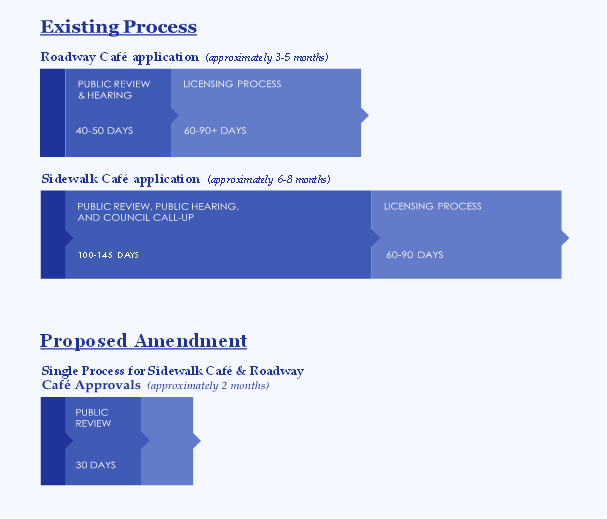
The first ballot question would amend the Charter to streamline the process to use public space for uses like ramps, benches, planters, and cafes. Should the ballot measure pass, this process, known as revocable consent, would be revised in several ways. First, with respect to revocable consents generally, the proposed amendment would remove the mandatory public hearing, modernize the public advertisement requirements and direct the Department of Transportation to use alternative methods to seek public input. Second, with respect to revocable consents for sidewalk cafes, the proposed measure combines the roadway cafe application and sidewalk cafe application into one application. Currently, sidewalk café applications take six to eight months, and roadway café applications take three to five months. Replacing these two processes with a single, streamlined process will result in one process that takes approximately two months.
Why does ballot question #1 matter?
New York City is an outdoor city. Our streets and sidewalks are where New Yorkers connect and congregate, escaping small apartments and office buildings for block parties, bike rides, and public concerts. Yet too often areas that should be easy to access can be locked up in bureaucratic mazes and red tape. Public spaces are sites of creativity and entrepreneurship and should represent all that is vibrant, social, accessible, and engaging about New York City.
Revocable Consent
Context
New York
City’s streets and public spaces are enhanced by private uses that serve
residents and visitors alike. Hotels may install planters to improve
streetscapes, restaurants may operate outdoor dining areas, and property owners
may construct accessibility ramps, stoops, benches, or other structures within
the public right-of-way. Because these uses occupy City property, they
generally require a revocable consent issued by the Department of
Transportation (DOT).
While it is essential that the City retains oversight of its property, COGE
received compelling testimony that the Charter provisions governing revocable
consents have created an unnecessarily lengthy, expensive, and administratively
burdensome process.[18]
These requirements delay projects, increase costs for applicants, particularly
small businesses, and consume significant City resources without providing
commensurate public benefit.[19]
A revocable consent grants a person or entity the right to construct and maintain certain structures on the City’s inalienable property, including streets and sidewalks.[20] The Charter establishes a multi-step approval process. After an application is submitted, DOT must hold a public hearing.[21] Section 371 of the Charter requires applicants to publish notice of the hearing twice, at their own expense, in both a daily and weekly newspaper. Additional notice may also be required for affected Borough Presidents, Community Boards, and Council Members.[22] These publication costs, required to be paid by the petitioner, may be as high as $1,500. The Commission received testimony highlighting the expense of the entire process, which one restaurant owner estimated to be $70,000, which precludes many restaurants from pursuing outdoor dining at all.[23] In addition, notice of the hearing must run in the City Record for three weeks.[24] Once DOT approves a revocable consent, the Mayor must, with limited exceptions, separately approve the consent agreement, and finally, the consent agreement must be registered with the Comptroller.[25] Although revocable consents remain revocable at any time by the City and cannot be transferred without DOT approval, applicants must nonetheless complete this lengthy process before receiving authorization to use City property.[26] Revocable consent holders are also required to pay annual compensation to the City for the use of the property.[27]

COGE heard consistent testimony highlighting the lengthy and costly process associated with obtaining a revocable consent, the substantial fees associated with the publication requirement for revocable consents, and the general lack of attendance at the required public hearings.[28] In some cases, required publication costs exceed the applicant’s annual revocable consent fee.[29] Witnesses described spending countless hours navigating the application process and that the complexity and expense of the revocable consent process may prevent small businesses from even applying.[30] Council Member Gale Brewer has similarly testified before another Commission that the existing revocable consent process creates unnecessary “encumbrances” to reasonable uses of the public right-of-way and suggested replacing many revocable consents with a more straightforward permitting process.[31]
COGE received testimony reflecting broad support for streamlining the revocable consent process generally and the outdoor dining process specifically.[32] Although outdoor dining represents only one category of revocable consent, it illustrates many of the broader procedural challenges affecting the current system. History Outdoor dining presents an additional layer of complexity because sidewalk cafés and roadway cafés are governed by separate approval processes. As a result, a restaurant seeking to operate both must pursue two distinct applications, increasing costs, administrative burdens, and processing time.
The City has permitted sidewalk cafes since at least 1934.[33] Initially, sidewalk cafés required a license issued by the Department of Licenses with approvals from the Police Department and the local Borough President. Over time, responsibility for administering the program shifted among City agencies.[34] In 1975, voters approved the Uniform Land Use Review Procedure (ULURP), requiring revocable consents for uses of City property, including sidewalk cafes, to undergo review by Community Boards, the City Planning Commission, and the Board of Estimate, in addition to other licensing requirements. In 1982, the City Council established an alternative process for sidewalk café revocable consents that remained separate from, but less burdensome than, ULURP, while retaining additional licensing and approval requirements.[35]
During the COVID-19 emergency, the City temporarily suspended many of these requirements through the Open Restaurants program, allowing restaurants to establish sidewalk and roadway dining through a streamlined self-certification and registration process rather than individual licenses and revocable consents. At its peak, approximately 11,770 restaurants participated in outdoor dining.
Following the expiration of the COVID-19 emergency, the City enacted Local Law 121 of 2023 to permanently reform outdoor dining. The law transferred responsibility for outdoor dining from the Department of Consumer and Worker Protection to DOT, established new procedures for sidewalk and roadway café revocable consents, and was accompanied by a citywide zoning amendment adopted by the City Planning Commission.[36] In 2024, DOT implemented the law through rules establishing the Dining Out NYC program.
Although Local Law 121 substantially improved the outdoor dining framework, significant inefficiencies remain. Sidewalk cafés continue to require approvals from DOT, the local Community Board, the City Council, and the Mayor, while roadway cafés require approval only by DOT following notice to the local Community Board and Council Member and a public hearing.[37] Testimony noted that the process for obtaining a revocable consent, estimated to take six months, can result in restaurants not opening their outdoor dining until the year following their initial application and has urged the Commission to remove the revocable consent process altogether.[38] Since Dining Out NYC replaced Open Restaurants, the number of authorized outdoor dining establishments has declined significantly. As of July 6, 2026, DOT had fully issued only 1,549 outdoor dining licenses.[39]
Maintaining separate approval processes for sidewalk and roadway cafés also imposes unnecessary costs on restaurants. Because the two applications frequently proceed on different timelines, applicants often must participate in separate public hearings and pay publication costs twice for a single outdoor dining operation.
COGE’s Proposal
COGE explored ways to reduce the time, cost, and administrative burden associated with revocable consents while preserving appropriate public oversight and the City’s stewardship of its streets and public spaces. COGE’s proposal would remove the requirement that all revocable consents undergo a public hearing. Instead, DOT or the Office of Technology and Innovation (which grants revocable consents for telecommunications purposes) could choose whether to hold a public hearing on a proposed revocable consent in its discretion.
Notice of a public hearing for a revocable consent or a franchise would no longer need to be published in newspapers, and notice would only need to be published in the City Record for six days, instead of 15. Importantly, the proposal would continue a public review process: DOT or OTI would need to provide notice of a petition for revocable consent to the Community Board, City Council member, and Borough President, and provide an opportunity for them to submit comments. Community Boards, Borough Presidents, and City Council members could waive their right to receive notices for certain types of revocable consents.
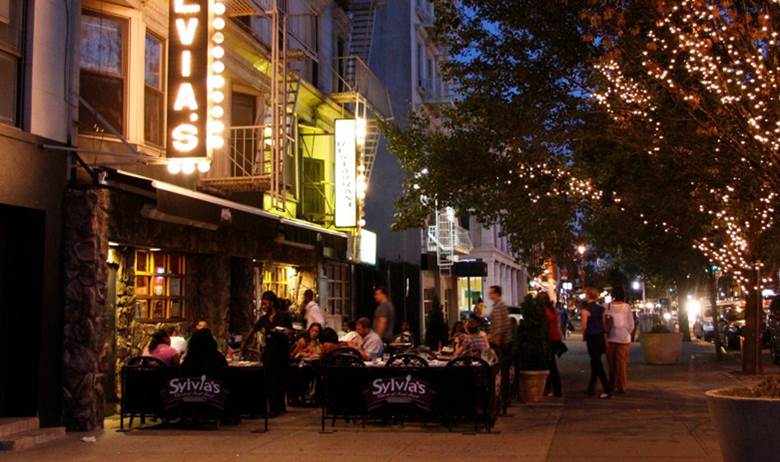
Sidewalk cafes would become subject to the same process as all other revocable consents. This would mean that petitions for revocable consents for sidewalk cafes would no longer be subject to review by the Community Board, and the City Council would no longer be able to disapprove the granting of a revocable consent for a sidewalk cafe. Today, all sidewalk cafe applications must be filed with the Council, which has the opportunity to “call up” or resolve to review the application.[40] The Council rarely exercises its power to review a sidewalk cafe, and even among applications that are reviewed, the majority are approved. Nevertheless, the time between filing the application and the Council decision to review the application adds delay. By the same token, the requirement that DOT notify the City Council member of the petition maintains Council involvement in the review of the revocable consent application.
In addition to the ballot changes, the Commission is pleased to recognize that DOT will launch an initiative to clear the backlog of revocable consent applications such that, by the time the ballot measure goes into effect, if adopted, the final processing phase—currently 60-90 days—will be approximately 14 days. Both the current process and the revised process diagramed below assume continuation of current agreement with Comptroller, which allows for opening of a cafe in parallel to Comptroller registration.
See figure below which compares the existing sidewalk and roadway processes to the proposed simplified process.
Question 2: Reform the Contracting Process to Improve Small Business and Nonprofit Opportunities to Work with the City
What would ballot question #2 do?
The second ballot question would bring greater transparency to the City’s procurements, reduce burdens for City contractors by simplifying the pre-contracting questionnaire, and simplify internal procurement processes by authorizing the Mayor to delegate certain contract approvals to the contracting agency. Additionally, to free up significant amounts of staff time, the proposed amendments would simplify a mandatory client services plan. Additional non-charter reforms also impacting contracting—including significant improvements to the nonprofit procurement process—are detailed in the Appendix.
Why does ballot question #2 matter?
New Yorkers move fast. Yet too often the services and programs our communities rely on take far more time than New Yorkers can afford to wait. A government that moves quickly and delivers high-quality results can help restore public faith in our city’s ability to tackle the challenges our residents face. In addition to mattering to everyday New Yorkers, improving the procurement process also matters to City government and contractors. Any City agency that needs to build or buy anything, from affordable housing to homeless services, is caught up in a bureaucratic morass. This ballot question will cut the red tape government faces as it works to serve New Yorkers.
The City’s procurement of nonprofit services was of particular focus to the commission and are a large part of why ballot question #2 matters. Nonprofit organizations are vitally important both to their communities and to the City, which depends upon the nonprofit sector to provide incredibly important services across the five boroughs. Nonprofit providers step in where the need is greatest, helping families find housing, giving young people summer jobs, feeding seniors, defending tenants, and forming the basis of the social safety net of which New York City is so proud. It would be hard to overstate the importance of the services provided by nonprofit providers, and yet the process the City goes through to hire nonprofits to do this essential work is mired in red tape that cause significant financial and operational problems for the nonprofits and those they serve.
Procurement
Context
Procurement – that is, the purchase of goods, services or construction -- in the City of New York affects almost every aspect of City government and public life. In Fiscal Year 2025, the City procured goods and services from outside contractors worth $42.3 billion – nearly 40% of the City’s budget.[41] The City relies on vendors to provide a wide array of City services, from afterschool programs to landscaping to software development. The City’s infrastructure, from wastewater treatment systems to parking garages to solar panels built atop our cultural institutions, are largely built through contracted labor. The City also purchases numerous goods, from pencils to fire hoses to vehicles. These goods and services are necessary for City agencies to run smoothly and deliver on their missions.
Procurement is a critical tool for the City to deliver services, and the City’s use of procurement has only grown over time. However, the Charter provisions governing procurement have remained largely unchanged since 1989, when voters adopted a wholesale change to the City government that replaced the Board of Estimate with the City’s current governmental structure. Today’s problems with procurement are much the same as they were in 1989. Testimony received by the Commission reveals a complex process that results in long cycle times to procure new goods and services, creates challenges that block small businesses from competing, and is plagued by delayed payments to contractors.[42] While many issues with the City’s procurement process stem from the complexity of its contracts, insufficient personnel and State-law hurdles, the Commission considered whether changes to the Charter could reduce the burdens imposed on small businesses and hasten the speed with which the City enters into contracts.
 |
Citywide Procurement by Industry-Fiscal 2025
A typical procurement follows a circuitous route through numerous City agencies. Take, for instance, a standard procurement for human services through a Request for Proposal (RFP).[43] The RFP process begins with the Pre-Solicitation step, which includes the initial planning and completion of a pre-solicitation review that must be approved by the Office of Management and Budget (OMB) and the Mayor’s Office of Contract Services (MOCS). After approval, the agency can release the solicitation, which is published for a median of 50 days. Once proposals are received, agencies complete their evaluations, a process that has a median cycle time of 130 days. Once the agency recommends a proposer for award, the agency must determine that the selected vendor is responsible and the contract must be negotiated and executed. This stage can include finalization of scope of services, reimbursement rates, and salary levels.[44]
At each step, the procurement may be reviewed by various oversight entities including MOCS, OMB, and the Law Department. MOCS verifies that proper procurement and contracting procedure is being followed. OMB ensures that there is sufficient funding for the contract in the relevant agency’s budget, and, if being funded via the City capital budget, that a given project meets capital eligibility requirements. The Law Department confirms that the contract complies with all relevant laws, that its terms adhere to relevant citywide practice and also does not expose the City to unnecessary legal liability. Each of these oversight stages can require significant back and forth between the oversight entity and the contracting agency — with the contracting agency having to confer with the vendor if the information requested by the oversight entity is not readily available. These approvals during the award stage after vendor selection add a median of over 100 days to the process. Finally, the agency submits the contract for registration with the Comptroller, who has up to 30 days to do so.[45] COGE heard testimony that it can take at least a year for human services contractors to receive payment for services rendered.[46] Public testimony also described how under the current system, contractors often have to take out loans to cover their financial gaps while they await payment from the City.[47] As one testimony described, “we are now paying interest when we have to get loans because we are not reimbursed. That money should be going back into programs, into our services that we provide.”[48]
The number of steps involved in the procurement process are all aimed at ensuring that the City’s dollars are being spent lawfully and carefully. These steps include the numerous internal processes described above, as well as requirements imposed on vendors, including completing PASSPort disclosures and questionnaires, described in greater depth below. But in addition to all of these pre-contract checks, City contracts are also subject to robust post-contract audits, including from the City Comptroller, the State Comptroller, the Department of Investigation and internal agency audits. These audits are critical in ensuring that the City’s dollars are spent prudently, that vendors are complying with the terms of their contract, and that City contracts are well-designed to prevent program fraud and abuse. Any proposed changes to the City’s procurement system must ensure that integrity checks are not compromised and that City vendors continue to adhere to strong labor practices and do not engage in unlawful discrimination.[49] History The City’s current byzantine procurement system is in many ways a reaction by policymakers to various corruption scandals and incidents of substantial mismanagement, including, most prominently, the Parking Violations Bureau scandal in 1986. The Parking Violations Bureau scandal, which erupted during the Koch Administration, was the stuff of tabloid headlines: the revelation of a multimillion-dollar kickback scheme involving collection of unpaid parking tickets, leading to the suicide of one of the alleged principal perpetrators and high-profile prosecutions of City officials involved in the scheme.[50]
Thrust into the limelight, procurement became the topic of numerous government reports in the late 1980s, which faulted the City’s contracting operations as “awash in a sea of paper, plagued by inordinate delays and clouded by unclear and inconsistent rules and procedures which slow City business to a crawl and discourage vendors from stepping forward to bid.”[51]
Prior to 1989, procurement policies previously were highly fragmented, complex and opaque, with wide variances in procedures across agencies and lacking centralized oversight. Prior to its abolition in 1989, the Board of Estimate possessed a variety of powers relating to procurement.[52] The 1989 Commission, convened in the wake of the Supreme Court decision striking down the Board of Estimate, proposed instead to vest the Mayor with oversight of the City’s procurement.[53] The Charter entrusted to the Mayor and their agency appointees broad powers to manage each specific procurement, many of which were previously held by the Board of Estimate. In addition, the new Charter, based on recommendations from the American Bar Association Model Procurement Code, established the Procurement Policy Board (PPB), which was given responsibility to establish rules and policies for procurement but not have involvement in the procurement process itself.[54] The Charter also included a requirement for public hearings on certain contract awards. The basic framework proposed by the 1989 Commission – and ultimately adopted by the voters – remains today. With the experience of more than a quarter century, it is clear that many of the 1989 reforms were successful, but certain procedural steps in the procurement process, coupled with additional regulations added after 1989, contribute to some of the inefficiencies and burdens that plague procurement today. COGE’s Proposal COGE proposes easing procurement along three axes: (1) less paperwork to reduce burdens for small businesses, non-profits, and other entities doing business with the City; (2) more transparent and simplified regulatory structure governing procurements; and (3) fewer reporting requirements to free up staff time that would be better spent on substantive reviews. Combined, the areas below would save small businesses dozens of hours of work per contract, ensure a 12% reduction of the City’s procurement timeline, and free up hundreds of hours of work at each agency across the city.
Less paperwork to reduce burdens for small businesses, nonprofits, and other contractors
· Vendor Questionnaires: To reduce burdens on small businesses and others, COGE proposes to streamline existing questionnaire requirements. The Commission received testimony regarding the burdens of the PASSPort questionnaire, and in particular the challenges it creates for small businesses.[55] These questionnaires, which must be completed by vendors before they can be awarded a contract, contain information about the vendor, its principals and its affiliates and a long series of questions relating to past performance, investigations, and issues. Simplifying the questionnaire will not only reduce the burden on small businesses, nonprofits, and others, but as a result may also increase interest in contracting with the City and therefore overall competition. Lower barriers to entry mean more opportunities for vendors and better, more cost-effective results for the City.
· Today, local law provides strict requirements that must be included in the questionnaire. The questions do not vary by type of vendor or the nature of the contract at issue.
· The Commission proposes to grant the PPB the authority to determine the questions that are part of the questionnaire and to vary the specific questions that must be answered by category of vendor and contract value. Such a change could provide measurable relief to small businesses; and by making contracting easier, it may also increase competition by encouraging more vendors to bid on City contracts, ultimately driving down costs and improving performance.

Faster process to expedite procurements and contract administration
Even small improvements in procurement cycle times can have an outsized impact over the City’s portfolio of over 198,000 annual transactions.[56]
· Public Notice: To speed up in the procurement process, the Commission proposes to make permanent a public comment period instead of a public hearing for contract awards. The Charter previously required agencies to hold a hearing before entering into contracts over $100,000 that were awarded by other than competitive sealed bids.[57] These hearings would typically delay a contract by at least 30 days and were poorly attended. This provision, added in 1989, was the subject of substantial debate by the 1989 Charter Revision Commission with some members of the Commission worried that these contract hearings “would waste agency time and add the very inefficiency” the Commission was trying to avoid.[58] State law recently amended this provision of the Charter, replacing the public hearing requirement with a public comment period.[59] But the State law expires at the end of 2030. The Commission proposes to make this change permanent and to provide the PPB with the authority to determine the threshold for contracts subject to this requirement.[60] A higher threshold would save an additional two weeks for these contracts.
· Delegation of Approvals: To simplify procurement approvals, COGE also proposes to amend the Charter to authorize the Mayor to delegate certain approvals to agency chief contracting officers. Various sections of the Charter require Mayoral approval for certain types of contracts and for use of certain procurement procedures. The Mayor may delegate these powers to the City Chief Procurement Officer; however, the Mayor is precluded from further delegating the approval to the agency chief contracting officer.[61] The Commission proposes to authorize the Mayor to further delegate this authority. This could save one to two weeks and could affect more than 120 contracts annually. Of course, periodic reviews of any delegated function will remain to ensure satisfactory performance, and delegations would remain within the discretion of the Mayor and relevant Deputy Mayor.
· Regular Procurement Policy Board meetings: In response to compelling testimony on the need for greater transparency and predictability in the City’s regulation of procurements, the Commission proposes to require the Procurement Policy Board to meet at least quarterly to strengthen oversight, improve accountability, and enable more timely updates to procurement policy.[62] More frequent meetings will allow the Board to respond more quickly to emerging challenges and provide a regular forum for reviewing and improving the City’s procurement practices.
Eliminate unnecessary reporting to free up staff time to work on substantive reviews
· Client Services Plan: The Charter requires agencies that award client services contracts to annually produce a draft and final plan detailing anticipated contracting actions for the fiscal year and hold at least one public hearing each year following release of the plan.[63] The multiple drafts and requirement for public hearings, which have little to no attendance, create duplicative work for agencies, take time and resources away from their primary responsibilities, and do not provide a meaningful opportunity for the public to engage. To save hundreds of hours of staff time, COGE proposes to revise these provisions to authorize the publication of the report without the need to first publish a draft report and hold a public hearing.
 |
Note: See Appendix for descriptions of the related internal reforms the City is undertaking.
Question 3: Speed up Street Safety Projects, Office Leasing, and Activation of City Land
What would ballot question #3 do?
The third ballot question would amend the Charter to simplify review of street safety projects and reduce construction timelines. It would also fast-track sale or lease of modest City properties, the air rights above City-owned landmarks, and lease of office space for City workers.
Why does ballot question #3 matter?
Street safety projects that improve dangerous intersections are too often stalled by unnecessary process requirements, allowing government bureaucracy to get in the way of saving New Yorkers’ lives. New Yorkers must be our first priority, not complex internal documentation processes that push paper instead of making school drop-off safer. Additionally, the City—unlike any private entity—must go through long land use review processes in order to be allowed to sell land, including air rights. Sale of land is simply a change in ownership; any significant project undertaken by the new owner beyond as-of-right then goes through the same land use review process again. The lengthy process for gaining the authority to dispose of City property makes little sense for the City’s small, unused, surplus properties that are no longer needed for City purposes and whose disposition will have little to no effect on the surrounding neighborhood. Similarly, the current lengthy process for gaining the authority to sell air rights over City-owned landmarks essentially traps those air rights, which means lost revenue that could go to supporting the maintenance of the landmarks. A faster process would help the City sell or lease surplus properties and air rights over landmarks, rather than paying money to maintain properties it no longer needs. Finally, the City must be able to compete in the rental market and should not have to go through long processes to rent office space, wasting taxpayer dollars and missing out on superior properties for City workers.
Major Transportation Projects
Context
New York City’s streets have continually evolved to meet the changing needs of its residents. However, some street redesign initiatives, including those focused on addressing dangerous intersections or increasing pedestrian safety, are subject to mandated delays that slow down the projects and, in so doing, risk lives and injuries. Under the Charter, a “major transportation project”—defined as a project affecting 1,000 consecutive feet of roadway or four consecutive blocks, whichever is less, or any bike lane regardless of length—must undergo consultation with four separate agencies before the Department of Transportation (DOT) may certify compliance.[64] Projects involving bike lanes are subject to additional procedural requirements.[65] As part of this process, any agency implementing a major transportation project (most often DOT) must notify various officials and the local community board and give a presentation to the community board upon request. The agency must also consult with other agencies, including the Police Department and Fire Department, and the Fire Department must confer with affected firehouses near the major transportation project. The agency implementing the project must certify that all of these consultations took place.[66]
These presentation and certification requirements can cause substantial delays in the implementation of street safety projects.[67] In particular, the requirement that an agency implementing a major transportation project certify that the Fire Department conferred with affected firehouses involves extensive paperwork that can prevent street safety projects from moving forward. Litigants can sue to stop a project where they allege that an agency did not properly follow this process.[68]
COGE heard consistent testimony that street redesigns, including improved traffic signals, roadway markings, bus lanes, bike lanes, pedestrian islands, and other safety enhancements, are essential to protecting everyone who uses the City’s streets while improving the reliability of the transportation network.[69] COGE heard testimony from delivery workers whose livelihoods depend on safe bike infrastructure, bus riders seeking more reliable service, and residents who simply want to travel safely, that the City should deliver street safety improvements more quickly.[70] The Commission heard testimony that the major transportation project requirements consume substantial staff time, delay critical safety improvements, and increase the risk of litigation, often without improving project outcomes.[71] As a result, projects that could reduce crashes and save lives may be postponed for months or longer.[72] One example is DOT’s planned safety improvements along Baychester Avenue in Co-op City in the Bronx. Developed in response to requests from parents and school administrators after more than a dozen children were injured along the corridor, the project would reconfigure travel lanes, improve school loading areas, expand curb space for buses, and enhance pedestrian safety for the approximately 5,800 students who travel through the area. Because the project qualified as a major transportation project under the Charter, implementation was delayed by nearly a year.[73]
In 2025, DOT designated 37 projects as Major Transportation Projects (MTPs). Of those, 13 were delayed due to the MTP review process. As a result, these projects missed the 2026 construction season and were deferred to various points in 2027. All but two of the delayed projects involved the installation of bike lanes.
History
While the vehicles on City streets have changed over time, so too has the way those streets are designed and used. There was no overnight parking until the 1950s Fifth Avenue remained a two-way street until 1966, bus lanes did not appear until 1963, and the City’s first bike lanes were not installed until 1978.[74] More recently, the City has transformed its streets through safety-focused improvements designed to make travel safer, more efficient, and more accessible for all New Yorkers.
Since the launch of Vision Zero in 2014, the Department of Transportation has made important strides in street safety. These improvements have contributed to measurable reductions in traffic fatalities across neighborhoods of every income level, with the greatest reductions in pedestrian fatalities occurring in the City’s lowest-income communities, on average 34%.[75] Individual projects have also demonstrated substantial safety benefits. For example, the installation of a protected bike lane on Third Avenue in Manhattan reduced total injuries by 33 percent and injuries to drivers and passengers by 43 percent.[76] These improvements save lives and benefit pedestrians, cyclists, motorists, bus riders, delivery workers, and everyone else who relies on the City’s streets.
COGE’s Proposal
Unnecessary procedural requirements should not impede the timely delivery of proven safety improvements. Modernizing the Charter’s major transportation project provisions would allow DOT to implement life-saving street redesigns more efficiently while continuing to engage affected communities and agencies and maintain appropriate public accountability.
This proposed Charter amendment would eliminate any requirement that an agency that is consulted about a major transportation project must itself confer with specific sub-components of that agency. This would mean that, while DOT can still be required to consult with agencies such as the Fire Department, the Fire Department can no longer be required to confer with certain local firehouses when DOT proposes a major transportation project. This is meant to reduce delays that result from mandatory intra-agency consultations, which micromanage agencies within themselves. Agencies are best positioned to determine who within their own agencies has the greatest expertise on a specific issue. Determining who within an agency has the relevant expertise to address a particular matter is a core structural function of agency heads. COGE anticipates that these amendments would accelerate the delivery of street safety and infrastructure projects, including bike lanes and bus lanes, reducing project timelines by at least 33%.
In addition, this proposed Charter amendment would allow DOT to start work on a project before making a presentation to a community board, where DOT determines that there is a risk of significant injury that may occur absent immediate implementation based on factors including crash data and other consideration relating to the need to preserve public safety. This change, if adopted, would enable DOT to commence work on important road safety projects in parallel with any required notification and presentation requirements.
Finally, this proposed Charter amendment would provide that failure to consult with an agency would not affect the validity of a project. If this amendment were passed, DOT would still be required to consult with other agencies and give presentations at the request of a community board before implementing a major transportation project, but a lawsuit could not stop the implementation of a street safety project based on technical errors in following that procedure.
These reforms would help DOT deliver life-saving transportation projects more efficiently while maintaining transparency, accountability, and meaningful community participation.
Disposition of Surplus Lots
Context
The City uses City-owned land to meet its residents’ needs, from parks to affordable housing to libraries. City-owned property also plays a critical role in delivery of government services and includes essential institutions such as courts, schools, historical buildings, and community facilities. Strategic planning with regard to the City’s property allows the City to respond to ever-changing agency needs and leverage the value of the limited land resources in the City’s portfolio. Dispositions – that is, sales or leases – of City-owned property are subject to a process known as the Uniform Land Use Review Procedure.[77] This involves a seven-month review process in which the affected Community Board and Borough President provide recommendation; the City Planning Commission (CPC) reviews and issues either an approval or disapproval, followed by review by the City Council.[78] The laws governing the dispositions of most City-owned property date back to the 1989 Charter Revision Commission. At the time that the 1989 Commission was evaluating the process for disposing of public land, the City had a massive portfolio of properties acquired via abandonment and tax foreclosure in the aftermath of the City’s fiscal crisis and population decline in the 1970s. These included entire blocks of housing. Because these properties were so significant, significant land use review processes made sense, as selling them often had a similar functional impact as, for example, a rezoning.[79]

Today, that supply of City land has largely been developed. Instead, much of the City’s existing portfolio is comprised of small lots which are subject to the same ULURP as the large vacant lots of the 1980s. A key responsibility of the Department of Citywide Administrative Services is selling or leasing land that the City no longer needs. These include properties that were once used for municipal purposes, but do not meet modern agency needs or standards, such as decommissioned pumping stations. Yet, the length, cost, and uncertainty of proceeding through the approval process means that these properties remain trapped — sitting fallow and generating neither public benefit nor tax revenue, because it is simply not worth the ULURP required to authorize their sale. As a result, authorization for standalone dispositions – that is dispositions that are not accompanied by another zoning action – are relatively rare. Indeed, DCAS has submitted an average of less than one standalone disposition per year, not including sliver lots that are sold to an adjacent owner. This means that properties that could be put to productive use sit empty.
For example: On Winman Avenue sits an unused former Department of Environmental Protection Pumping Station. Decommissioned in the 1990s it was transferred to the Department of Citywide Administrative Services. It has sat unused for almost three decades. Due to budget constraints the site only receives irregular maintenance and has been repeatedly cited as a blight on the neighborhood.[80] Because of processes detailed in the Charter disposing of the property is lengthy and complex—leading it to sit abandoned rather than returned to productive use.
History
New York City voters have recently tackled part of the dispositions issue. In last year’s Charter amendments, voters created a faster process to dispose of properties for affordable housing projects as well as properties that “cannot be developed… [due to their] size, shape, applicable zoning, configuration or topography render such development economically impracticable or infeasible.”[81] Such properties instead travel through an Expedited Land Use Review Process “ELURP” which shortens the disposition process to only 90 days while ensuring that Community Boards and the Borough President still have a chance to review dispositions (just as in ULURP). However, there are sometimes properties that are developable. For example, take the former Winman Avenue Pumping Station described above: a 6,000+ square foot lot that is zoned for a one or two-family home. By all accounts it is independently developable, but it is too small for the City to build affordable housing on and the seven month ULURP process is too complex and expensive for the City to undertake. So instead the lot has sat unused for over 30 years.[82]
COGE’s Proposal
COGE proposes to expedite the disposition process for small City-owned lots that are less than 10,000 square feet and are not individual landmarks that have been designated by the Landmarks Preservation Commission. This small subset of City owned properties would be subject to the Expedited Land Use Review Procedure, as set forth in section 197-e of the Charter.
Disposition of these properties would remain subject to a robust public review process with review by the affected Community Board and Borough President, and final decision by the City Planning Commission. These amendments would reduce the timeline for authorizing the sale or lease of small parcels of City-owned land from approximately seven months to 90 days. The proposal is limited in a number of ways. First, ELURP maintains significant public review processes and continues to require an environmental review. If a project requires an environmental impact statement under state and local law, it will remain subject to ULURP in order to receive a more extensive public and environmental review.
The proposal is limited in a number of ways. First, ELURP maintains significant public review processes and continues to require an environmental review. If a project requires an environmental impact statement under state and local law, it will remain subject to ULURP in order to receive a more extensive public and environmental review.
Second, only properties located on a lot size of smaller than 10,000 square feet are eligible for a disposition via ELURP. While these relatively small lots constitute the majority of the City’s lots that it may wish to dispose of, they account for a minority of the total land. Currently DCAS has just over a square mile of vacant land spread across approximately 1,500 vacant lots. However, only 6% of that land would be eligible for ELURP, ensuring that this proposal is specifically targeted towards only the small and modest lots that the City currently finds difficult to sell or activate. Third, no individual landmark would be subject to the expedited process. Finally, even after a property is approved by the City Planning Commission for a disposition via ELURP, it still undergoes a public auction process ensuring that the City gets the best possible price for its land.
The diagram below illustrates the distribution of lots under DCAS jurisdiction.
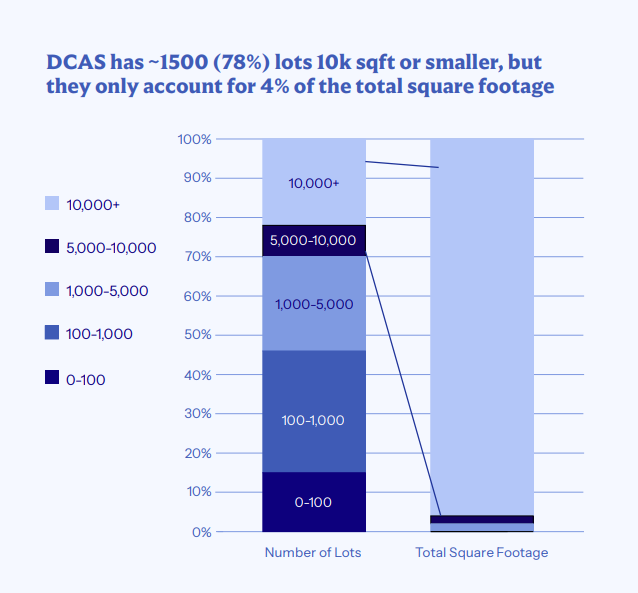
Even once the City obtains the necessary approvals to dispose of property it no longer needs, the disposition must be effectuated by yet another process that can add another year or more to a project—typically either through auction or negotiated disposition. In certain instances, DCAS is also required to hold an additional hearing on the sale or lease of property. Since December 2022, DCAS has held 34 of these hearings and received testimony in only two; in both those hearings, the testimony supported the DCAS auction. COGE proposes to remove the public hearing required after the City has already received authorization to dispose of its property. If more than two years have elapsed between the final approval of a disposition pursuant to ULURP and the execution of an agreement actually disposing of such property, the City is required to hold an additional hearing with public notice published 45 days in advance of that hearing. In light of the fact that these hearings are so sparsely attended, this source of delay can be removed without a significant impact on public oversight.
Disposition of development rights from landmarks
Context
A similar situation exists with the unused development rights of New York City’s landmarked properties, with the City sitting on valuable assets it cannot monetize. In New York City, every lot is zoned for a specific amount of development. For example, a 10,000 square foot lot in a low-lying residential neighborhood might be zoned for a building with 5,000 square feet (a one-story building), while a similarly sized lot in mid-town might be zoned for 180,000 square feet (a 30 story building). For many properties the current building on the site is built to a size that is less than the zoning allows. For most property owners this is not an issue—if they so choose, they can extend their existing building to use the full buildable square footage allocated by zoning. However, for landmarked buildings, where the buildings are historically or architecturally significant, a property owner may not be able to modify a building to use the unused square footage. Absent any way to use the square footage on the lot the unused development rights (colloquially known as “air rights”) can become trapped.[83]
History
Since 1968 New York City has had a zoning mechanism to transfer the unused development rights of a landmarked building to a nearby property.[84] As set out in the 1968 zoning code, section 74-79 allows the City Planning Commission (with City Council approval) to grant permission for a special permit to transfer development rights from a landmarked property to a receiving site. However, over the half century that the program has existed only 12 properties ever utilized the mechanism.[85] A report discussing the history of the program and why it has been under-utilized noted several reasons for why the program has been rarely used, but noted in particular “the Special Permit requirement, which entails expensive and uncertain public review [through ULURP],” which one estimate put as costing up to $750,000.[86]
In 2024, in part due to recognition of the challenges with the existing program the City Council modified the Zoning Resolution to create a simpler to use process as part of the City of Yes for Housing Opportunity reforms.[87] Since that process was amended, one project has already completed the process with another approximately 10 projects in process. The City Council’s changes have been immediately effective compared to a program than in 50 years completed only 12 transfers, with none since 2009.
The new transfer program requires a public hearing before the Landmark Preservation Commission, and often includes presentations before Community Boards. It also ensures that any landmarked property making use of this provision is appropriately maintained by requiring both up-front restoration work to bring a landmark into “sound” condition and a continuing maintenance plan which ensures that the building is maintained over the long term. Through this program, landmarked properties are able to sell formerly trapped development rights and raise funds to maintain the buildings ensuring they are preserved.
However, New York City itself is not able to fully benefit from this program. Because all City dispositions currently require ULURP, even the disposition of development rights much go through the seven-month process that was identified as a key hurdle to the older program. The result is that many City-owned landmarks are deprived of resources that could go to the restoration and maintenance of these important historic assets, and development rights that could help address the City’s need for new housing and economic opportunity remain trapped and unused. To this point, the Commission heard testimony from the Fire Department, noting that a number of firehouses are landmarked and that transfer of their development rights could help with upkeep of these critical – and historically significant – neighborhood fixtures.[88]
Enabling the transfer of development rights programs for landmarked buildings is recommended by government and experts alike. For example, the Advisory Council on Historic Preservation, the nation’s federal preservation agency, formally recommends such programs stating that “Public-serving institutions should support zoning code changes that encourage greater density and availability of housing in tandem with preserving historic buildings.”[89] However, as historic preservationist Sara Bronin noted in testimony before the Commission, “the City itself cannot utilize this improved process.”[90]
COGE’s Proposal
To ensure that New York City can utilize the development rights it controls that are currently “trapped” by the complexities of the ULURP process this Commission proposes that the transfer of development rights where the granting site is a City-owned landmark be subject to the 90-day ELURP process, with final approval authority vested in the City Planning Commission after a public review process by the affected Community Board and Borough President. Such a process will still ensure ample public review of any proceeding (including a public auction process), but will help the City secure funds to maintain its landmarked properties. While the proposal for expedited dispositions of land, described above, specifically exempts landmarked buildings, this separate proposal respecting the disposition of landmark development rights helps ensure that City-owned landmarks can benefit from the sale of the development rights above them even as City-owned landmarks remain under City stewardship.
Disposition to neighboring property owners without an auction
Context
The City owns a number of properties that “cannot be developed due to [their] size, shape, applicable zoning, configuration or topography, which factors, singly or in combination, render the development of such property economically impracticable or infeasible.”[91] As such, they are useless to all but adjacent property owners, severely restricting potential purchasers and likely obviating the need for an extensive notice, hearing, and auction requirement. For that reason, these properties are not well-suited for public auction.
History
In 2010, state legislation temporarily relieved DCAS of the public auction requirement for sliver lots, accessways, and interior lots — authorizing the “SAIL Away” Program — though the process requires a public hearing, mayoral authorization, and a 30-day posting after land-use approval. The legislature has renewed this authorization for five-year intervals since 2010, most recently extending it in 2025 until 2030.[92]
In recent years, the SAIL Away direct sale program has become the most active of DCAS’s disposition mechanisms, with multiple dispositions each year. Last year, New York City voters approved a change that subjects SAIL Away properties to ELURP, rather than ULURP, meaning that the City can obtain the authority to dispose of these properties more quickly. This change is likely to enable DCAS to respond more quickly to purchase requests from adjacent owners, making it all the more important to make the SAIL Away program permanent. COGE’s Proposal The Commission’s proposal makes the SAIL Away program permanent, so that the City does not need to seek periodic reauthorization. This will enable the City to benefit from this program that has proven useful in disposing of these odd lots.
Office Leases
Context
The Charter also imposes a number of requirements governing the City’s lease of office space for the City workforce. Unlike the private sector, the City is required to go through a multi-step approval process before it can lease out office space. Specifically, the Charter requires the City Planning Commission to hold a hearing and approve office leases and purchases, even if City is moving into an existing commercial office building. After the City Planning Commission approves the office space, the City Council then has 20 days to disapprove of the acquisition.[93] This slows the City down compared to private sector counterparts by imposing additional layers of review even when there is no meaningful land use impact as changing

the lessee of existing office space does not alter land use or change the characteristics of a neighborhood. In turn, this slowdown often causes the City to lose out on properties that would have been financially or programmatically advantageous to the City and for public use.
History
The current process slows the City down compared to private sector counterparts by imposing additional layers of review even when there is no meaningful land use impact, as changing the lessee of existing office space does not alter land use or change the characteristics of a neighborhood. In turn, this slow-down often causes the City to lose out on properties that would have been financially or programmatically advantageous to the City.
There is no question that the City’s disposition of its property and acquisition of City office space must remain subject to sufficient oversight to ensure that transactions advance the City’s best interests. This includes ensuring that City dispositions and office-lease acquisitions continue to receive robust community input. It also means that these transactions will remain subject to the vitally important existing oversight mechanisms within the City that have proven particularly adept at identifying and bringing to light untoward transactions and corrupt behavior. But the need for oversight should not result in paralysis.
COGE’s Proposal
COGE proposes to amend the Charter to authorize a quicker process for City office leasing. Currently, any proposed acquisition of office space for City workers, including leases of office space in existing buildings, must undergo a process that includes notifying the local community board and all borough presidents; a hearing and vote by the City Planning Commission; and an opportunity for the City Council to disapprove the lease by a two-thirds vote. In practice, the Department of Citywide Administrative Services undertakes lengthy negotiations with office building owners prior to bringing a proposed acquisition to the City Planning Commission and the City Council, so this review process delays office leases and other acquisitions without providing for meaningful review.
These proposed Charter amendments would remove both the City Planning Commission hearing and approval requirement and the City Council’s disapprove authority over office acquisitions. Instead, the commissioner of DCAS would be required to make a finding that the acquisition is in the best interests of the City, to provide a notice of intent to acquire office space to the local community board, City Council member, and borough president, and to notify the City Council and Comptroller after completing the acquisition. This streamlined process is intended to balance the City’s need to find office space for its workers with the need to ensure adequate public notice and input. Recognizing the importance of transparency in the City’s real estate transactions, DCAS has also expressed its commitment to work with the City Council on legislation relating to transparency for the City’s real estate portfolio and processes.
Question 4: Simplify Building Permitting
What would ballot #4 do?
The fourth ballot question would amend the charter to simplify construction permitting. The amendments would create a centralized construction permitting hub, allow additional divisions at the Department of Buildings to approve certificates of occupancy, and consolidate waterfront permitting in the Department of Buildings.
Why does ballot question #4 matter?
Right now, someone renovating their house or building affordable housing must navigate a maze of more than a dozen agencies to get the construction permits they need. The burden of the complexities of city agencies ought to be on government—not on New Yorkers. This ballot proposal will require the City to create a centralized permitting hub so that New Yorkers have one digital front door to all the construction permits they need. Additionally, the proposal makes common-sense changes to DOB’s structure and authority that will save taxpayer dollars and make government make more sense.
Centralized Permitting Hub
Context
Today permitting for new construction is divided across a wide variety of agencies. The Department of Environmental Protection is required by the Charter to approve stormwater pollution prevention plans while the Department of Parks and Recreation handles the protection and planting of street trees during construction. Similarly, DOB confirms compliance with zoning regulations and adherence to building codes (including fire protection systems), while the Fire Department conducts a separate plan review and issues permits for fire alarm installations and checks that such systems function and are installed appropriately.[94] COGE heard testimony that the current permitting system is fragmented, requiring applicants to navigate multiple agencies with separate application processes, timelines, and points of contact. This fragmentation can create unnecessary delays, increase administrative burdens, and make it difficult for applicants to understand the status of their projects.[95] Additionally, some applicants simply struggle with understanding the whole gamut of required permits. As a recent government report outlined, there is no centralized source describing which approvals are required.[96] Multiple administrations have studied the challenge of permitting in New York City. Across these many analyses numerous suggestions have been made to improve the permitting process.
History
The complexity of interagency permitting is not new. Commenting in the 1930s during one attempt to centralize permitting, the New York Times editorial board wrote: “At present the owner has to deal with inspectors from various departments...If he is engaged in putting up an apartment house, for example, he will find the building inspector telling him how to build his retaining walls and the tenement house inspector telling him where to put them...the first ordering the construction of stairs, while the second speaks with authority on such matters as the size of the treads, rises, platforms and handrails.”[97]
COGE’s Proposal
COGE received considerable testimony in favor of creating a central permitting hub.[98] The Commission’s proposed amendment would authorize the establishment of a centralized permitting hub through which applicants could access and manage construction-related permits and approvals across City agencies, subject to budget appropriations. Other agencies that issue permits and approvals for new construction, including DEP, FDNY, and DOT, would also be required to cooperate with DOB in developing the system and to accept applications through the system. While individual agencies would retain their existing statutory and regulatory authority to review applications and enforce applicable laws, the amendment would facilitate a more coordinated, transparent, and user-friendly permitting process. A centralized permitting hub would provide a single point of entry for applicants, improve coordination among agencies, increase transparency into the permitting process, and help identify opportunities to resolve interagency issues more efficiently. This system would need to be established by 2030, or later as DOB determines is feasible. This amendment would consolidate 40 construction permits and approvals from 18 separate offices and agencies into a single, streamlined process.
The proposal does not diminish the substantive review responsibilities of agencies such as the Department of Buildings, the Department of Environmental Protection, the Department of Parks and Recreation, or the Fire Department. Rather, it is intended to improve how those reviews are coordinated and delivered to the public. By modernizing the City’s permitting process, the amendment seeks to reduce unnecessary administrative complexity while preserving the health, safety, and environmental protections that agency review provides.
COGE believes that improving coordination among permitting agencies will help accelerate housing and infrastructure projects, reduce costs associated with permitting delays, and provide a more predictable and efficient experience for New Yorkers seeking construction approvals. Consistent with the Commission’s broader focus on improving government efficiency and service delivery, this proposal would lay the foundation for a more integrated and customer-focused permitting system.
DOB Deputies
Context
The Department of Buildings regulates New York City’s over one million buildings and over 40,000 active construction sites. Its responsibilities include reviewing plans, issuing permits, conducting inspections, enforcing the City’s Construction Codes and Zoning Resolution, and issuing certificates of occupancy that allow buildings to be safely occupied and used.
For more than 150 years, DOB has played a central role in protecting public safety by ensuring that buildings are designed, constructed, and maintained in accordance with applicable laws and regulations. As New York City has grown, the Department’s responsibilities have expanded to accommodate new construction methods, evolving building codes, sustainability initiatives, and increasingly complex development projects.
Despite significant modernization efforts, certain provisions of the City Charter continue to reflect an organizational structure developed nearly a century ago. These provisions may unnecessarily limit the Department’s ability to organize its leadership and decision-making processes in ways that promote efficient permitting and timely project completion while maintaining rigorous safety standards.
History
The 1936 Charter established the Department of Buildings’ current leadership structure, consisting of a Commissioner and two Deputy Commissioners, while also creating a borough-based organizational model with a Borough Superintendent responsible for operations in each borough.[99] A principal objective of the 1936 Charter was to centralize power in more efficient and effective citywide agencies.[100] However, as the 1936 Charter Revision Commission explained: a special problem was presented in the treatment of the functions of the city with respect to the planning, construction and inspection of private buildings. It was plain that duplication of authority should be eliminated in the interest of uniformity. A centralized department would eliminate these evils. There was, however, concern lest a centralized department would require builders in outlying boroughs to go to Manhattan for their certificates.[101]
To address those concerns, the Charter established borough offices so that applicants could continue to receive services locally. At the time, this decentralized structure reflected the realities of a paper-based permitting system in which applications, plans, and approvals were handled in person. Today’s permitting environment is fundamentally different. DOB now processes approximately 275,000 applications annually covering projects ranging from small residential alterations and curb cuts to major affordable housing developments, commercial buildings, and the installation of clean energy infrastructure such as solar panels.
Over the past 15 years, DOB has significantly modernized its operations. In 2011, DOB launched the Development HUB, allowing centralized electronic filing and virtual plan review for large projects. In 2016, DOB introduced DOB NOW, replacing its decades-old Building Information System with an online platform for permit applications, inspections, and related filings. During Fiscal Year 2025, nearly 160,000 initial and renewal work permits were issued through DOB NOW—the highest level in five years.[102] Despite the technological improvements of the HUB system, permitting timelines remain lengthy. For example, the average new building project still takes more than four years from initial filing to completion of construction and final inspections necessary to obtain occupancy.
COGE’s Proposal
Although DOB has centralized many aspects of plan review through the Development HUB, certain projects continue to require additional review and final approval at the borough level before permits or certificates can be issued. These administrative handoffs can require new staff to become familiar with projects that have already undergone extensive review, resulting in duplicative effort, delays, and the loss of institutional knowledge accumulated during earlier stages of the permitting process.
The Commission’s proposed amendment would authorize the Commissioner of Buildings to delegate final approval authority to additional senior officials within the Department, rather than limiting that authority under the existing Charter structure. This change would provide the Commissioner with greater flexibility to organize the Department in a manner that reflects modern permitting practices and operational needs.
The proposal would not alter the substantive standards governing permit approvals, inspections, or enforcement, nor would it diminish the Department’s responsibility to protect public safety. All applicable building, zoning, fire safety, and environmental requirements would remain unchanged. Instead, the amendment would modernize the Department’s internal governance by allowing qualified senior officials to make final determinations where appropriate, reducing unnecessary administrative bottlenecks while preserving accountability under the Commissioner’s supervision.
COGE believes that modernizing the Department’s organizational flexibility will improve the efficiency of the permitting process, reduce avoidable delays, and help accelerate housing production and other construction projects without compromising the rigorous safety protections that New Yorkers expect. As with the Commission’s other proposals to improve government operations, this amendment is intended to update an outdated Charter structure so that it better reflects the realities of twenty-first century government and enables the City to deliver services more effectively.
Waterfront Permitting
Context
Today, nearly all permits for the demolition or construction of buildings are issued by the Department of Buildings (DOB), with the exception being certain front permits.[103] In general, while DOB oversees the permitting of non-maritime waterfront structures on private property, the Department of Small Business Services (SBS) is responsible for permitting maritime structures and all structures or buildings on City-owned land. The process is somewhat opaque, such that one leading waterfront-focused non-profit notes that “determining which of these two agencies will conduct the review can be complicated, and it is better to contact the Department of Buildings and ask them which agency has

jurisdiction.”[104] In practice, when a waterfront project requires approvals administered by SBS, DOB plays a critical role in supporting the review, utilizing its technical expertise to handle the construction-related issues which are routinely evaluated by DOB on projects throughout the City. However, the Charter dictates that SBS must issue the permit, increasing complexity and requiring close coordination between agencies before decisions can be issued. The Commission heard testimony reinforcing that desire for a reduction in interagency red tape that prevents maritime activity and streamline government processes related to waterfronts.[105]
History
New York City’s waterfront has fueled the City’s economic growth. The importance of the waterfront was recognized with the establishment of a Department of Docks in 1870 to regulate and maintain the City’s waterfront piers and wharves.[106] The Department of Docks took many names and forms over the ensuing years but generally maintained its power to handle the permitting of waterfront structures. In explaining why the Department of Docks was not consolidated with other agencies during the 1936 Charter modernization, that Commission explained that “the construction and maintenance of docks, piers and other wharf property requires specialized experience and is left with the Department of Docks.”[107] The Department of Docks’s authority to handle the permitting of waterfront structures was maintained in the following decades,[108] and waterfront authority bounced among different agencies.[109] In 1977, that authority was vested in the Department of Ports and Terminals.[110] Originally, this department was to be subsumed into the “Office of Economic Development,” but maintaining it as part of the Department of Ports and Terminals was consistent with “the overwhelming sentiments of the maritime business and labor community in urging an independent [department].”[111] Over time, various agencies took this waterfront permitting authority, before it was moved to the Department of Business Services in 1991[112] (which was re-named the Department of Small Business Services in 2002.)[113] Across all levels of government, there is growing emphasis on modernizing and streamlining permitting processes while maintaining appropriate regulatory oversight. COGE heard testimony expressing support for expanding public access to the waterfront and encouraging appropriate waterfront development.[114] As the City advances resiliency initiatives, infrastructure investments, and economic development projects under the Department of City Planning’s NYC 520 Comprehensive Waterfront Plan, timely, coordinated, and efficient permitting will become increasingly important. Consolidating waterfront permitting functions within DOB will help ensure that the City’s regulatory processes better support these long-term priorities while maintaining appropriate safety oversight.
COGE’s Proposal
The Commission’s proposed amendment would centralize the City’s waterfront permitting process within the Department of Buildings (DOB). Importantly, this change would not affect how the City determines the use of waterfront land; rather, it would streamline the process for ensuring compliance with building safety regulations governing existing and future waterfront structures. By consolidating waterfront permitting responsibilities within DOB, the amendment would simplify and rationalize the City’s regulatory framework. It would align these responsibilities with the agency that already administers the City’s construction permitting, inspection, and code enforcement programs, reducing the need for interagency coordination and creating a more efficient and predictable review process for applicants.

Question 5: Require Contributions to the Rainy Day Fund to Ensure Sufficient Budgetary Reserves
What would ballot question #5 do?
The fifth ballot question would amend the charter to require the City to create a formula to ensure contributions to the revenue stabilization fund, or “rainy day fund,” to save money for use in future years to address unexpected financial hardships. The charter change sets a target amount of money to be held in reserve at 12% of City tax revenue, directs the development of a contribution formula, in consultation with the Comptroller, as well as additional advance notice to the City Council and other state and local actors who exercise various fiscal functions. Deposits to the rainy day fund would be made subject to adoption in the City’s annual budget process. The charter change would also impose withdrawal criteria aligned with State law.
Why does ballot question #5 matter?
It would be hard to overstate the importance of New York City having a strong fiscal foundation—for the government, for New Yorkers, and for the country. This question ensures that New York City plans responsibly for its future.
Context
A rainy day fund—formally, a budget stabilization or revenue stabilization fund—is a dedicated reserve that a government builds up during periods of economic growth and draws down during downturns or other unanticipated revenue shortfalls. The purpose of such a fund is to ensure that the City can maintain the same level of services during a downturn, precisely the moment when residents most need government to deliver.
Like all jurisdictions, the City’s tax revenue is sensitive to economic cycles. Revenue can swing with the health of financial markets and the larger economy. In past recessions, the City has seen temporary dips in revenues that have forced difficult decisions regarding staffing levels and core services. A well-designed and well-funded rainy day fund can be an important tool for blunting the budgetary impact of such economic swings.
The City maintains a rainy fund today— called the Revenue Stabilization Fund—in addition to other City reserves such as General Reserves, Retiree Health Benefit Trust, and the Capital Stabilization Reserve. However, COGE received testimony regarding ways in which the City’s rainy day fund can be strengthened. Commenters, including the City’s Comptroller, Mark D. Levine, testified that, under the Charter, the Revenue Stabilization Fund lacks a target fund size, formulas for making required deposits, and criteria for making withdrawals.[115] These commenters recommended that the Charter be amended to set a target size for the Fund, require formula-based deposit mechanisms, and establish the conditions and size of withdrawals.

The Commission also heard testimony from several economists and academic researchers cautioning against setting stricter rules surrounding deposits to, and withdrawals from, the rainy day fund. These commentators argued that restricting withdrawals could risk starving the City of funds in a time of need, and that mandating contributions could mean funds couldn’t be used to meet the current needs of New Yorkers.[116] Such commenters were united in their critique of strict withdrawal limits, which could tie the government’s hands from spending when it really needs to address the needs of its residents. For example, testimony pointed out that many state governments did not draw on existing reserves even during the 2008 recession, despite evidence that government spending is important during times of downturn to smooth shocks for low- and middle-income households.[117] Such commentators argued that “the narrower and more specific the withdrawal rules are, the less likely the City could use them in a genuine time of need,” creating the potential for “painful spending cuts . . . while funds are sitting in a reserve.”[118] To prevent this problem, testimony recommended the adoption of guidelines for withdrawals rather than strict withdrawal rules. Notably, testimony received from the City Council’s central staff also strongly cautioned against inflexible rules that “risk preventing the City from accessing reserves when they are needed most or requiring deposits precisely when competing fiscal priorities demand available resources.”[119] The Council testimony also underscored the need to “recognize the City’s complete fiscal toolkit rather than focusing exclusively on the [revenue stabilization fund]” and highlighted that other accounts, including the Retiree Health Benefit Trust, are “viewed as reserves by the rating agencies” and thus should form a part of any formal reserves policy. Other testimony received by the Commission urged the Commission to adopt stronger withdrawal rules and argued that any target be based only on amounts in the revenue stabilization fund.[120]
History
Until 2019, the City was not authorized to maintain a long-term rainy day fund due to State-imposed balanced-budget requirements stemming from the 1970s fiscal crisis. The 2019 Charter Revision Commission focused on this problem and placed before voters a proposal authorizing a rainy day fund in the City Charter to enable the City to save money for future years, which voters approved by a wide margin. Subsequent State legislation approved in 2020 further authorized the rainy day fund, and Mayor Bill de Blasio formally established the Revenue Stabilization Fund by Executive Order in 2021 (EO 62). The City has since made deposits into the rainy day fund and to date has not yet made a withdrawal. The total amount into the fund today is $1.969 billion.
Public finance experts generally agree that state and localities should manage the risk of a budgetary imbalance by building up fiscal reserves. In order to avoid managing a crisis through spending reductions and layoffs, which would exacerbate an economic downturn and undermine the integrity of public services, fiscal reserves allow a state or city to cover short-term funding needs during a crisis.
The City has had strong fiscal management rules and practices dating back to the 1975 fiscal crisis, including the development of four-year financial plans in the budget process, following Generally Accepted Accounting Principles (GAAP), outside fiscal monitors, and the general debt service fund. A 2024 review by the New York City Comptroller found that the City is unique among municipalities in the strength of its fiscal management rules and practices. Nonetheless, the Commission agrees with commenters that the 2019 Charter amendment, though laudable, did not set clear parameters for the rainy day fund, remaining silent on target balances, deposit requirements, and withdrawal criteria. When crafted thoughtfully, such requirements could ensure that the City builds up its reserves in good times so that it can use them to maintain important and essential services during downtimes, while being careful to not overly restrict the City’s budgetary flexibility to deposit and withdraw funds.
COGE’s Proposal
The Commission’s proposed amendment would strengthen the City’s Revenue Stabilization Fund by establishing a target balance, mandating the creation of a formula-based methodology for making deposits, and implementing criteria for making withdrawals. Specifically, the proposal will establish a target level of reserves in the rainy day fund equaling 12% of City tax revenues for the prior fiscal year. Heeding the recommendations provided by much of the testimony before the Commission, the proposed amendment will not establish a rigid contribution formula, but instead will require the City to publish a methodology describing the formula for making deposits into the rainy day fund whenever the balance of the fund is below the 12% target level, and to update such formula at least every four years. In setting the target at 12 percent, the proposed amendment balances the need to have a reserve fund sufficient to weather an economic downturn while also recognizing the city’s other fiscal management tools. Finally, the amendment will require that withdrawals of more than 50% of the total amount of the fund may be withdrawn in any fiscal year only if the Mayor has certified that there is a compelling fiscal need, including but not limited to a national or regional recession, a reduction in total revenues from the preceding fiscal year, a natural disaster, or a declared state of emergency.
The amendment proposes to establish general guideposts for developing the methodology. The Commission considered models from other States with more rigid formulas set forth in their statutes. However, a rigid formula fixed in law could undermine the very purposes of having reserves, as highlighted by various testimony presented to the Commission. For instance, an inflexible formula might require deposits when additional funds ought to be spent on another acute need, such as pandemic recovery. For that reason, the Commission agrees with the testimony it received that reliance on revenue growth triggers alone to require deposits could result in mandatory deposits even in financially precarious situations when City funds ought to be deployed to address immediate issues rather than being placed in reserves. For these reasons, the proposed amendment requires that the methodology take into account whether the City has experienced revenue growth, has an operating surplus, and any other factor relating to sound fiscal management. This is meant to ensure that deposits are made only when the economy is growing and the City is on sure financial footing.
The Commission also recognizes that the Mayor does not act alone in the budget adoption process. For that reason, the methodology would be developed by the Mayor’s Office of Management and Budget, in consultation with the Comptroller and with additional advance notice to the Council, Independent Budget Office, State Comptroller and Financial Control Board. These consultations are meant to ensure that the methodology is responsive to the concerns of the Council (which adopts the budget) and the Comptroller (who has broad authority over matters affecting the City’s finances), as well as other State and local actors who perform various fiscal functions. Further, any deposit will be made as part of the annual budget process.
Proposals for Future Consideration
In addition to the ballot proposals advanced in this report, the Commission carefully considered a number of other issues that generated significant public interest or extensive discussion among Commissioners. After thoughtful deliberation, the Commission concluded that these matters would benefit from additional study, are more appropriately addressed through administrative improvements or State legislation, fall outside the Commission’s authority under the Charter, or are otherwise better reserved for future consideration. These issues, and the Commission’s rationale for not advancing Charter amendments on them at this time, are described in greater detail below in the following categories:
· Election changes
· Civil service
· Franchise and concession reforms
· Building and construction codes
· Ethics, oversights, and investigations
· Duplicative reporting requirements and antiquated public officer bonds
Election changes
Context
Currently, New York City holds “closed” primary elections for all elected officers. In a closed primary system, voters registered with a political party can vote for their party’s nominee.[121] The winners of each party’s primary then advance to the general election, in which all registered voters can cast their ballot, regardless of party registration.[122] In closed primary elections, voters who are not registered or affiliated with a party cannot participate in a primary. In a city where the majority of voters are registered Democrats, the winner of the Democratic primary often wins the general election.[123] The Commission received substantial testimony from concerned residents indicating that, although all voters can vote in the general election, this process can create a feeling of disenfranchisement among voters who are not Democrats, including the City’s more than one million unaffiliated voters.[124] Many of these voters testified before the Commission and expressed a feeling of being locked out of the elections for citywide offices.[125]
What COGE heard
Robust public outreach allowed the Commission to solicit feedback from many members of the public, a substantial number of whom expressed an interest in electoral reform concerning the City’s closed primary elections. According to testimony received by the Commission, “open primaries” offer one alternative to the current primary system. The Commission heard that in an open primary, any voter can vote in a primary election, regardless of their own partisan affiliation. The many proponents of open primaries who testified before the Commission argued that such a system would increase participation in local elections.[126]
Although the bulk of testimony the Commission received on this issue was to promote open primaries, the Commission also heard from some critics of such a policy change. For example, the Commission heard testimony arguing that open primaries do not increase turnout, grassroots political participation, or small dollar donations; further, the Commission heard testimony arguing that political parties help organize voters, and that electoral reform should make more parties viable, instead of rendering them obsolete.[127]
The question of whether the City should adopt a form of “open primary” has been debated and examined by several Charter Revision Commissions and received renewed attention in recent years. The 2003 Charter Revision Commission proposed a top-two open primary system by referendum.[128] However, the proposal was rejected by voters. The question was reconsidered by the 2010 Commission, but it was decided that more deliberation and research was required.[129] The 2024 Charter Revision Commission recommended that the question of open primaries be deferred to a future Commission so that more recent changes to the City’s primary elections – namely ranked-choice voting –
 |
could be adequately studied.[130]
Most recently, the 2025 Charter Revision Commission considered the viability of proposing open primaries to voters. The 2025 Commission evaluated an open primary system in which all voters would receive the same primary ballot and ranked-choice voting would be used to select the top two candidates, regardless of party. Those two candidates would advance to the general election. The Commission noted that the main objectives of this change would be giving unaffiliated voters a more effective voice in City government, making City government more representative of such voters, and increasing voter turnout in local elections.[131] But the 2025 Commission ultimately declined to place a question about open primaries on the ballot.
Conclusion
Throughout the public outreach process, the Commission received extensive testimony on the question of open primaries from unaffiliated voters, advocacy organizations, and everyday New Yorkers, and it is grateful for the depth of engagement this issue inspired. The Commission concludes that primary election reform could be considered by a future commission because this Commission was charged with a specific focus on government efficiency. Although electoral reforms did not fit neatly into the Commission’s focus on government efficiency, a future commission could properly consider all options and decide to propose an electoral reform if it determines such a measure would best serve the city.
Civil Service
Context
The Commission heard substantial testimony about the impacts of civil service requirements and ideas for civil service reform. Because civil service is governed by State law, the Commission is not putting forward ballot measures about civil service. Below are summaries of issues the Commission heard about the civil services system and steps the current Mayoral administration is taking to is improve workforce management.
New York City’s ability to deliver essential public services depends on its workforce. More than 300,000 public servants maintain infrastructure, protect public health and safety, support vulnerable populations, and provide the services residents rely on every day. The City’s ability to recruit, hire, and retain talented employees is essential to effective government.
The civil service system is the foundation for that workforce. Built on the principles of merit and fitness, it is meant to ensure that hiring and promotion decisions are based on qualifications and ability rather than political influence or personal connections. These principles have served the City for more than a century and remain essential to maintaining public trust.
The workforce environment, however, has changed significantly since New York State’s civil service laws were enacted in 1883. Agencies now compete for specialized talent in a rapidly evolving labor market which demands more familiarity and expertise with technology. Meanwhile, changing technology and resident expectations require government to operate with greater speed and flexibility. While the principles of civil service remain vital, many of the processes supporting them have not kept pace.
Civil service establishes the framework through which the City recruits, hires, and promotes employees. For “competitive” class positions, candidates generally compete through examinations administered by the Department of Citywide Administrative Services (DCAS), which establishes qualifications, administers exams, and creates eligible lists from which agencies make appointments. Approximately 83 percent of City titles are in the competitive class. Other positions are classified as “non-competitive,” “labor,” or “exempt” classes and are generally filled through an interview process. Regardless of title classification, agencies must still recruit qualified candidates and complete required approval processes before appointments can be made.
What COGE heard
COGE heard considerable testimony regarding the challenges posed by the City’s civil service system and opportunities for reform. Testimony highlighted concerns about lengthy hiring timelines, administrative complexity, limited flexibility in meeting workforce needs, provisional and exempt appointments to fill hard-to-recruit positions, and challenges recruiting and retaining employees in highly specialized fields.[132] Testimony also supported updating the Charter to establish a regular, mandatory cycle for reviewing civil service classifications so that job titles are periodically evaluated against the duties employees actually perform.[133] The Commission heard testimony that the City should consider establishing a five-year City government workforce plan, modeled on the City’s Capital Strategy, in order to anticipate staffing needs, address workforce gaps, and measure progress over time, as well as establish strategic hiring goals, identify opportunities for title consolidation and civil service reform.[134] The Commission also received testimony recommending that DCAS regularly analyze and report key operational hiring and civil service metrics to identify bottlenecks, measure progress, and inform modernization efforts.[135] Additionally, the Commission heard testimony regarding the need to make civil service information easier to understand and navigate.[136] Speakers emphasized that while the goals of civil service - merit, fitness, and accountability in public employment - remain important, much of the way the current system plays out may not support those goals.
Conclusion
Because State law largely governs the civil service framework, significant reforms require State action. Proposals, some of which do not require State Law or charter changes and which the Commission understands DCAS is already undertaking, could include strengthening Citywide workforce planning through better data and forecasting, upgrading technology to streamline the process, making civil service easier to access and understand, expanding career pathways, better aligning civil service and hiring processes, updating assessment approaches, and pursuing State-level reforms that provide agencies with greater flexibility and clear accountability to meet staffing needs, including through the use of provisional appointments and non-competitive and exempt class titles where appropriate.
Franchises and Concessions
Context
Concession agreements are when the City sells the rights to privately use city-owned property. They cover a wide range of agreements, including hot dog vendors, restaurants operating in plazas, as well as the right to put NYC’s logo on a t-shirt. Concessions are approved through the Franchise and Concessions Review Committee (FCRC), a committee with representation from the Mayor, Mayoral appointees, the Comptroller, and Borough Presidents, which meets monthly with administrative support from the Mayor’s Office of Contract Services.

The City’s registered trademarks are among the most valuable in the country. COGE heard testimony about how current concession rules restrict the City’s ability to market its intellectual property, restricting a potential source of revenue. Currently, the City’s intellectual property is subject to the same concession rules as its real property.[137] This means that the City goes through a similar process to allow a toy manufacturer to use the DSNY logo on a toy garbage truck as it would to give a 20-year concession to operate a restaurant in Central Park.
What COGE heard
COGE heard testimony that the City’s registered trademarks are among the most valuable in the country and that this is a potential source of significant revenue, but that many private companies are not willing to wait the six to nine months and go through the byzantine and at times invasive concessions process to work with the City on licensing.[138]
The Commission also heard testimony that the City’s concession processes should better distinguish between organizations that provide public benefits and for-profit commercial entities. Testifiers argued that the current Franchise and Concession Review Committee (FCRC) framework imposes unnecessary administrative and legal burdens on nonprofits seeking to steward, activate, and maintain public spaces.
Testimony emphasized that smaller concessions should be treated differently from large commercial operators whose activities are intended to serve the public rather than generate profit. Testifiers recommended clearer guidance for navigating the FCRC process, streamlined and right-sized agreement templates, and the use of simpler agreements such as memoranda of understanding where appropriate.[139] New Yorkers also urged the City to create a more streamlined process for smaller or nonprofit concessions and public-space partnerships, describing the current legal, contracting, and negotiation requirements as overly burdensome.[140] They cited operational challenges, including requirements related to employee restroom access for food concessions, as barriers to activating public plazas and other public spaces.[141] One testifier recommended establishing a separate category for public realm stewardship agreements to distinguish nonprofit civic partnerships from revenue-generating commercial concessions.[142] Additional testimony focused on park concessions and funding. Witnesses argued that successful concessions increase park use and maintenance demands, yet much of the additional revenue generated is directed to the City’s general fund rather than the parks where it is generated.[143] Finally, one witness described how uncertainty surrounding license agreements and restrictions on sponsorship and naming rights can hinder their nonprofit organizations’ ability to generate revenue that supports free public programming, reducing programming capacity and jeopardizing major sponsorship opportunities.[144]
Conclusion
The franchise and concession process can be improved through rulemaking by the Franchise and Concession Review Committee (FCRC). The FCRC could adopt a rule exempting temporary, nonexclusive licenses from the concessions process or significantly streamlining the process for these concessions. This would allow New York City Tourism, which currently administers all trademarks, to more freely enter into licensing agreements with businesses seeking to use the City’s IP.
Short-term concessions under 30 days are currently exempted under FCRC rules.[145] Extending this exemption to apply to all concessions under 90 days would give applicants more flexibility to have short term or seasonal pop ups or short term licensing agreements without having to wait for a process that would likely take longer than the lifespan of the concession itself. Further improvements to the rules could substantially simplify the process for other types of small concessionaires.

Building Construction Codes
Context
The Department of Buildings (DOB) administrates the New York City Construction Codes, which includes the Building Code. Currently, City Council legislation is required to change any provisions of the Building Code. While the Commission ultimately did not move forward with vesting the Department of Buildings with rulemaking authority for building code, this is a topic ripe for future consideration.
What COGE heard
Many technical regulatory programs and jurisdictions rely on administrative rulemaking to keep standards current while preserving opportunity for public notice and comment. The Commission has heard testimony suggesting that the DOB should be provided the authority to adopt either entire codes or routine technical code amendments through the City’s existing City Administrative Procedure Act (CAPA) rulemaking process––an approach that is consistent with the State’s building code. This would enable the City to respond more quickly to evolving safety standards while maintaining transparency and public participation. Additionally, some New Yorkers pushed for DOB to have the authority to adopt all or part of not only its own codes by rule but also other Construction Codes in an effort to build a more coherent, streamlined, efficient set of codes.
Conclusion
While this Commission did not take up code by rule nor consolidate plan review, permitting, and inspection into one agency, these actions may be of interest to a future commission.
Ethics, oversights, and investigations
Context
New York City maintains a framework of ethics laws and oversight mechanisms designed to promote accountability. These include audits conducted by the Comptroller, investigations by Department of Investigation (DOI), ethics oversight by the Conflict of Interest Board (COIB), civilian oversight of police conduct through the Civilian Complaint Review Board (CCRB); enforcement of the City’s human rights laws by the Commission on Human Rights (CCHR); internal investigations conducted by the New York City Police Department and other agencies; and agency-specific compliance and audit functions. Together, these entities help safeguard public resources, enforce ethical standards, protect civil rights, and promote accountability across City government.
In addition, City contracts are subject to oversight through post-award audits conducted by the City Comptroller, the State Comptroller, DOI, and internal agency audit units. These reviews help ensure that public funds are spent responsibly, vendors comply with contractual obligations, and the City’s procurement processes minimize fraud, waste, and abuse.
What COGE heard
The Commission heard testimony from the Commissioner Nadia Shihata of the Department of Investigation, Manhattan District Attorney Alvin Bragg, and other stakeholders encouraging the commission to consider broader reforms to the City’s oversight framework, including proposals to provide certain oversight entities with dedicated funding as a percentage of the City’s budget.[146] Commissioner Shihata testified on four core proposals.
First, the DOI Commissioner recommended that COGE amend the Charter to give DOI budget independence to prevent City Hall or City Council from abusing their control of the agency’s budget and staffing. She reported that DOI’s staffing decisions have been negatively affected by budget challenges and the shifting hiring and budget mandates between different administrations. DOI has studied existing models for an independent budget and found success in the structures of the Office of the Inspector General for the City of Chicago or the New Orleans Office of the Inspector General. In these examples the office budget is determined by setting their budget as a percentage of the City budget. The Commissioner also suggested that the agency be explicitly afforded independence while spending within their budget , including as to hiring, salary, promotion, and other than personnel expenditures, without external approvals.
Additionally, the Commissioner urged a Charter change that would authorize removal of a DOI Commissioner for cause.
The Commissioner also recommended an amendment to extend the term of the DOI Commissioner to five years. This change would result in DOI terms overlapping Mayoral administrations and limit improper influence or retaliation by any Mayoral administration.
Finally, Commissioner Shihata asked that the Commission consider codification of existing Executive Orders on City employees’ obligation to cooperate with DOI, the consolidation of all agencies’ Inspectors General within DOI, and DOI’s access to agency data and records.
Conclusion
While the Commission recognizes the importance of these proposals, they warrant a dedicated and comprehensive review beyond the scope of this Charter revision process. The Commission believes these issues could be the subject of focused study by a future commission or similar body charged with evaluating the City’s ethics and oversight framework and developing recommendations to strengthen public integrity and accountability.
Duplicative reporting requirements
Context
Government reports often serve essential purposes – many reports are useful to both the City and the public, as they provide key insight into what agencies are doing and what they plan to do. These reports ensure that the City roots its policy determinations in current data and other factual indicators, and they can also serve as useful interim steps before a substantive policy change.
Today, well-intentioned reporting requirements are codified in the Charter and Administrative Code; however, many of those requirements either overlap or are largely duplicative and only serve limited, short-term functions, while imposing significant burdens on City employees. These reporting requirements continuously grow, imposing an ever-increasing strain on agency resources, as agencies struggle to keep up with writing, coordinating and timely submitting all mandatory reports. A review of a portal of reporting requirements maintained by the Department of Records and Information Services (DORIS) found that more than 1,500 reporting laws have been passed or updated since 2011. The number of reporting requirements is growing quickly: from 2020 through 2025, more than 80 reporting laws, on average, were added or updated each year. A review of a portal maintained by DORIS revealed over 2,000 separate reporting requirements, most of them recurring – nearly 1,000 produced every year, and more than 350 every quarter. Commission staff conducted a survey among all agencies, which found that more than 125,000 staff hours are spent each year on reports. These requirements have substantial costs: the New York Police Department, for instance, estimates that the salary cost of employees dedicated explicitly to publishing reports is $1.6 million, not including costs associated with the review of their work or the time spent gathering and explaining data. Each of these reports necessitates staff time and energy that may be better spent on implementing policies, rather than writing about them.
Previous Charter Revision Commissions have recognized that the reporting requirements in the Charter “does not appear to form a coherent structure of planning, management and reporting to support effective performance-based management and public accountability.”[147]
The 2005 Charter Revision Commission commissioned two expert reports, which found “overlap and duplication in the current system and an ineffective linkage between spending and results, there is little ability to trace connections among the documents so that they provide a composite picture of City government, there is no certainty that the stated recipients are the actual users, and it is no longer clear that the documents perform their intended functions.”[148]
The 2010 Commission proposed a ballot measure to create the Report and Advisory Board Review Commission (RABRC) to review periodic reports required by the Charter, Administrative Code, or other local law, which voters adopted.[149] RABRC can waive any reporting or advisory board requirement, subject to the Council’s disapproval.[150] If RABRC waives a reporting requirement, the relevant report ceases to be required by law.[151] Once RABRC has decided to waive a reporting requirement, the Council must approve or disapprove the determination. RABRC must base its waiver determination on specific factors, including, but not limited to, whether the report provides useful information for evaluating a program’s results or for assessing the effectiveness of the management of City resources, whether it is duplicative or remains useful in light of changed circumstances, and whether the benefits of the report outweigh the use of public resources to produce it.[152]
However, the problems associated with overlapping, duplicative and limited-utility reports have only grown since RABRC’s creation. In that time, local laws have required or revised requirements regarding over 1,500 reports, but RABRC has only eliminated 28 reports.
What COGE heard
The Commission received testimony urging reforms to RABRC or to the imposition of guardrails on legislation requiring reporting. While recognizing that reporting requirements can be vitally important to ensure accountability and transparency, testimony received by the Commission explained that agencies end up spending time and resources on reports that have “outlive[d] their usefulness” either because the report is “duplicative of other reports” or because “changed circumstances have so changed the mandates of the targeted agencies that the reports ... are no longer relevant to their mission.”[153]
The Commission received testimony urging the Commission to consider either strengthening the RABRC process or changing how reports are created in the first place. The Commission also received testimony in support of imposing automatic sunsets upon local laws that add reporting requirements or advisory boards.
Conclusion
The Commission recommends a future Commission take up these considerations and consider mechanisms for reducing the burdens of ever-growing reporting requirements while maintaining adequate transparency. The City Council could also consider whether any new reporting requirements should include a sunset provision.
In the interim, the Commission is pleased to recognize that the administration plans to undertake an effort to work with the Council and make greater use of RABRC in its current form.
Public Officer Bonds
Context
Section 1122 of the City Charter requires “each officer of the city who has possession of or control over any funds of the city” to secure a bond “in such sum as may be fixed and with sureties to be approved by the comptroller.” In practice, however, the Comptroller has not fixed sums and sureties, and as a result this provision is generally inoperative. However, for some officers—including the Comptroller, Deputy Comptrollers, Commissioner of Finance, City Collector, and NYPD Commissioner— the specific dollar amount of the bond is spelled out in the Administrative Code and therefore still required.[154] The City, not individual officials, pays to obtain all surety bond premiums.[155]
Public officer bonds were adopted in New York at least by the early 1800s as a means of ensuring accountability and protecting the public from the dishonest or fraudulent conduct of public employees.[156] Originally, City officers needed to personally obtain the required bonds and sureties, so they were therefore responsible for paying the bond amount to the City if they failed to faithfully discharge their duties. In an era when public officials had more direct access to public funds,[157] these bonds ensured that public officials had skin in the game and thought twice about mishandling public funds.
In 1912, the State Legislature amended the Public Officers Law to provide that governments bear the cost of public officer bonds.[158] In addition, the present system features an interlocking web of safeguards and oversight structures to ensure accountability: modern financial controls ensure that public officers do not directly handle City monies, and checks and balances limit how funds can be accessed or withdrawn. As such, the bonding requirement evolved from a useful personal accountability tool to, effectively, a superfluous procedural requirement with little function or purpose. Furthermore, the City’s codified requirements do not adequately protect the City. Surety bond insurance only covers everything up to the bond amount. The Comptroller’s bond is set by the Administrative Code at $200,000, so the City would only be covered up to $200,000 if the Comptroller fails to faithfully perform his duties— grossly inadequate coverage for a City with a budget of $127 billion.
Congress removed bond and surety requirements for all federal employees and officials in 1972. Similar to the City, the federal government used to require that employees personally bear the cost of their bonds; however, the federal government began buying the cost of surety bond premiums in 1955. Congress determined that the federal government was paying more money in surety bond policy premiums than the value of claims filed against those policies and found that the federal government could therefore save millions of dollars if it simply eliminated the bonding requirement.[159] Instead, Congress recommended that the federal government effectively self-insure against public officials not faithfully discharging their duties.
Today’s requirement to file a surety bond no longer fulfills its original purpose as a personal accountability tool, in part because the City has developed a robust and intertwined system of oversight and accountability that makes such bonding requirements redundant. Moreover, public bonds now create administrative burdens for agencies and could serve as fodder for vexatious litigants to disrupt effective governance through overwhelming government offices with frivolous requests.
What COGE heard
Testimony before the Commission highlighted the anachronism of public officer bonds, with one testifier noting that “The City now has Comptroller audits, the Department of Investigation, the Conflicts of Interest Board, and modern financial controls. And the City pays the bond premiums itself — gutting the original rationale of personal accountability entirely.”[160]
Conclusion
 |
COGE recommends that a future commission—or the City Council—consider removing outdated bonding requirements for City officials. Although the Commission ultimately focused its proposals on structural changes to speed up processes such as contracting and procurement and to shore up the City financial reserves, a future commission—or the City Council through local legislation—could consider amending the Charter to reform the City’s public bond requirements.
Appendix
The Appendix covers additional areas that were the subject of testimony before the Commission, including procurement, hiring and capital processes, capital and workforce planning, and the use of technology in City government. Testimony highlighted the need for substantial improvements in these areas, but upon review of the Charter, the Commission concluded that many of the solutions lie outside the Charter. The important work of improving the efficiency of City government is not limited to this Charter Revision Commission, and COGE is pleased to recognize the many internal reforms the City is undertaking to address these important areas. This Appendix highlights some of those changes.
Making OMB oversight more efficient
The Charter tasks the Mayor’s Office of Management and Budget (OMB) with performing “all such duties in regard to the budget and related matters as the mayor may direct.”[161] OMB plays a central role in preparing the budget and the financial plan, preparing budget modifications, and in managing city expenses and capital spending throughout the year to ensure consistency with the budget and the financial plan.
OMB’s oversight role, which flows from the mayor’s responsibility to manage the budget, includes review of all city spending to ensure that hiring, contracting, and other spending actions are consistent with the budget and the financial plan. The city’s financial oversight rubric emanates in part from the state’s Financial Emergency Act (FEA), which was enacted in response to the city’s fiscal crisis in the 1970s. The FEA implemented strict controls that require the publication of fouryear financial plans that forecast revenues and expenditures, which must be updated quarterly, and annual budgets that are balanced under Generally Accepted Accounting Principles. The FEA also limits the city’s ability to issue bonds, such that bond proceeds can only be used to cover capital costs, and it directs property tax receipts into a General Debt Service Fund for payment of General Obligation bond debt service before accruing to the city’s General Fund. Most of these obligations have been incorporated into the Charter.
Mayors rely on OMB’s expertise to ensure compliance with these complex requirements and to maintain budgetary stability for the city. Indeed, whether in the aftermath of 9/11, the Great Recession, or the COVID-19 pandemic, actions to curtail expenses necessary to balance the budget were implemented by OMB.
One of the most recent measures to impose fiscal controls, which has largely been in place since the pandemic, was a hiring freeze, including most recently the 2-for-1 hiring restriction. The hiring restriction was designed to slow spending and shrink the city’s workforce, and while it managed spending, it frustrated agency operations due to delays in the hiring process. Agencies were required to wait for monthly allotments of new hires, and implementation of the freeze, combined with misalignments in agency budgets, created undue complexity that further delayed and confused the hiring process.
Recognizing that the status quo was untenable, and under the direction of Mayor Mamdani, OMB has initiated reforms that will remove many of these delays. The 2-for-1 hiring restriction has been lifted, half of funded vacancies have been eliminated, and agency budgets for personal services have been realigned. These reforms will allow agencies to hire up to their budgets, as long as they adhere to salary rules, and should significantly reduce both the complexity and the timeline of the hiring process. OMB has already approved more hiring and promotion decisions in June 2026 (the first month that the hiring freeze was fully lifted) than in any month of 2025.
OMB’s Role in the Hiring Process
OMB’s oversight of agency hiring is an integral part of managing the budget, as personnel decisions routinely result in unanticipated divergences from the budget and financial plan. Up until 2002, OMB participated in a Vacancy Control Board to centralize review of citywide hires. Then, starting in 2002, OMB approval was required for all hires at mayoral agencies, and in 2020 this review was extended to include promotional actions as well. Hiring and promotional actions are formally referred to as Planned Action Reports or PARs.
Agencies routinely submit PARs to OMB as they contemplate hires or promotions. OMB reviews these proposed hires and promotions to ensure that agencies have sufficient funding and headcount and to ensure that salaries meet basic guidelines. Actions that do not meet salary guidelines are reviewed for exceptions on a case-by-case basis. Actions that could create a Personal Services funding shortfall or exceed an agency’s available budget authority are discussed with the agency before commitments are made. As operational needs evolve throughout the fiscal year, agencies may face new spending pressures, including higher overtime costs, increased service demands, or other unforeseen personnel expenses. OMB works with agencies to address these pressures through budget management and resource allocation while maintaining the City’s legally required balanced budget, ensuring that personnel decisions are consistent with both an agency’s budget and the City’s financial plan.
In addition to lifting the 2-for-1 restriction, which will inherently drive down processing time for PARs as resort to attrition levels and monthly allotments become unnecessary, OMB is undertaking additional measures to modernize and streamline the PARs process through an online portal called PAR Central. This will provide additional transparency by giving agencies status updates on each individual action, tracking the number of days the items are with OMB versus the agencies, and providing centralized data tracking for OMB leadership. PAR Central is currently in a pilot phase with the Department of Citywide Administrative Services, the Department of City Planning, and the Department of Design and Construction, with the expectation that the Department of Health and Mental Hygiene, the Department of Buildings, the Department of Environmental Protection, and the Law Department will be added this summer.
OMB’s additional reform efforts include reducing the number of reviews, and enhanced flexibility for agencies to repurpose vacancies if they have budget.
On top of these reform efforts to streamline the PAR process and accelerate agency hiring, a service standard will be formalized and carefully monitored for PAR review, and approval or return. OMB will review standard hires and promotions within 14 days and hires and promotions requiring salary exceptions within 29 days. Altogether, these efficiency reforms to our hiring process will help to make New York City more competitive with the private sector.
OMB’s Role in Capital Projects
OMB is responsible for reviewing capital projects that are funded with bond proceeds, including affordable housing deals at HPD. Capital projects are subject to complex bond financing requirements that determine which projects are eligible for capital financing, and failure to follow these requirements could jeopardize the city’s credit rating. OMB must also ensure that there is adequate budget authority for a capital project to proceed, and that the scope for any given capital project is consistent with the purpose for which it was first approved in the capital plan. After confirming that these requirements are met on a capital project, OMB will issue a “Certificate to Proceed” (CP) that authorizes the related spending on the project.
A recent Capital Process Reform Task Force made several recommendations in order to streamline and accelerate capital project delivery, including CP approvals. Reforms to the CP approval process to date have already yielded success: for example, 1,186 CPs were approved by OMB in fiscal year 2025, with an average processing time of 81 business days.
The reforms advanced by the task force and currently underway include standard CP templates, expanded work allowances, additional blanket CPs, expanded use of early completion incentives to decrease slippages in project schedules, and increased use of the Capital Project Scope Development Fund.
On top of these reforms, OMB is committing to a service standard of 40 calendar days.
Additional procurement changes
Context
The City relies on contractors to deliver a wide array of essential services, execute critical programs, and improve the quality of life for New Yorkers. As such, the City has an obligation to make the contracting process as efficient, accessible, and straightforward as possible.
New York City’s nonprofit organizations are indispensable partners in delivering public services and are a cornerstone of civic life. They work alongside government to provide critical services, expand opportunity, strengthen neighborhoods, enrich the City’s cultural fabric, steward parks and public spaces, promote public health, support education and workforce development, protect the environment, provide foster care, and respond to emergencies and emerging community needs.
A strong partnership between City government and the nonprofit sector is essential to ensuring that programs and services are delivered effectively, equitably, and efficiently. Nonprofit organizations bring deep subject-matter expertise, trusted relationships with the communities they serve, and the flexibility to innovate and respond quickly to changing needs. In many cases, they extend the City’s capacity and enable government to deliver services that would otherwise be difficult or impossible to provide at the same scale.
Recent innovations in City contracting
Since 2025, the City Council has passed two laws mandating advance payments to human services providers. Local Law 156 of 2025 amended the Charter to require payment of 50 percent of the annual contract value for human services contracts within 30 days of contract registration.[162] Local Law 11 of 2026 further requires quarterly advance payments for certain human services contracts administered by the Department of Homeless Services and the Mayor’s Office of Criminal Justice.[163] Local Law 156 became effective on July 1, 2026, and Local Law 11 will take effect in the next fiscal year. Together, these reforms are intended to provide nonprofit providers with the upfront operating funds necessary to begin delivering services immediately while reducing chronic cash flow challenges.
The Mayor’s Office of Contract Services (MOCS) is also implementing several initiatives to accelerate procurement and get service providers paid faster. MOCS leads a yearly initiative to ensure agencies submit new contracts for registration on time, enabling prompt service provision and availability of funds. MOCS is also exploring technological and operational changes that would allow agencies to pay approved portions of invoices while disputed or incomplete portions remain under review. This reform would unlock payments to providers where portions of an invoice are approved.
Additionally, the City, in partnership with the City Council, is piloting the treatment of certain Council discretionary awards of up to $25,000 to community-based organizations as grants rather than procurements. Early results indicate meaningful time savings in getting these agreements established and paid.
Lastly, the Mayor’s Office of Nonprofit Services has worked to standardize audit guidelines so that the City can maintain sound financial oversight while reducing duplicative documentation requirements and supporting faster payment.
Additional commitments to nonprofit procurement
Alongside the ballot initiative and its ongoing reforms, the Administration will pursue two additional, complementary reforms designed to accelerate funding to nonprofit providers while maintaining appropriate fiscal controls, competition, accountability, and legal compliance. First, the City will begin moving Council discretionary awards from procurements to grants, an approach that in the pilot stage described above has shown to cut time to payment from 10 months to six months. Second, the City will begin moving to competitively procure umbrella agreements to create pools of qualified, pre-vetted providers eligible to receive future project-specific task orders. Once the umbrella agreement is established, the time from agency articulating a specific project to service delivery is expected to save as much as seven months off the current 13-month process.
In August 2025, MOCS, in partnership with the City Council, launched the City Council Discretionary Grant Pilot, which replaces the traditional contracting process with direct grant agreements for approximately 100 eligible nonprofits receiving $25,000 or less in City Council discretionary funding. The pilot enables these organizations to receive 100 percent of their awarded funds upfront within four months of allocation, helping to streamline the process and provide timely resources to support their critical work. MOCS will begin to expand the existing discretionary grant pilot by eliminating the current $25,000 cap and treating all nonprofit discretionary awards as grants rather than procurements. This will enable the City Council to distribute funding to nonprofit organizations more quickly while avoiding many of the delays inherent in the procurement process.
Any expansion should be accompanied by appropriate fiscal and legal safeguards, including standardized financial guidance, advance payment controls, enhanced oversight, reporting requirements, audit rights, and any necessary amendments to the Procurement Policy Board (PPB) Rules.
Once implemented, internal additional City reforms are expected to cut processing time for Council allocations from approximately 10 months to six months. The revised process and corresponding timelines are illustrated in the diagrams below.
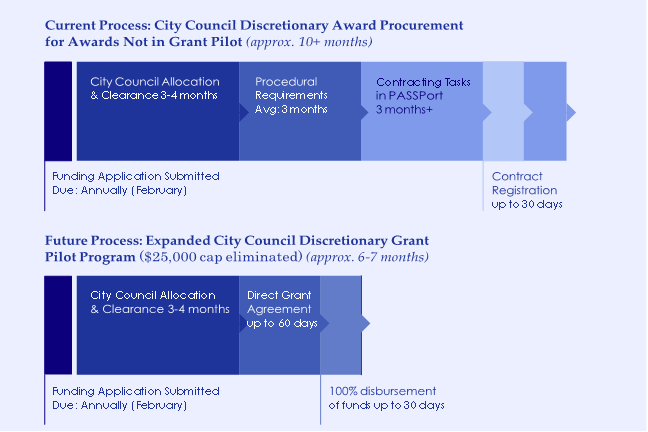
In addition to the discretionary grant expansion, the City will begin to implement a competitively procured Umbrella Agreement and Task Order (UA+TO) procurement model to establish pools of qualified, pre-vetted nonprofit providers that are eligible to receive future project-specific Task Orders (TOs). Once an Umbrella Agreement is in place, agencies will be able to issue streamlined mini-competitions for individual task orders rather than conducting a full procurement for each new program or service. The City will also utilize pre-approved Mobilization Task Orders to fund startup activities while longer-term Operational Task Orders are finalized, significantly reducing the time between provider selection, service delivery, and initial payment.
 |
Implementation will occur through a phased, four-year rollout, beginning with a pilot agency before expanding citywide. As the model is scaled, additional agencies will transition to the new procurement framework, creating a more efficient, flexible, and consistent approach to procuring nonprofit services across City government. Under the current procurement process, the end-to-end contracting timeline for nonprofits selected through a master/umbrella agreement Request for Proposals (RFP) is approximately 387 days. After the issuance of the initial RFP, it is estimated that agencies will be able to issue service-specific Task Orders through streamlined mini-RFPs in approximately 180 days, significantly less than the standard RFP process. The Commission anticipates that once umbrella agreements are established, cut procurement times from 13 months to six months. The cumulative procurement cycle timelines under the current and proposed processes are illustrated in the graph below, which illustrates that while standing up an umbrella agreement requires a full procurement process, once it is established, additional contracts are far faster to procure.
Long-term capital and workforce planning
The Commission heard testimony about the importance of planning ahead, especially when it comes to capital planning and workforce planning and the connection between the two. The Commission heard that the city must take bold steps to build more homes to address our affordability crisis, while combatting climate change, building the workforce of the future, and reversing the past harms of disinvestment through more equitable, sustainable and balanced capital planning. The Commission learned about recent changes in the charter and State law that have facilitated a number of related initiatives and, in response to testimony, is detailing those efforts here.
Based around the principles of growth, equity, and resiliency the Department of City Planning (DCP) is in the process of developing a Citywide Capital Plan that will ensure these principles are embedded into the city’s investment decisions. The goal is to ensure that the Mayor, City Council, Borough Presidents, Community Boards, and agencies are able to make data-driven decisions related to city facility and infrastructure needs and to allow stakeholders to better understand the city’s path towards an energy transition to decarbonization.
The plan will have two components--The Citywide Statement of Needs and TenYear Capital Strategy--each the subject of amendments in the NYC Charter between 2024 and 2025. In 2024, NYC voters approved Ballot Proposal 5, Capital Planning, to require the disclosure of condition data for city facilities, where appropriate and mandate that facility needs inform capital planning. Similarly, in 2025, the Charter was amended to establish requirements for the production and periodic updates of a fair housing plan, the goals of which include facilitating equitable and sustainable housing development. The plan will also include demographic data, growth targets, resiliency needs and budget requests for each NYC Community District.
Each winter, the Department will publish the Citywide Statement of Needs to add transparency to the capital planning process. Within the plan, the Department will articulate citywide challenges and goals and individual community perspectives through the inclusion of the work of the city’s Community Boards through the Community District Needs process.
To support the development of the next phase of the plan this year, the Department and agency partners have a variety of projects underway, including:
· Updated community needs and budget requests from our 59 Community Boards;
· Growth projections that show how the city has grown, and where it is now projected to grow. This data will include demographic detail, including race, and income;
· A new, user-friendly state-of-good repair score for each city-owned public facility;
· An assessment of the city’s progress towards decarbonization and emissions reductions through strategies like Local Law 51, and electrification efforts;
· A map of the city’s housing targets and detailed information regarding the city’s fair housing strategy and Fair Share assessments of city facilities.
Every two years, on odd years, the Department will then publish Goals and Principles in a draft Ten-Year Capital Strategy. This Strategy will be revamped to incorporate the city’s Fair Housing Framework, as required in the City Charter amendment of 2025. This statement of principles will be followed in the spring of each odd-numbered year with the publication of the full Ten-Year Capital Strategy and include project examples from the goals of the citywide capital plan and contextualization of the projects from the Capital Commitment Plan into a map of capital projects. In the future, we will expand an assessment of how the funding of projects are helping to implement the guiding principles of the plan, like growth, equity, and resiliency. The combination of these two components, linked by unified goals into a Citywide Capital Plan, will help facilitate a narrative picture the City has not been able to achieve before: a public conversation about growth trends across neighborhoods, resiliency planning and the fair distribution of housing and service delivery, all tied to the financial responsibility of the capital budget.
As part of its long-term planning, the City is committed to connecting more New Yorkers with good jobs in construction and related industries. In 2025, the NYC Office of Talent and Workforce Development (NYC Talent) launched a new Industry Partnership to expand the City’s workforce efforts in fields related to resilient infrastructure. The Resiliency, Manufacturing, Industrial and Infrastructure Council, or “ReMaIIC,” works to support equitable growth by bringing together stakeholders across sectors including manufacturing, industrial, construction, transportation, utilities, decarbonization, supply chain, waste and materials management, building operations, and water systems to coordinate workforce development strategies and solutions. ReMaIIC engages businesses across New York City to better understand ongoing employer demand and hiring trends across these sectors.
Another important tool for equitable workforce development is the City’s Community Hiring initiative, which leverages the City’s purchasing power to connect City vendors to talent and jobseekers to career opportunities. Through Community Hiring, City agencies set workforce goals in their contracts for vendors to provide employment and apprenticeship opportunities to low-income individuals and those who live in low-income communities, including NYCHA housing. Community Hiring goals apply to City procurement contracts for services in industries like construction, building services, technology, architecture, and human services. This initiative was operationalized by NYC Talent in 2025 and is projected to drive thousands of jobs available to jobseekers through the City’s public workforce system, including the NYC Department of Small Business Services’ Workforce Career Centers, once fully implemented.
The City also signed new Project Labor Agreements (PLAs) in 2024 and 2025. PLAs are specific types of collective bargaining agreements that the City negotiates with the building trades for certain types of construction projects. PLAs are a great tool to ensure cost-effective, efficient, and safe capital project delivery, while ensuring labor harmony, fair wages and benefits for workers, and opportunities for other workforce development efforts. The City’s new PLAs cover a cumulative project value of approximately $9 billion, including many resilient infrastructure investments like the construction of new buildings and parks, installation and renovation of wastewater filtration plants, and more. The City has had PLAs since 2009, but the recent PLAs cover the most amount of capital construction work ever. For the first time, they also include Community Hiring goals directly in the PLAs which will increase access to quality union construction careers for more New Yorkers.
Taken together, the long-term capital and workforce strategies reflect significant movement towards building a resilient future.
Technology
As governments take on increasingly complex responsibilities for millions of people, often in real time, technology has become essential to both policymaking and service delivery. Technology is no longer a back-office function—it is a core component of how modern government operates and delivers services to the public. The City now stands at another inflection point. A new generation of technologies is entering public life at unprecedented speed. These technologies are evolving faster than traditional procurement cycles, budgeting processes, and organizational structures were designed to accommodate.
If the City embraces this moment, technology can help create a government that is faster, more responsive, and easier to navigate. Services can become more proactive, personalized, and accessible. If the City fails to adapt, however, it risks investing significant resources in systems that are outdated before they are fully implemented and falling behind both technological change and New Yorkers’ expectations.
Modernizing technology governance and delivery
Across the five boroughs New Yorkers raised a wide range of concerns, questions, and ideas about the role of technology in City government. A recurring theme was that the City’s technology governance, workforce, and service delivery models have not fully kept pace with the demands of modern government.
The Commission heard testimony that the City should modernize its governance of centralized technology functions by replacing outdated and fragmented references to the Department of Information Technology and Telecommunications (DOITT) and other legacy offices with a framework that reflects the creation, mission, and responsibilities of the Office of Technology and Innovation (OTI).[164] Witnesses also emphasized the importance of a governance model that supports modern technology management, including a product-based approach focused on outcomes, continuous improvement, and user value, drawing on successful practices from peer jurisdictions.[165] Residents and experts also identified challenges with the City’s procurement and hiring systems. Some questioned whether existing procurement rules can keep pace with rapidly evolving technology, noting that solutions may become outdated during lengthy contracting processes.[166] Others argued that the City should reduce its reliance on external vendors and invest more in recruiting and retaining engineers, designers, product managers, and other technology professionals who can build and maintain critical digital services in-house.[167] Finally, many New Yorkers focused on the experience of interacting with City government. They described a fragmented digital landscape in which agencies operate separate applications, logins, and data systems, and questioned why government cannot more seamlessly connect information across agencies or proactively identify residents eligible for services rather than requiring them to navigate multiple bureaucracies.[168]

Building the government of the future
The Office of Technology and Innovation (OTI) is working to transform how City government operates, delivers services, makes decisions, strengthens trust, and improves outcomes for New Yorkers. Achieving this vision requires more than adopting new technologies—it requires changing the way government approaches technology as a strategic capability.
OTI is building the people, practices, and systems needed to make technology a core asset for improving government performance. This transformation is already underway through efforts to modernize procurement, strengthen the City’s technology workforce, improve digital service delivery, and promote responsible innovation.
One area of focus is developing more flexible approaches to technology procurement. Traditional procurement processes are designed to acquire known solutions based on fixed requirements over established timelines. However, rapidly evolving technologies require government to test, learn, and adapt. More agile procurement approaches can allow the City to evaluate solutions incrementally, incorporate lessons learned, and reduce the risk that technology becomes obsolete before it is deployed.
The City is also drawing on lessons from successful government technology models, including federal digital service teams such as the United States Digital Service and 18F, which brought together technologists, designers, product managers, procurement specialists, and policy experts to modernize public services and improve how government solves problems.
At the same time, OTI is building a culture of continuous improvement focused on addressing root causes rather than simply treating symptoms. This includes becoming more metrics-driven, investing in user research and product management, and measuring success through outcomes and public impact, not outputs alone. DCAS is exploring updates to information technology civil service titles to help the City better attract, develop, and retain the specialized talent needed to design, build, and manage modern technology services. A world-class technology workforce requires not only recruiting talented professionals, but also creating career pathways that recognize and reward the unique skills of engineers, designers, product managers, and other technologists in public service.